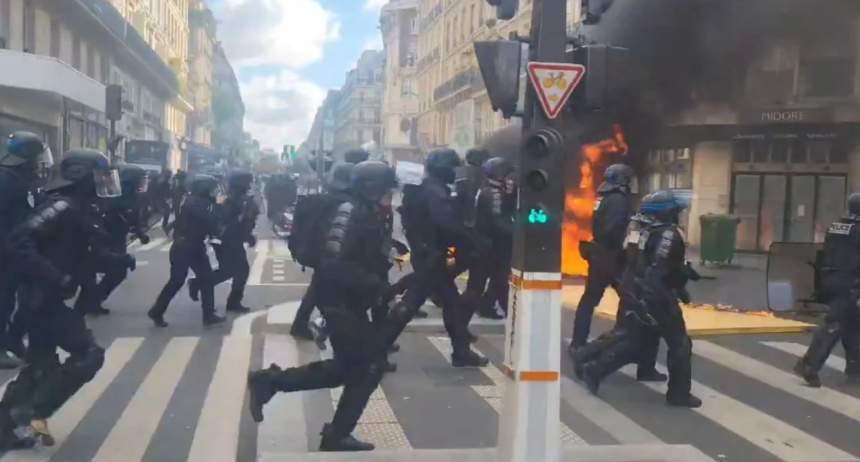
The precision, the anger of the students and the memory of the yellow vests brought France to the streets. Dozens of arrests since morning, tear gas from Paris to Lyon and a movement that is still searching for its form.
The march had not even begun. At Place de la République , the historic square of French protests, where it was due to depart at around 2pm local time, 3pm Greek time, tensions had already broken out. Police repeatedly used tear gas against several hundred demonstrators, according to AFP journalists.
Most wore masks and were dressed in black . Some threw fireworks at the security forces. The capital had already woken up to a tense atmosphere, with dozens of arrests since the early hours of the morning, as pressure mounted in Paris and other French cities.
The fire spreads from Marseille to Normandy
Paris was not the only front. In Marseille, protesters threw objects and police responded with tear gas, while a local police station was targeted by protesters. In Lyon , police used tear gas to disperse nearly 300 people who had gathered in front of a university.
The most worrying incident occurred early this morning in Rouen , Normandy. A university building was damaged by a fire that, according to a source close to the investigation, was probably caused by arson . In Toulouse , authorities intervened to prevent blockages on trains and at a roundabout.
The numbers of a day of rage
The country is currently experiencing nationwide protests involving many social groups. According to sources close to Interior Minister Laurent Nunes , by noon the authorities had recorded 140 demonstrations in the regions, with 32,800 participants , and 166 arrests nationwide.
But there is another interpretation. AFP journalists observed fewer blockades than the protesters had predicted. On social media, a participatory map had recorded hundreds of action points in the previous days, including gas stations, oil depots and refineries. The gap between intentions and the reality on the street is one of the questions that will determine the future.
From the price of gasoline to the high school uprising
The October 17th movement was born on social media in response to rising fuel prices and the urgency of everyday life. But the impetus that gave it substance came from schools. For weeks, high school students have been taking to the streets demanding more resources for education and less police repression. At the October 6th rally, organizers spoke of 450,000 protesters across the country, with students now joined by fellow students, teachers and parents.
Today, all these angers converge. The unions, led by the CGT , and parties such as France Insubordinate and the New Anti-Capitalist Party have requested permits for marches from the prefectures, something that Prime Minister Sébastien Lecorny has recognized as their right. The CGT’s general secretary Sophie Binet warned that the mobilization will continue as long as no answers are given. The Paris police chief, however, had rejected the route from Place de la République to Place de la Concorde that the student assemblies had declared.
The shadow of the yellow vests
The date was not chosen by chance. October 17th refers directly to November 17th 2018 , the day the yellow vests were born on the roundabouts of France. And then it all started with the price of fuel, to develop into a long and violent challenge to the authority of Emmanuel Macron. It is no coincidence that the secretary of the Communist Party Fabien Roussel called for a mobilization similar to that of 2018, nor that well-known figures of the movement of that time have already appeared alongside the students.
The atmosphere is already tense. According to Prime Minister Le Corneille, as reported by the BBC, 215 students, 85 teachers and 715 police officers have been injured since the beginning of the student protests. The question now is not whether France will take to the streets again. It is whether today will remain an outbreak or become the beginning of a new movement that the government will not be able to ignore.