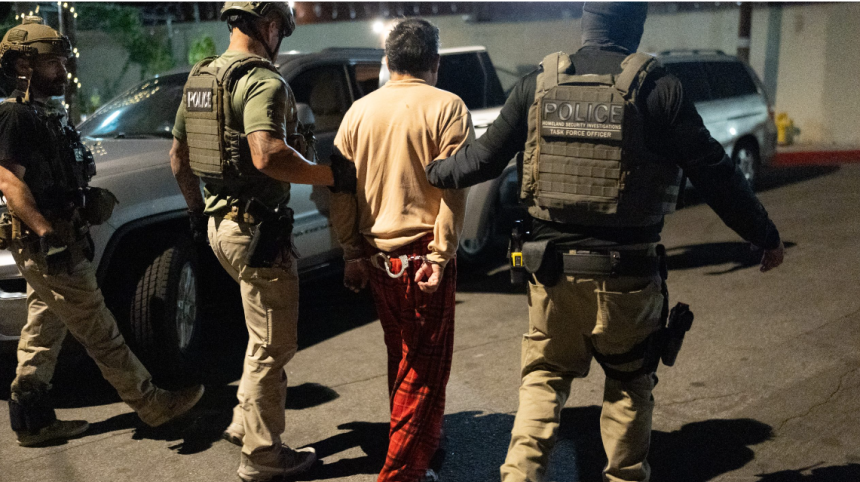
Twenty-eight legal permanent residents of California are facing criminal charges that could derail their path to U.S. citizenship as part of a federal crackdown on illegal voting by non-U.S. citizens. The case extends beyond alleged illegal voting, with much of the charges related to false statements on naturalization applications, interviews and voter registration forms .
The US Department of Justice announced on Monday, October 19, that the operation “Operation Protect the Vote” is being carried out with the cooperation of the four federal prosecutorial districts of California. According to the announcement, all the defendants are green card holders , while eleven arrests had been made on the day of the operation. Authorities say the cases include knowingly false declarations of US citizenship and, in several cases, participation in electoral contests without the relevant right.
The distinction between lawful permanent residence and U.S. citizenship is at the heart of the case. A green card allows permanent residence and work in the United States, but does not grant the right to vote in federal elections. At the same time, registering to vote, actually exercising the right to vote, and responding to the naturalization process are different acts, which are examined separately.
A case in point is that of 42-year-old Jose Antonio Banuelos-Diaz , who has lived in the United States for nearly four decades and has spent his entire adult life as a legal permanent resident. Federal authorities allege that in 2007 he falsely claimed to be a U.S. citizen in order to register to vote and that he later provided false information during the naturalization process. He is not accused, however, of voting .
He told the Associated Press that he was unaware of his registration until he was arrested outside his Los Angeles home. He remembers getting a driver’s license around that time, but he says he never tried to vote because he knew he wasn’t eligible. He said if there had been a mistake, it should have been discovered and reported to him much earlier.
Banuelos-Diaz was released after his arrest, but the charge he faces could, if convicted, carry a sentence of up to five years . His case highlights the importance of proving the specific circumstances, knowledge, and intent of the accused. The mere fact of a name being listed on the electoral roll does not, by itself, answer all questions about how the registration was made and the statements that accompanied it.
The case of Pamela Arbues Line , who was arrested in San Diego after her citizenship interview, presents different characteristics. According to court documents described in the report, authorities claim that she had repeatedly registered to vote and voted, while during the naturalization process she denied having participated in an election or declared herself a U.S. citizen.
Laine, who is originally from the Philippines , reportedly explained that she believed she had acquired citizenship through her mother. According to the government’s version, however, she was already 19 when her mother was naturalized and did not automatically acquire U.S. citizenship at that time. According to the documents, she claimed that she learned of her true status in June, when she was renewing her Social Security card, and applied for naturalization that same day.
The criminal consequences vary depending on the offense. The Department of Justice lists a maximum sentence of five years for some of the felony charges included in the operation. There is, therefore, no uniform sentencing framework for all defendants. Also, a prescribed maximum sentence is not a mandatory minimum sentence , nor can the potential total sentence be calculated simply by adding up individual limits.
Beyond imprisonment, cases can have a significant impact on naturalization applications and, depending on the facts and applicable provisions, can have serious immigration consequences. The outcome is not automatic or the same for everyone. It will depend on the charges that are proven, the details of each case, and the decisions of the competent authorities.
The operation is part of a broader effort by the Trump administration to tighten controls on non-citizen voter turnout ahead of the midterm elections. The federal government has made protecting election integrity a priority. The cases also fuel a dispute with California authorities over the accuracy of the data and how citizenship is verified.
The Justice Department has requested background checks on about 20,000 registered voters it believes may not be citizens. The state disputes the reliability of the federal estimates and is seeking clear documentation of the methodology. The presence of individuals on a background check list is not evidence of illegal registration or voting , and background checks can be problematic when they do not reflect subsequent naturalization. Reuters also notes that available studies characterize noncitizen voting as extremely rare.
Another personal dimension emerges from the case of Amadeep Kaur . Her husband, Kulwinder Singh , said that she has difficulty with English and that she had taken the written test for a driving license in Hindi. He claimed that they do not know how she was registered on the electoral rolls and that the ballot paper she returned in 2024 was taken as a registration form. This is the family’s explanation, which will be evaluated together with the evidence cited by the prosecution.
These diverse cases illustrate why the investigation requires individualized consideration . The government attributes knowing violations, while some defendants plead ignorance of registration, misunderstanding of documents, or misconceptions about their citizenship. Whether any of these explanations are confirmed and what legal significance they have are issues that must be judged on a case-by-case basis.
Regarding naturalization, a substantial clarification is also needed. The general rule provides for at least five years of lawful permanent residence , along with other requirements. The possibility of applying based on three years concerns specific categories, mainly spouses of US citizens who meet the relevant conditions. It does not generally apply to every green card holder.
The continuation of the cases will be determined by the electoral records, naturalization documents, depositions and proof of the elements of each alleged offense. The charges are not convictions , just as the specific prosecutions do not in themselves prove widespread electoral fraud. For those involved, however, the stakes are already high, as the attempt to acquire citizenship has turned into a legal showdown with possible criminal and immigration consequences.