For the fourth time since former jihadist al-Jolani took power in Syria, the Greek Orthodox town of Suqaylabiya , the ancient Seleucid city , has been targeted again. Over the weekend, a serious clash with residents of the neighboring Arab town of Qalaat al-Mandiq once again plunged one of the world’s oldest Christian communities into fear. Shops were destroyed, gunfire was heard, residents were intimidated in their own town. Online reports even mention the injury of a woman .
The residents are not talking about a single incident. They are talking about coordinated attacks , a pattern that repeats itself over and over again, while the state watches. The picture they describe is of a community living under constant siege , never knowing what the next night of terror will bring.
The official version, of course, sounds much more reassuring. The state agency SANA speaks of an “episode” that included an attack on a store, of Internal Security Forces that “restored order” and of arrests on both sides . The head of the Al-Gham region, Mohammed al-Atal , assures that the case is being dealt with through legal channels and calls on citizens not to circulate old videos and unconfirmed information. The reason given by the authorities is the reason for the downgrade : an incident, a riot, everyone a little to blame. For the people of Selevkovilo, however, this is something much more serious.
The Greek Orthodox community’s complaint is a catalyst . Yakub Mirza , head of internal relations for the European Syrian Union (ESU) , describes a blood-curdling picture: instead of protecting the victims from new attacks, the security forces essentially confined them to their homes . The victims were treated as a problem to be managed and not as citizens entitled to protection.
The Syrian Union Party (SUP) condemns the destruction of shops , the shootings and the intimidation of residents and calls for a transparent investigation , accountability and stricter security measures . And it goes on to make a demand that shows how deeply rooted the fear is: to allow Christians to staff the Ministry of Interior’s Internal Security Forces , so that they can guard their communities themselves. The warning is clear and worrying: without this institutional participation, these people may end up believing that self-protection is their only option . When a community goes so far as to say this publicly, it means that it has lost trust in the state that is supposed to protect it.
In this climate, the voice of the priest of Suqaylabiya, Father Fadi Sankari , sounds both as a consolation and a cry. He calls his parishioners to unity and rejects any thought of revenge . But he also reminds them of something self-evident that in today’s Syria seems to have been forgotten: ” No one has the right to invade your homes or threaten your security and dignity .” He asks the authorities to finally assume their responsibilities for the protection of civilians and warns that the city is in danger of becoming a field of lawlessness . The community, he says, is not asking for retaliation. It is asking for justice .
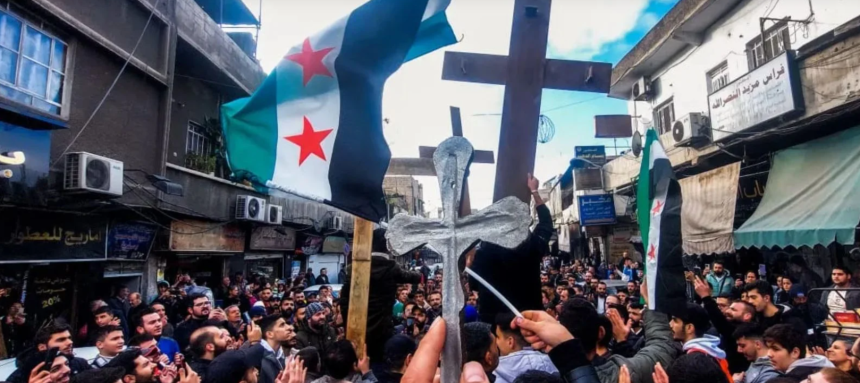
Solidarity was not long in coming. According to reports online, Christians held a solidarity march in Damascus , showing that Seleucids is not alone, at least within Syria.
Outside Syria, however, where one would expect the loudest voice, there is a deafening silence . The Greek Orthodox community has made public appeals to the Foreign Ministries of Greece and Cyprus , asking for institutional interventions that will ensure its peaceful coexistence in the new Syria. These appeals have remained unanswered to this day . Unanswered even after terrorist incidents , bombings and casualties among the region’s Christians.
And we are not talking about a marginal group. We are talking about one of the oldest Christian communities in the world , about people who have kept the Orthodox faith alive in these lands for two millennia. Before the civil war, the Greek Orthodox of Syria exceeded one million . Today there are no exact figures, but independent estimates speak of about 400,000 remaining . A community that is shrinking dramatically , that lives under the constant pressure of uncontrolled Islamist groups , and that sees its numbers dwindling year after year.
Athens and Nicosia cannot pretend not to listen. Seleucid is not just a name on a distant map. It is a piece of the history of Hellenism and Orthodoxy , a place that still carries in its name its Greek origin. Every attack that goes unanswered, every appeal that gets lost in the drawers of ministries, sends a message: that these people are alone .
The fourth attack has happened. The question is how many more will it take before the silence is broken. And if, when it is broken, there will be anyone left to listen to it.