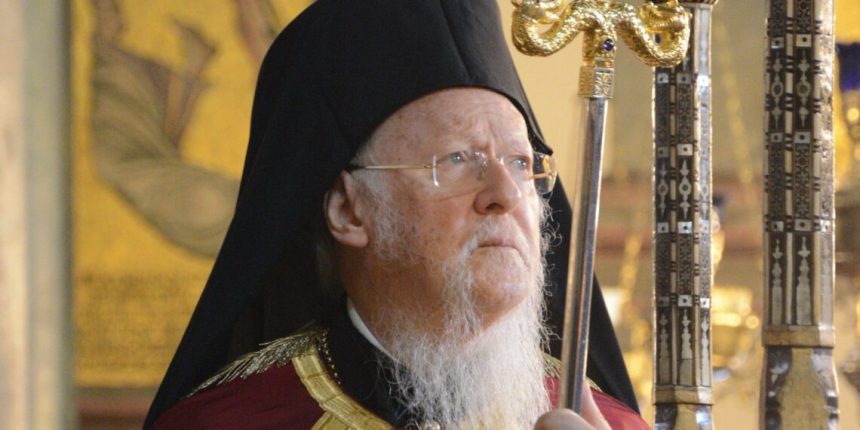
In a particularly sharp intervention on the war in Ukraine, the stance of the Russian church leadership and the future of global Orthodoxy, Ecumenical Patriarch Bartholomew denounces the religious justification of the Russian invasion , defends the decision of the Ecumenical Patriarchate to grant the Tome of Autocephaly to the Orthodox Church of Ukraine and warns of the dangers posed by the subordination of church life to national and geopolitical pursuits.
In an interview with Byron Karydis for the magazine Books’ Journal , the Primate of the Church of Constantinople takes a position on issues that go beyond the boundaries of a bilateral ecclesiastical confrontation. He refers to the relationship between faith and political power , the theological approach to war, the responsibility of religious leaders towards human suffering, and the need to preserve the canonical unity of Orthodoxy .
His statements take on particular weight, as they are made at a time when the war in Ukraine continues to cause human losses, destruction and deep social wounds, while the ecclesiastical consequences of the conflict remain significant.
The Ecumenical Patriarch categorically rejects the claim that the granting of Autocephaly to the Ukrainian Church was a factor that provoked the Russian military invasion. On the contrary, he maintains that this specific ecclesiastical decision was driven solely by the need to restore the ecclesiastical unity of the country’s Orthodox believers.
“The granting of Autocephaly to the Orthodox Church of Ukraine was a purely ecclesiastical act, a decision taken with the need to restore the unity of the Orthodox faithful in this long-suffering country in mind,” he emphasizes.
This position refers to the historical and canonical perception of the Ecumenical Patriarchate of its responsibilities towards the local Orthodox Churches. The granting of the Tome of Autocephaly, in January 2019, was one of the most significant ecclesiastical developments of recent decades, provoking a strong reaction from the Moscow Patriarchate.
The disagreement was not limited to an administrative or organizational issue. It extended to the interpretation of canonical jurisdiction , the historical rights of the Church of Constantinople, and the relationship of the local Churches with the Ecumenical Patriarchate.
On the part of Moscow, the decision was challenged as to its canonical foundation, while the Ecumenical Patriarchate maintained that it acted within the framework of its historical and canonical competences. The confrontation led to a serious deterioration in relations between the two Patriarchates and highlighted different perceptions of the ecclesiastical order.
His Holiness insists that ecclesiastical decisions cannot be determined by fear of political backlash , even when they have broader social consequences. The Church, according to his reasoning, must respect political institutions, without abandoning its spiritual and canonical responsibilities.
It appears particularly clear when referring to the attempts to link Autocephaly with the Russian invasion.
“For the last 4.5 years, Ukraine has been severely tested by a war that certainly did not start because Autocephaly was granted to its Church,” he points out, criticizing those who, in his assessment, attempted to shift responsibility for the military conflict.
The distinction is particularly important, as the ecclesiastical decision of 2019 and the full-scale Russian invasion of February 2022 are different events, with different natures and different responsibilities. The military conflict in Ukraine had, after all, already begun in 2014, before the granting of the Tomo of Autocephaly.
The Ecumenical Patriarch’s sharpest reference, however, concerns the stance of Russian ecclesiastical figures , whom he accuses of attempting to lend religious legitimacy to the military invasion.
Without naming specific individuals in the relevant excerpt of the interview, Mr. Bartholomew argues that the war revealed a deep contradiction between the proclamations of spiritual brotherhood and the attitude of certain representatives of the Russian church leadership towards the Ukrainian people.
“In reality, the Russian military invasion allowed the hypocrisy of those church figures in Russia who supposedly cared about the Orthodox faithful of Ukraine to become clearly visible,” he states.
An even more severe denunciation follows, with a clear theological dimension.
“They baptized it ‘holy,’ tried to ground it theologically and metaphysically, and blessed the fire against the Ukrainian people,” he says, denouncing the use of religious arguments to justify war violence.
His criticism does not simply concern the attitude of specific individuals towards the decisions of the Russian political leadership. It raises a much deeper issue, whether church authority can be identified with state strategy and provide a theological cover for military operations .
For the Ecumenical Patriarch, the attempt to present a war as “holy” goes against the core of the Christian message, which focuses on human life, love of neighbor, reconciliation and peace.
He makes particular reference to the ideology of the “Russian world” , which is linked to the perception of a broader cultural, historical and spiritual unity under Russian influence.
His Holiness views with strong reservations the ecclesiastical exploitation of this concept, as he believes that it can lead to the subordination of spiritual life to national and political pursuits .
In his interview, he characterizes this approach as “ethno-racial ideology,” arguing that certain church figures sought to keep Ukrainian believers under their own spiritual dependence.
This reference acquires particular weight in the light of Orthodox ecclesiology, which does not identify the Church with a nation or a state. The synodal condemnation of ethnophyletism in Constantinople in 1872 constitutes a historical point of reference for the rejection of national origin as the supreme criterion of ecclesiastical organization and unity.
The current debate over the “Russian world” is therefore linked to a broader question about the future of Orthodoxy. Can the Church maintain its ecumenical character when national aspirations claim a decisive role in shaping church life?
The Ecumenical Patriarch answers this question by reiterating the need to preserve the unity, synodality and spiritual independence of the Church from state expediencies.
Despite his harsh criticism, his position is not limited to denouncing the violence of war. It also includes a clear message of support for the Ukrainian people , who are still suffering the consequences of the conflict.
His Holiness refers to the human losses, the missing, the refugees and the destruction of churches and other infrastructure, emphasizing that the Church cannot remain indifferent to human suffering.
“We stand by our Ukrainian brothers, we pray for the prevalence of peace and justice, for the end of this unholy war,” he emphasizes.
The use of the term “unholy war” acquires particular symbolism in contrast to the attempts to religiously justify the conflict that he denounces.
At the heart of his position is the belief that the Church must defend justice and stand by the side of the victim of an attack , without abandoning its mission of reconciliation and peaceful resolution of differences.
Mr. Bartholomew points out that condemnation of violence must be accompanied by concrete efforts to end the hostilities.
“In any case, we must defend justice, stand by the side of the victim of an attack, but also work with all our strength to end the war, for the prevalence of peace,” he says.
This position highlights the distinction between the recognition of responsibility for a military attack and the need to find a peaceful solution. For the Ecumenical Patriarch, the search for peace does not presuppose the silencing of injustice, but the attempt to redress it through dialogue.
In this context, it attributes particular responsibility to religious leaders , who, as it underlines, have the ability to encourage understanding, support the cessation of hostilities and contribute to the creation of conditions of reconciliation.
His call for a ceasefire and dialogue is not just about Ukraine, but expresses a broader understanding of the public role of religion in times of international conflict.
Religious communities, according to this approach, are called upon to function as agents of peace and not as mechanisms for reinforcing national conflicts.
Another important part of the interview concerns the relations between Church and state , which the Ecumenical Patriarch approaches through the historical development of Orthodox societies.
It recalls that in many regions the Church played a decisive role in social organization, education, the preservation of cultural identity and the spiritual cohesion of populations, often before the formation of modern nation-states.
This historical reality explains, according to him, why the relations between ecclesiastical and political institutions have taken different forms from country to country.
However, His Holiness points out that historical tradition cannot be treated as an unchanging pattern . Church-state relations evolve within changing societies and must be shaped with respect for religious freedoms and human rights.
“State-Church relations are a dynamic process, which is in constant interaction with society,” he notes, underlining the importance of adapting to modern conditions.
This position acquires additional interest in a period in which the relationship between religious and political power is at the center of international debates, particularly in cases where ecclesiastical institutions are called upon to take a position against state military decisions.
For the Ecumenical Patriarch, preserving the historical and spiritual identity of the Church does not require its identification with political power. On the contrary, the ecclesiastical witness must maintain its freedom, so that it can defend Christian principles even when they conflict with state choices.
The interview also makes special reference to the ecumenical role of the Patriarchate of Constantinople , which continues to exercise its mission within a particular historical, political and institutional environment.
His Holiness refers to the difficulties that the Mother Church has faced over time, but also to its steadfast commitment to the mission recognized by the Orthodox canonical tradition.
The seat of the Ecumenical Patriarchate in Constantinople constitutes an element of historical continuity, while its role is not limited to the geographical boundaries of Turkey. Its ecclesiastical presence and responsibilities are linked to the history and functioning of global Orthodoxy.
“We continue, despite any difficulties, committed to our sacred duty,” emphasizes Mr. Bartholomew, citing the long Christian tradition, the ministry of his predecessors and the historical contribution of the Nation.
At the same time, it acknowledges that certain steps have been taken to address past injustices, expressing the expectation that this process will continue.
Particularly important is his reference to the danger of Orthodoxy being confined within narrow national frameworks , an issue that is directly linked to today’s ecclesiastical controversies.
The Ecumenical Patriarch emphasizes that the Orthodox Church cannot be viewed as a sum of independent religious organizations, which are connected to each other only through occasional agreements.
On the contrary, it insists on its character as one, Holy, Catholic and Apostolic Church , whose unity is expressed through common faith, sacramental communion and synodal tradition.
“We do not see Orthodoxy as a confederation of local independent Churches, as perhaps some would like, but as the one Holy, Catholic and Apostolic Church,” he states characteristically.
This formulation is at the core of the ecclesiological approach of the Ecumenical Patriarchate. The Autocephaly of the local Churches , according to this understanding, does not negate the common ecclesiastical identity nor does it abolish the need for coordination, dialogue and synodal cooperation.
At the same time, the discussion on the manner of exercising canonical powers and the role of the first throne continues to be the subject of different interpretations among the local Orthodox Churches.
His Holiness defends the primary role of the Ecumenical Patriarchate in preserving the unity of Orthodoxy , which he connects with the centuries-old canonical tradition and the diaconal mission of the Church of Constantinople.
The use of the term “primary” has particular ecclesiological significance, as it highlights the Patriarchate’s perception that its primacy is linked to specific responsibilities for the cohesion and canonical order of Orthodoxy.
This position is not presented as a claim to secular power, but as an expression of ecclesiastical responsibility and ministry, as understood and defended by the Ecumenical Throne.
At a time when national confrontations, geopolitical conflicts and different ecclesiastical approaches create serious challenges, Mr. Bartholomew brings back to the fore the need to maintain the spiritual and canonical unity of the Orthodox Church .
His interview with Books’ Journal thus highlights three interrelated dimensions of the current crisis: the theological responsibility towards war , the conflict between the universality of the Church and ecclesiastical nationalism , and the need to preserve the unity of Orthodoxy in an environment of intense international upheaval.
The Ecumenical Patriarch is not limited to defending a historic ecclesiastical decision. With his statements, he raises a broader question about the mission of the Church in the modern world. If religious leadership is supposed to serve peace and human dignity, how can it justify or bless a war against people whom it previously recognized as spiritual brothers?
This contradiction lies at the core of his criticism of Russian church figures and explains the severity of his formulations.
At the same time, the defense of Ukrainian Autocephaly is linked to his belief that the Church must address ecclesiastical problems based on canonical tradition and the spiritual needs of the faithful , without being determined by the pursuits of state authorities.
In conclusion, the Ecumenical Patriarch reaffirms the commitment of the Church of Constantinople to its mission.
“The Ecumenical Patriarchate […] will continue, within the framework of its ecumenical mission and ministry, to exercise its primary role in safeguarding the unity of Orthodoxy and in the ministry of every faithful member of the Church,” he emphasizes.
The message of the interview is clear. Orthodoxy, according to the Ecumenical Patriarch, cannot be turned into a tool of national antagonisms nor provide religious legitimacy to military violence. It must remain faithful to its ecumenical mission, defend peace and justice, and preserve its unity beyond national and political borders.