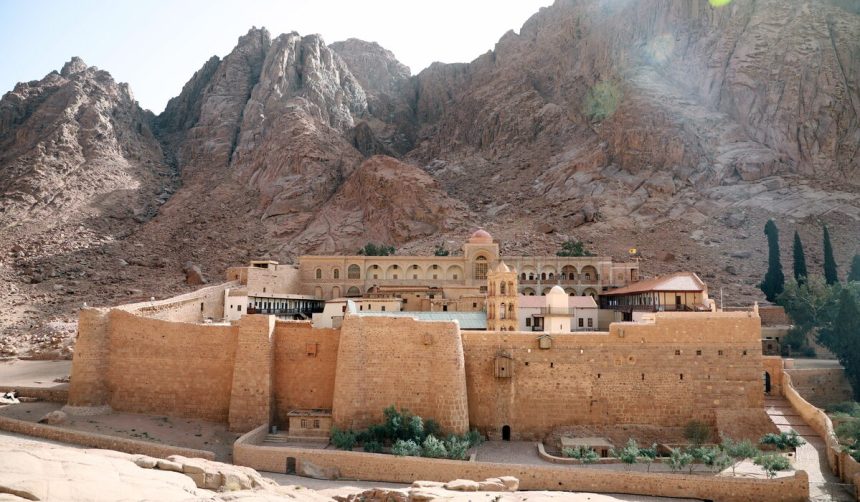
The Holy Monastery of Saint Catherine in Sinai, the oldest functioning Orthodox monastery in the world and a UNESCO monument, is at one of the most critical junctures in its history. According to the Greek government and Egyptian reports, the Egyptian Supreme Court is expected to issue its final decision on the property and legal status of the Monastery on October 24.
- From the 2015 lawsuit for 71 land plots to the 2022 confiscation decision and the Ismailia Court of Appeals: the ten-year legal dispute
- Supreme Court prosecutors reject usufruct and Achtiname: the loss of 10 properties and 28 land plots is on the table
- Abbot Symeon hesitates to sign: Mount Athos reacts to “dual ownership”, Jerusalem and Phanar support the agreement
- Gerapetritis vs. Polakis and Douros: the confrontation in Athens reaches the point of whether there will even be a trial on October 24th
- Signature, unfavorable verdict or new postponement: the three scenarios for the future of the Monastery
The court will rule on the cross-appeals of the Monastery and the Egyptian state against the 2025 decision of the Ismailia Court of Appeal. At the same time, negotiations for a compromise agreement with Cairo have stalled shortly before signing, while in Athens the case has turned into a field of fierce political confrontation.
From the 2015 lawsuit for 71 land plots to the 2022 confiscation decision and the Ismailia Court of Appeals: the ten-year legal dispute
The case began in 2015, when the Egyptian government filed a lawsuit claiming 71 plots of land around the Monastery, along with compensation for illegal occupation.
- 2022: The South Sinai Court of First Instance issues a decision that amounts to confiscation: expulsion of the monks, demolition of buildings and payment of compensation.
- May 28, 2025: The Ismailia Court of Appeal moderates the decision. It orders the expulsion from 29 plots of land, but recognizes the legal use of certain lands and the right to use them for religious purposes.
- 2025–2026: Both the Monastery and the Egyptian state appeal to the Supreme Court. At the same time, negotiations for an out-of-court settlement begin, lasting almost ten months.
- October 24, 2026: Expected date of the final decision, which is however disputed by the opposition.
Supreme Court prosecutors reject usufruct and Achtiname: the loss of 10 properties and 28 land plots is on the table
According to reports, two top prosecutors are recommending the rejection of the Monastery’s appeal and the partial acceptance of the Egyptian state’s appeal. They reject the main argument of usufruct, arguing that public, archaeological and protected lands belong to the state. They also note that the Court of Appeals examined each plot of land and each title deed separately.
If the court adopts the recommendations, the Monastery is estimated to lose 10 properties, while the character of 28 land plots will be questioned. The Egyptian side characterizes the invocation of the Achtiname, the testament attributed to Muhammad, as communicative, as the text was not presented at the trial and provides general protection of worship, not property titles.
Abbot Symeon hesitates to sign: Mount Athos reacts to “dual ownership”, Jerusalem and Phanar support the agreement
After nearly ten months of negotiations, the agreement with the Egyptian state has stalled just short of signing. Its supporters acknowledge that it is not perfect, but emphasize that it ensures the presence of the monks, the uninterrupted operation of the Monastery, and legal personality enshrined in Egyptian law, something that does not exist today.
Archbishop Sinai and Abbot Symeon and the brotherhood are hesitant to take the final step. According to reports, they are influenced by the reactions of the former Abbot Damian and circles of Mount Athos. The Holy Community of Mount Athos sent a letter to Symeon, rejecting the “dual ownership” plan, by which ownership would pass to the Egyptian state and the Monastery would only have the right of use. The Athonites warn that this changes the status quo and creates a dangerous precedent.
On the other hand, the Patriarchate of Jerusalem and the Ecumenical Patriarchate appear ready to support the signing as the only option that ensures the survival of the Monastery. Sources supporting the agreement attribute some of the current problems to past manipulations, such as the absence of institutional recognition of the Monastery in the Egyptian legal order.
Gerapetritis vs. Polakis and Douros: the confrontation in Athens reaches the point of whether there will even be a trial on October 24th
The government presents the case as a matter of time and institutional shielding. Foreign Minister George Gerapetritis and Deputy Minister Alexandra Papadopoulou have stated that a final decision is expected on October 24. Gerapetritis has been arguing since 2025 that the crucial thing is for the Monastery to acquire legal status under Egyptian law, while he has received assurances from Cairo that its religious Greek Orthodox character will not be affected. According to reports, Athens believes that it has exhausted diplomatic margins and that the final decision now belongs to the Sinai Community.
SYRIZA directly disputes this image. Parliamentary spokesman Pavlos Polakis claimed on October 15, presenting a document, that no trial has been set for October 24, denounced pressure on the monks to sign and asked for the agreement to be made public. Rena Dourou warned of the risk of “unconditional surrender of ownership” and demanded explanations for the origin of the information about the decision on October 24.
Questions have also been raised in the public debate about Sinai’s mineral wealth, such as rare earths, and the involvement of American officials in the negotiations. These allegations have not been officially confirmed.
Signature, unfavorable verdict or new postponement: the three scenarios for the future of the Monastery
The week that begins will show whether the case is headed for a judicial or diplomatic conclusion:
- Signing of an agreement before the decision: The Monastery acquires legal personality and a guaranteed right to operate, at the cost that critics cite for the ownership issue.
- Adverse final decision: If the prosecutors’ recommendations are adopted, the Monastery risks losing real estate without the guarantees of an agreement.
- New postponement: If it is true that no trial has been set, the pending case and the pressure to sign will continue.