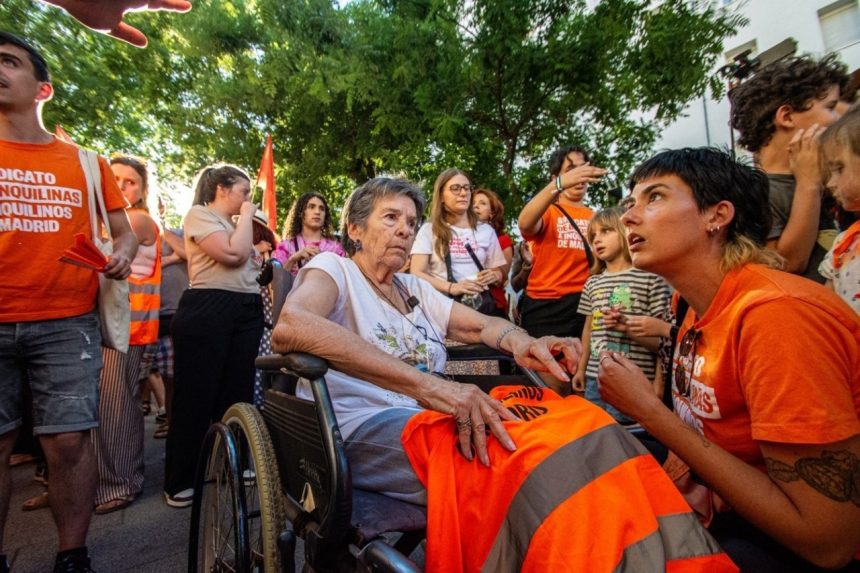
87-year-old Maricarmen Abascal breathed her last today in a bed at the Gregorio Marañón Hospital in Madrid, far from the walls that had seen her grow, love, and age. “We regret to announce that Maricarmen passed away today,” wrote the Madrid Tenants’ Association, in simple words that nevertheless carry the weight of an entire country. Because her story, as the Association noted, was “a turning point in the history of this country.”
For more than seventy years, the small apartment in the Retiro was her world. She spent an entire life there: her childhood, her joys, her losses, her quiet days of old age. Every corner of it held a memory. Every window looked out on a neighborhood that was changing around her, that was getting more expensive, that was becoming more and more foreign to people like her.
On September 23, all of this ended in the most cruel way. Maricarmen could no longer pay the rent increases. And so, an 87-year-old woman was forcibly removed from her home of a lifetime, lying on a stretcher. This image, of an old woman walking out of her door not on her own legs but helpless, on a stretcher, became the wound of an entire society. Immediately after the eviction, Maricarmen was admitted to the hospital. She would never leave again.
Spain did not remain silent. Her name became a slogan and her face a symbol. Thousands of people took to the streets across the country, demonstrating against the housing crisis that is suffocating millions of families. The anger went from the sidewalks to the political benches, and the confrontation that erupted ultimately led the country to early elections. An elderly woman from the Retiro, without ever seeking it, shook the foundations of an entire state.
And at some point, it seemed that the story would have a more tender ending. Her family, her lawyer, and the Tenants’ Association managed to reach an agreement: as soon as she was discharged, Maricarmen would return to her home. She would reopen her door, she would see her things again, she would sleep under her own roof again.
He didn’t make it.
The solution came, as the Tenants’ Association bitterly said, “too late,” at the end of a “torturous” process. The house was waiting for her. She couldn’t bear to wait any longer.
But Maricarmen did not leave silently. In the last weeks of her life, while her body was breaking down, her voice grew stronger. To those who accompanied her on this difficult journey, she left a simple and moving legacy: “Fight, keep fighting for what belongs to you.”
She didn’t talk about herself. She talked about others. About the young people who can’t rent a room, about the families who count every month if they’ll make ends meet, about the elderly who fear a knock on the door. She had already lost her battle. But she didn’t want the others to lose it either.
The Tenants’ Union bid her farewell in words that sounded more like an oath than an announcement. It acknowledged that Maricarmen had been at the heart of the protests of these weeks and promised that the struggle would not stop. “Your family, your lawyer and your Union will continue to defend the right to housing and fight against speculators,” they wrote, “with the strength and courage that you taught us.”
Today, an apartment in the Retiro sits empty. Her belongings are still there, waiting for a return that will never come. But Maricarmen was not lost in this empty house. She became something bigger than herself: the voice of those who are not heard, the face of a crisis that can no longer be hidden, a reminder that behind every number, every increase and every eviction there is a person.
Maricarmen didn’t make it home in time. But maybe, thanks to her, others will never have to miss out.