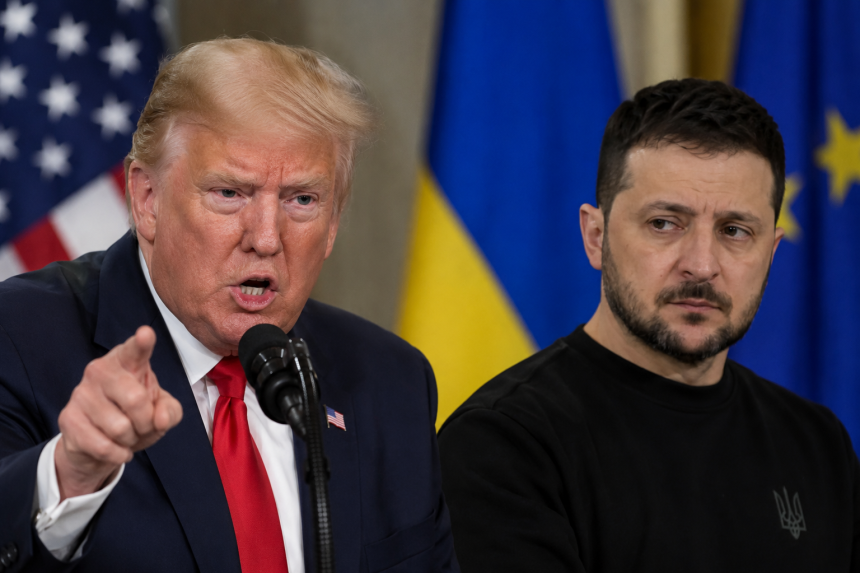
Donald Trump’s relations with Volodymyr Zelensky are developing into a new, particularly acute confrontation , as the American president directly questioned the Ukrainian leadership’s handling of the war with Russia, essentially calling for the replacement of the Ukrainian president and warning Kiev to stop attacks on Russian refineries.
Trump’s statements mark a new period of intense political pressure on Ukraine , at a time when Washington is attempting to redefine its relations with Moscow, linking the search for a diplomatic way out of the war with the needs of the international energy market.
The US president argued that Zelensky had repeatedly had the opportunity to agree to an end to hostilities, but did not take advantage of the opportunities presented to him. “Zelensky could have reached an agreement to end the war many times,” he said, holding the Ukrainian leadership partly responsible for prolonging the conflict.
He was even more categorical when referring to Ukrainian operations against the Russian oil industry. “He can do whatever he wants, but he can’t hit refineries,” he said, adding in a warning tone that “he would do well to stop.”
This intervention is particularly significant, as Russian refineries are one of the main targets of Ukraine’s economic pressure strategy. With these attacks, Kiev is attempting to disrupt fuel production and supply, while at the same time limiting the financial resources available to Moscow for the continuation of military operations.
For Washington, however, the destruction of energy facilities also creates a different problem. The instability in the supply of petroleum products could affect international prices , at a time when the US government is seeking to contain fuel costs for consumers.
The confrontation was not limited to the military side. Trump went a step further, directly raising the issue of political leadership in Ukraine. “I suggest that they get a new leader so that they can make a deal,” he said, adding that “it’s time for Ukraine to get a new president.”
This is an intervention with significant political implications, as the president of the United States is no longer limited to criticizing specific decisions by Kiev, but is openly linking the prospect of a peace agreement with the change of Ukrainian leadership.
Trump also reiterated his long-standing position that the war would not have broken out if he had been in the White House in 2022. He argued that the conflict was avoidable and attributed its start to political manipulations that he described as inadequate.
“There was no reason for this war to break out between Ukraine and Russia. It started because of incompetence,” he said characteristically.
Referring to the human and territorial cost, he claimed that Ukraine has lost 30% of its territory, while he spoke of more than two million dead on both sides. These numbers are claims by the American president and should not be taken as an independently verified account , given the significant discrepancies between estimates of war casualties.
Trump’s latest attack coincides with an equally significant development in the energy sector. The US president announced on Friday that he had reached an agreement to supply diesel from Russia , a move that, according to the report, constitutes a fundamental change in the policy of restrictions that the United States had adopted towards Russian energy exports.
The initiative is linked to the US government’s effort to address high fuel prices , which are a significant economic and political issue ahead of the midterm elections in the United States.
The action, however, is causing serious reactions in Ukraine, which considers economic pressure on Russia to be a necessary condition for any meaningful negotiation.
Zelensky responded in a particularly sharp manner, linking the US energy deal to new Russian bombings of Ukrainian cities.
“Today, Russia expressed its gratitude for the lifting of sanctions on diesel exports by dropping five glide bombs on residential buildings in Zaporizhia,” he said in a post.
The Ukrainian president argued that Moscow interprets any easing of economic restrictions as a sign that it can continue military operations without facing corresponding costs.
In his estimation, every additional billion dollars from Russian energy exports can boost the financing of the war machine , contributing to the purchase of components, the development of unmanned aerial vehicles, the production of missiles, and the recruitment of personnel.
Zelensky insisted that Russia will only truly agree to end the war when the economic and military capabilities that allow it to continue its operations are limited.
The disagreement reflects two different approaches to ending the conflict. The American side, as expressed in Trump’s latest statements, emphasizes reaching an agreement and stabilizing the energy market. In contrast, Kiev believes that any easing of pressure before securing substantive guarantees could strengthen Moscow’s negotiating position.
The issue is taking on even greater importance for Europe, which has invested politically and financially in supporting Ukraine and in trying to limit its dependence on Russian energy resources.
A potential broader shift in US policy toward Russian exports could create new realities in transatlantic relations , particularly if Washington and European governments take different paths on sanctions and the terms of a peace deal.
Behind the personal confrontation between Trump and Zelensky, a much broader issue is therefore taking shape: Who will determine the terms of ending the war, what position will Ukraine have in the negotiations, and what will be the economic price for Russia?
The American president appears determined to exert more pressure on Kiev, while Zelensky insists that lifting restrictions on Moscow without corresponding commitments risks undermining efforts for a sustainable peace.
The standoff over Russian refineries and diesel is no longer just about energy. It has turned into a deeper conflict over the West’s strategy toward Russia and the political future of Ukraine itself.
And while the two presidents exchange public warnings, the war continues, with the human cost rising and the prospect of an agreement remaining uncertain.