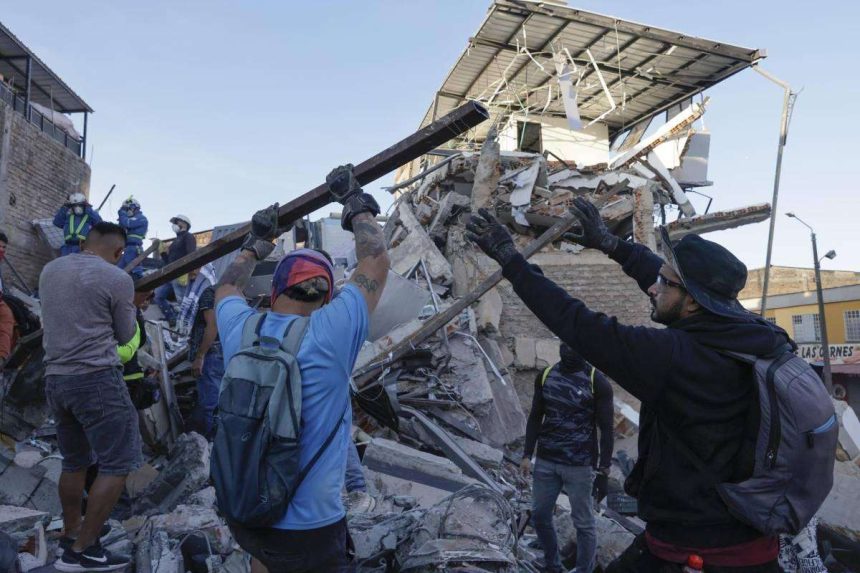
Panama has declared a state of emergency after two powerful earthquakes measuring 7.7 and 6.6 on the Richter scale struck the country on Friday, October 9, causing widespread damage, dozens of injuries and widespread disruption to the population. The seismic activity continued for hours, with more than 100 aftershocks , keeping authorities on alert and forcing thousands of residents to stay away from their homes.
Despite the intensity of the tremors and the serious damage recorded, authorities had not announced any deaths directly linked to the earthquakes. However, 27 people were injured , according to the Civil Protection, while homes, schools, hospitals, churches, hotels and road infrastructure were damaged across the country.
The scale of the devastation is reflected in the fact that all ten provinces of Panama , as well as two indigenous territories, reported problems from the earthquake. The greatest damage was found in the central provinces of Veraguas, Herrera, Cocle and Los Santos , where some communities faced serious access and communication problems.
The first and strongest earthquake, measuring 7.7 , was centered about ten kilometers southwest of the community of Pitalosa Arriba , in the province of Herrera, and had a focal depth of only ten kilometers . The shallow depth contributed to the particularly intense feeling of the tremor, which was felt even in neighboring Colombia .
A second strong earthquake of magnitude 6.6 followed, while aftershock activity remained intense. Among the more than a hundred aftershocks, tremors of magnitude 5.8, 5.5 and 5.2 were recorded, which increased concern about the strength of already stressed buildings.
The government announced the activation of emergency measures to accelerate rescue operations, technical inspections and the provision of aid to the affected areas. Minister of the Presidency Juan Carlos Aurillac announced the decision during a press conference in the capital, noting that the damage extends to a particularly large part of the country.
According to initial reports, approximately 420 homes and a similar number of schools were damaged. Problems were also identified in seven hotels, at least 13 churches and nine bridges , while technical services continue to conduct inspections to determine which buildings can be used safely.
The situation is particularly serious in the historic community of La Villa de Los Santos , where houses collapsed and the church of San Atanasio , an important monument of the colonial period that had been declared part of the national historical heritage in 1938, suffered major damage.
The loss of such a monument is not only a material disaster. It also affects the historical and cultural identity of a community that has preserved its architectural and religious tradition for centuries.
Images from the area show the anguish of residents. Families spent the night on the streets, under makeshift tents or in open spaces, fearing that another strong aftershock could cause further collapses.
Characteristic is the testimony of 90-year-old Tony Jimenez , whose home partially collapsed. The elderly man described the tremor as the most intense experience of his life, noting that even in his nineties he had never experienced anything like it.
The situation is complicated by landslides and road damage , which have cut off some communities. Although no missing persons had been reported as of Saturday, access to isolated areas remains a critical issue for rescue teams and Civil Protection services.
Significant mobilization was also recorded in coastal areas. On the island of Isla Cana , off the coast of the province of Los Santos, approximately 300 residents were evacuated as a precaution due to rising sea levels and strong sea waves.
In the town of Penonome , about 150 kilometers from the capital, a temporary shelter was set up for residents who could not safely return to their homes. Significant damage was recorded to the cathedral in the central square, public buildings and hotel facilities.
The impact was not limited to homes and public infrastructure. In Panama City , one of the water treatment plants that supplies the wider area was operating at only 20% of its capacity , raising concerns about the smooth supply of water. At the same time, tents and additional beds were set up in six hospitals to provide treatment in the event of new emergencies.
Air traffic in Central America was also severely disrupted. Tocumen International Airport, one of the region’s major air hubs, temporarily suspended operations after the first earthquake to allow for necessary security checks.
Although operations were restored a few hours later, the delays and flight cancellations caused a ripple effect at airports in other countries. Hundreds of passengers, mainly those traveling via Panama, were faced with long waits and uncertainty about the continuation of their travels.
Particular importance is being attached to the condition of the Panama Canal , one of the most important commercial maritime arteries in the world. The competent authority announced that ship transits continue normally, while specialized technical teams are carrying out inspections of the facilities to identify possible damage.
Maintaining the operation of the Canal is a critical factor for international navigation and global trade , as any prolonged disruption could significantly affect the transport of goods between the Atlantic and Pacific.
Panama is located in a particularly active seismic region, due to the interaction of different tectonic plates. Its geographical location, close to the so-called “Ring of Fire” zone of the Pacific , makes it vulnerable to strong seismic vibrations.
Seismologists point out that the region is affected by the movements of the Cocos, Nazca and Caribbean plates, which create complex tectonic phenomena. The existence of stricter building regulations, especially in the modern high-rise buildings of the capital, is estimated to have contributed to limiting human losses.
The country has faced major seismic disasters in the past. In 1991 , a 7.4-magnitude earthquake centered in neighboring Costa Rica caused 23 deaths, 559 injuries, and extensive damage in the border region of Bocas del Toro.
Latin American governments and international partners have mobilized on Panama’s side. President José Raúl Mulino thanked the leaders of countries in the region for their messages of support and offers of assistance, while the mobilization of the United States has been particularly significant.
Washington announced, according to relevant information, the dispatch of a specialized disaster response team and the allocation of $ 5 million in humanitarian aid . At the same time, the Southern Command of the US armed forces participated in supporting the affected communities, with helicopters that transported approximately 907 kilograms of food to hard-to-reach areas.
The next day finds Panama facing a major recovery operation. The safety of residents, the reopening of schools, the restoration of infrastructure, and the housing of those who lost their homes are the government’s immediate priorities.
At the same time, the ongoing post-seismic activity requires increased attention, especially in areas where serious structural damage has already been recorded.
Panama is experiencing one of the most serious seismic crises in its modern history. The fact that, according to the report so far, no deaths have been recorded is a particularly significant development given the magnitude of the tremors. However, the widespread destruction and uncertainty caused by the constant aftershocks are a reminder that dealing with a major natural disaster does not end when the first strong tremor stops.
The real test begins the next day, when an entire country is called upon to heal its wounds and safely return to normality.