
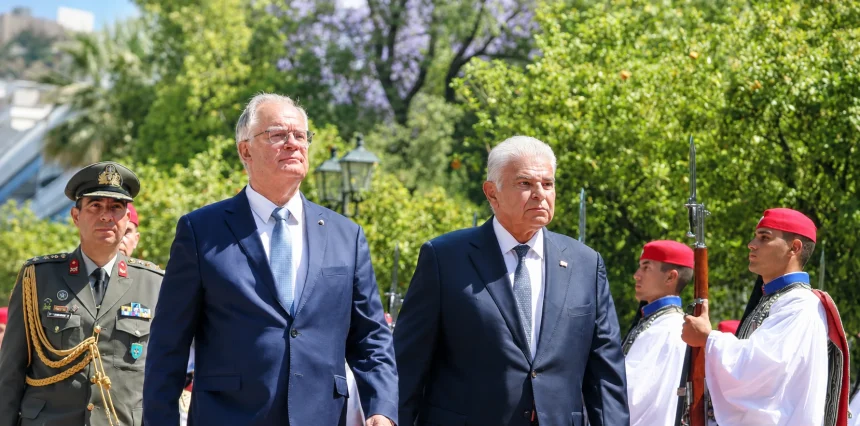
There are meetings of state leaders that function mainly as formal confirmations, but the meeting between the President of the Republic, Constantinos Tasoulas , and the President of the Republic of Panama, José Raúl Mulino, at the Presidential Palace, belonged to a different category. It was a meeting in which the two parties were able to talk about a common identity without having to construct it. Because the sea — the great constant that defines both countries — was present in every word of the discussion, as a common symbol, a common responsibility, and a common future.
Mr. Tasoulas said it with characteristic clarity: “We are connected by our great common relationship with the sea, which is for both our countries a key element of our history and identity.” For his part, President Moulino — a Maritime Law lawyer with a personal and professional connection to Greece dating back to 1992 — confirmed it in the same way: “Panama and Greece have the sea as a common symbol. We may be small countries, but the sea unites us.” Rarely is the common language of two states so naturally reflected in their diplomatic communication.
The visit also brought concrete results. During the meeting, the intention to sign bilateral agreements covering two main areas was confirmed: tourism cooperation and cooperation between the maritime chambers of the two countries. The choice of these areas is not accidental. Greece has one of the strongest shipping fleets in the world, while Panama controls the Canal , which is one of the most critical hubs of global trade . Strengthening the cooperation of their maritime chambers is not a diplomatic move but a substantial convergence of interests.
The common position of the two countries as members of the United Nations Security Council acquired particular weight at the meeting. Mr. Tasoulas referred to this capacity as a framework of shared responsibility for promoting the principles of multilateralism , democracy , human rights and free and safe navigation . Moulineau, for his part, recalled that a year ago he chaired the Security Council, with the central theme being precisely the safety of navigation and the seas . “At that time, we did not see on the horizon the situation that has arisen today and constitutes an obstacle to international cooperation and navigation,” he noted, leaving the allusion to the crisis in the Straits of Hormuz and the turmoil affecting them unclear but undoubtedly understandable.
The reference to the Panama Canal deserves special attention. Mulino recalled that the Canal is neutral and operates under a regime that requires it to remain open in times of war as well as in times of peace . “Today, we hope that the international situation will calm down, we hope that peace will prevail, so that the Canal and navigation can operate without hindrance in perpetuity.” At a time when freedom of navigation is a point of friction in the Gulf, the explicit guarantee of the Canal’s neutrality as a principle acquires geopolitical weight.
One of the most interesting elements of the meeting was the highlighting of the historical and human ties between the two countries. Mr. Tasoulas referred to the Greek community in Panama — which has a history of more than a century — emphasizing that, despite its small number, it has played an important role in science, technology, culture, politics and shipping. Moulinos himself added a historical element that few outside Panama know: “In our history, we also had a president of Greek origin, Mr. Lakas ,” referring to Demetrios Vasilios Lakas , president of Panama during the critical period of 1969–1978 , who was known for his role in the negotiations that led to the return of the Canal to Panamanian control.
Moulino knows Greece from a long and substantial experience. Since 1992 , when he first served as Minister of Foreign Affairs , and subsequently through numerous visits as a Maritime Law lawyer , he has developed friendly relations with Greek shipowners and colleagues. “I thank you very much for the high honor of being here today as President of Panama, with the aim of bringing our two peoples and our two countries even closer,” he said in closing, summarizing the purpose of the visit with disarming simplicity.
After the extensive talks between the two delegations, a ceremony of awarding with particular symbolism followed. President Tasoulas awarded Moulinos the Grand Cross of the Order of the Savior — the highest Greek decoration for foreign heads of state — while the Panamanian president reciprocated by awarding Mr. Tasoulas the Order of Manuel Amador Guerrero with Necklace , which bears the name of the first president of Panama. This mutual award constitutes, in itself, an act of equal esteem that seals what was said in words.