

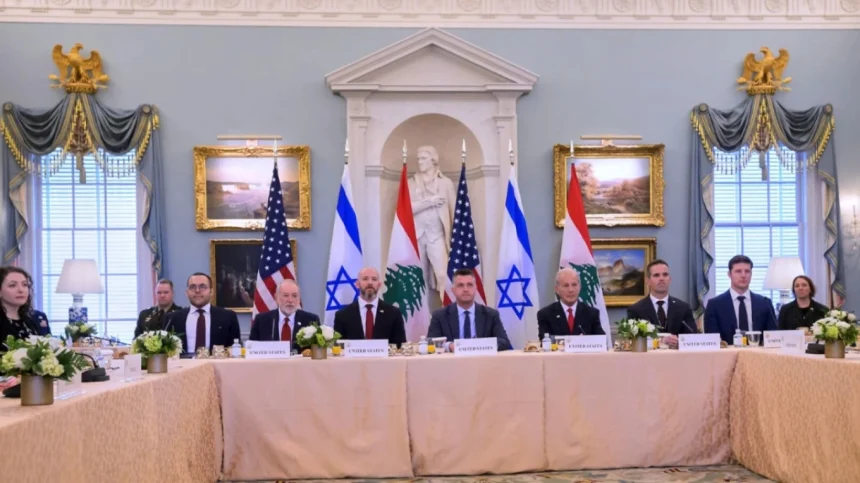
In the fourth round of negotiations under American mediation , held at the State Department in Washington, Israel and Lebanon reached a new agreement for a complete ceasefire .
The joint statement signed by the United States, Israel, and Lebanon reflects not just another round of ceasefire, but a more ambitious effort to create a stable security framework in the southern zone of Lebanon, with explicit references to the future of relations between the two countries. The crucial uncertainty remains the position of Hezbollah , which did not participate in the talks.
The core of the agreement is clear: the ceasefire “depends on the complete cessation of fire by Hezbollah and the removal of all its cadres and fighters from the areas south of the Litani River.” At the same time, it was agreed to create pilot security zones within Lebanese territory, from which the Shiite organization’s fighters will be absent and in which the Lebanese army will assume full control .
The demand for withdrawal south of the Litani is not new. The Litani River is about 30 kilometers from the Israeli-Iranian border and has been the geographical reference point for Western diplomacy in Lebanon for decades. As early as 2006, UN Security Council Resolution 1701 demanded the withdrawal of Hezbollah forces north of the Litani — a resolution that was never fully implemented. The fact that the same demand is being restated in 2026, in a new context that also includes Lebanese-controlled security zones , shows that negotiators are trying to give operational content to the old commitment. The
The joint statement also contains a political message that is not addressed to Israelis or Lebanese: “All countries reaffirmed that the future of relations between Israel and Lebanon must be decided by the two sovereign governments . They rejected any attempt, by any state or non-state actor , to hold the future of Lebanon hostage.” The reference to “state” and “non-state actor” leaves no doubt about the recipient, which is Iran as a financier and supporter of Hezbollah, and Hezbollah itself as an armed organization operating alongside and within the Lebanese state.
Iran has insisted that Israeli operations in Lebanon must end as part of a broader settlement that would include parallel nuclear negotiations. Washington, with the new agreement, is attempting to untangle the two tracks — that is, to move toward stabilizing Lebanon regardless of the outcome of the Iranian negotiations. It is a strategic choice that sends a clear message that Lebanon’s future is not a bargaining chip to be used at Tehran’s table.
Today’s agreement is another step in a series of subsequent ceasefires and extensions that have characterized the conflict. The first ceasefire on the Lebanese front came into effect on April 16, 2026 for ten days, was then extended for three weeks and then for another 45 days in May. On June 1, a first local agreement was reached, with Israel committing not to target the southern suburbs of Beirut and Hezbollah committing not to attack Israel. Today’s agreement attempts to go beyond this framework and extend the ceasefire to the whole of Lebanon , while raising the issue of Hezbollah’s permanent withdrawal.
The crucial question is whether Hezbollah will accept the terms. The organization has already expressed an initial open stance towards a complete ceasefire , but the specific condition of withdrawal south of the Litani is essentially of a different order of magnitude. It means abandoning positions that Hezbollah has held for years, disengagement from territory that it considers part of its operational radius, and acceptance of a Lebanese state presence in zones that it has essentially controlled alone. This decision exceeds the organization’s own powers and touches on the question of to what extent Tehran will allow such a strategic retreat.
The joint statement closes with a phrase that functions both as an invitation and a request for scrutiny : “These steps will allow progress towards a comprehensive peace and security agreement .” This is the first time that diplomatic language has explicitly referred to “ peace ” between Israel and Lebanon. It is a milestone in language that, if followed by action, would mean something of historic importance. Until then, the crucial obstacle remains the acceptance or rejection of the terms by an organization that was not at the table for this agreement.