
Donald Trump chose a particularly critical moment to send a new, tough message to Tehran. Despite the ongoing ceasefire between the United States and Iran, the American president left the possibility of renewed military operations wide open , using a phrase that is already causing heated debate in Washington, Tehran and international markets: “it continues!”
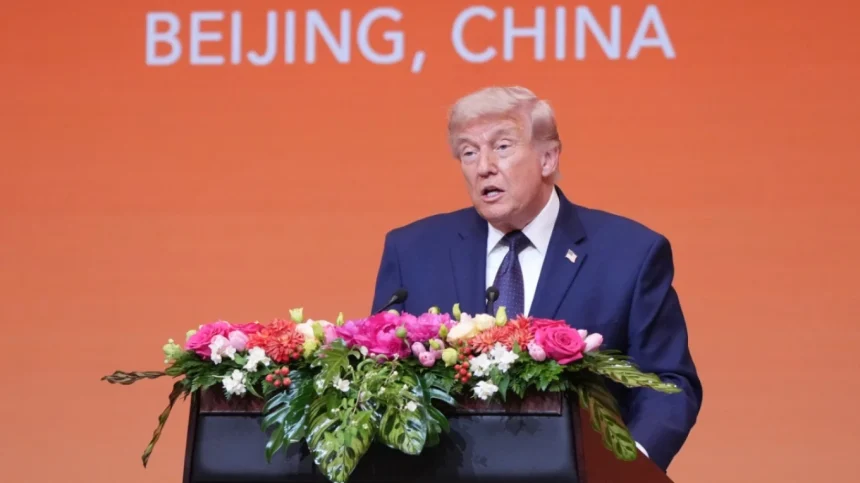
The reference was made in a lengthy post on the Truth Social platform, just hours before the second day of his talks with Xi Jinping in Beijing . Trump, attempting to link foreign policy to the narrative of the “return of American power,” presented the conflict with Iran not simply as a military operation, but as proof that the United States had returned to the center of international affairs.
Shortly before 1:00 a.m. Friday, the American president published a lengthy post, in which he referred to the Chinese president, the American economy, US domestic politics and the military campaign against Tehran. His style was familiar: sharp, personal and absolutely oriented towards the political confrontation with his predecessor, Joe Biden .
Trump claimed that when Xi Jinping spoke of the United States as a potentially “nation in decline,” he was actually referring—in his interpretation—to the Biden administration. In harsh language, he accused his Democratic predecessor of leaving behind a country that was weakened, politically divided, and less respected internationally.
In the same message, the American president attempted to present his own return to the White House as a turning point . He referred to immigration policy, taxation, crime and diversity policies, claiming that the country had been “reborn” within the first 16 months of his new administration. However, what stood out was not his domestic political rhetoric, but his clear reference to Iran.
Trump spoke of a “military victory” and a “military defeat of Iran,” adding the word “continues!” in parentheses. This particular formulation did not go unnoticed. On the contrary, it was treated as a direct warning that Washington does not consider the conflict to be definitively over and that the ceasefire could collapse if negotiations with Tehran do not lead to an outcome acceptable to the United States.
In other words, the American president did not limit himself to a review of what has already happened. He gave the impression that the military option remains active , even if for the time being both sides are formally in a phase of de-escalation. The phrase “continues” now functions as a political and diplomatic signal: to Iran, to China, to US allies, but also to Trump’s domestic audience.
He called the United States “the strongest military power in the world,” and argued that the American economy is back on a strong growth trajectory. In his own narrative, the military pressure on Iran, the stock market recovery, and the strengthening of the United States’ international image are all parts of the same political picture: an America that, he insists, is no longer yielding, but imposing its terms.
The timing makes the post all the more significant. Trump’s statements came while the ceasefire with Tehran remains extremely fragile . Before leaving for Beijing, the US president had stated that the ceasefire is on “mechanical support” , a phrase that captures how unstable he considers the current diplomatic environment. The image transmitted from Washington is that the talks are continuing, but without any certainty that they can prevent a new crisis.
US Vice President J.D. Vance has tried to keep a low profile, saying there is “progress” in the talks. However, the main disagreements remain deep. At the heart of the issue is Iran’s nuclear program and the US demand for commitments that would definitively prevent Tehran from acquiring a nuclear weapon.
Iran, after all, was not a peripheral issue in the Trump-Xi talks. On the contrary, it was at the center of the agenda in Beijing, overshadowing even traditionally big issues, such as trade, technology and US-China competition. According to the White House, the two leaders agreed that Iran should not acquire nuclear weapons and that the Strait of Hormuz should remain open to international shipping and energy transport.
The reference to the Strait of Hormuz is not accidental. It is one of the most critical sea lanes on the planet, through which a significant part of the world’s energy supply passes. Any military flare-up in the region could cause chain reactions in oil markets , transport security and the international economy. That is why China’s stance is particularly important, as Beijing remains one of the major buyers of Iranian oil.
Trump said that Xi Jinping assured him that China would not supply military equipment to Tehran . He even described this commitment as “very important.” At the same time, however, he admitted that the Chinese president had made it clear that Beijing wanted to continue buying oil from Iran. This balance reflects the complex diplomatic game that is underway: China appears not to want a nuclear Iran, but it also does not want a complete economic cutoff from Tehran.
In an interview with Fox News’ Sean Hannity , Trump insisted that the US strikes were necessary because Iran, he claimed, was very close to acquiring a nuclear weapon. When asked if the threat was that imminent, he replied with the phrase: “I thought so.” With this formulation, he attempted to present his decision as an act of prevention rather than an option for escalation.
The US president claimed that Tehran’s nuclear program was mainly based on three facilities, which were the targets of the US attacks. “It all started with those three facilities that we hit and we hit them hard,” he said, insisting that no other country could have destroyed these targets with the same effectiveness, “maybe only China,” he said.
The pressure on Tehran came with a stark warning. Trump said he did not intend to remain “patient much longer” and called on Iran to agree to the United States’ terms. “They have to make a deal. Any reasonable person would make a deal, but they could be crazy,” he said, once again using the tough, personal language that has characterized his public appearances.
His reference to internal developments in Iran also caused a particular sensation. Trump claimed that there is great turmoil within the regime, while he spoke of changes in the leadership structure of the Islamic Republic after the American strikes. His phrase that the “third echelon” with which the US is now negotiating is “more logical” and “smarter” than the first and second, which “no longer exist”, is interpreted as a clear hint at a serious weakening of senior figures in the Iranian power apparatus.
While the details of this report remain unclear, the political message is clear: Trump wants to show that US pressure has already changed the internal relations in Tehran. At the same time, he is sending a message that a deal can only be reached under the threat of force, not through concessions that could be interpreted as American weakness.
The crucial question now is whether Trump’s announcement constitutes negotiating pressure or preparing public opinion for a new military phase. International analysts estimate that Washington is still keeping the option of new operations on the table, especially if Tehran rejects American demands or attempts to buy time around its nuclear program.
Trump himself has repeatedly rejected the Iranian proposals as “completely unacceptable,” while he has signaled that American operations can continue if Tehran does not accept Washington’s terms. In this context, the phrase “Iran’s military crush continues” takes on more weight than a simple political exaggeration. It functions as a warning, as pressure, and as a message of deterrence.
The ceasefire, therefore, remains alive, but not stable. Talks continue, but under the heavy shadow of the military threat. China is trying to balance its energy interests with the need to avoid an uncontrolled conflagration in the Middle East. Iran is facing difficult decisions. And the United States, with Trump at the helm, seems determined to maintain pressure at all levels.
The next move will determine whether the current tension remains at the level of harsh rhetoric or opens the way for a new, dangerous military escalation. For now, Trump’s message from Beijing is clear: Washington does not consider the Iran case closed . And as long as the word “continues” remains on the table, the ceasefire looks more like a fragile pause than a real de-escalation.