

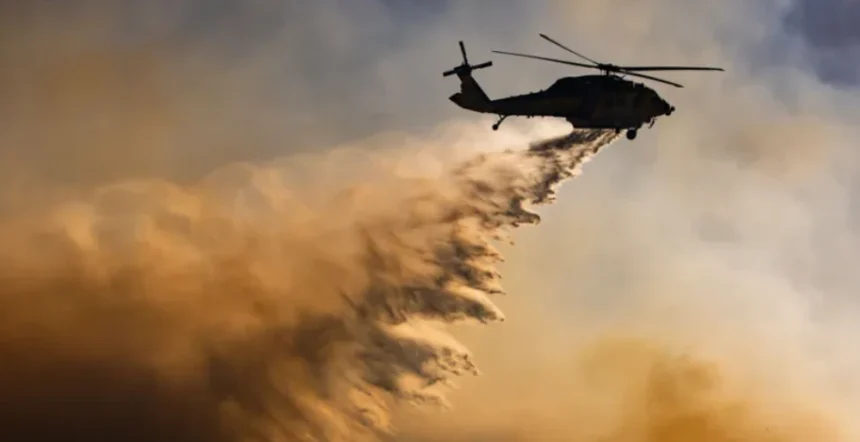
Southern California is once again facing the wrath of nature, as a large and rapidly developing fire threatens residential areas, forcing authorities to issue emergency evacuation orders.
The so-called Sandy Fire broke out in the hills above Simi Valley , an area located about 30 miles northwest of Los Angeles. The prolonged drought of the vegetation and the special local conditions allowed the flames to quickly take on nightmarish proportions, prompting the immediate mobilization of powerful ground and air forces.
The seriousness of the situation is highlighted by the fact that more than 17,000 people received urgent instructions to leave their homes, as the fire front threatened suburban neighborhoods.
The speed with which the fire spread in the first hours was overwhelming, as it was fueled by strong winds exceeding 48 kilometers per hour. In a short period of time, the fire burned more than five square kilometers of dry vegetation, while official reports from the Ventura County Fire Department already confirm the destruction of at least one residence . Despite the initial severity of the phenomenon, weather conditions showed a relative improvement during the night, with the wind intensity dropping significantly. This unexpected respite proved to be an ally for fire crews, allowing them to make significant progress in containing the fiery blaze.
However, the situation remains extremely critical and the alert level has not been lowered. As the agency’s spokesman, Andrew Dowd, pointed out, efforts are now focused on containing the fire as much as possible, before the winds strengthen again and cause new flare-ups.
So far, the fire remains without any official delimitation , which keeps the state apparatus on constant alert, while the exact causes that led to its occurrence are under systematic investigation. Evacuation orders and strict warnings remain in full force for many neighborhoods of Simi Valley, a city of more than 125,000 residents , who are watching with obvious anxiety the extinguishing efforts.
While firefighters were battling against time on the outskirts of Los Angeles , a second major front broke out in a completely different and isolated setting, on Santa Rosa Island , off the coast of Southern California. There, the fire quickly grew out of control, burning a huge area of 59 square kilometers .
The fire’s passage through the island left behind a destroyed home and a warehouse of logistical equipment, while forcing authorities to hastily evacuate eleven National Park Service employees who were in the area.
The disaster in Santa Rosa is causing intense concern in the scientific community, as the island is an extremely popular hiking and camping destination , but above all a wildlife refuge. The pristine ecosystem of the area is home to rare and protected species , such as the endemic island foxes, spotted weasels, as well as large populations of elephant seals. The ecological burden of the loss of natural vegetation in such a protected habitat highlights the losses from forest fires are not only measured in burned properties, but also in the incalculable damage suffered by the planet’s natural heritage.