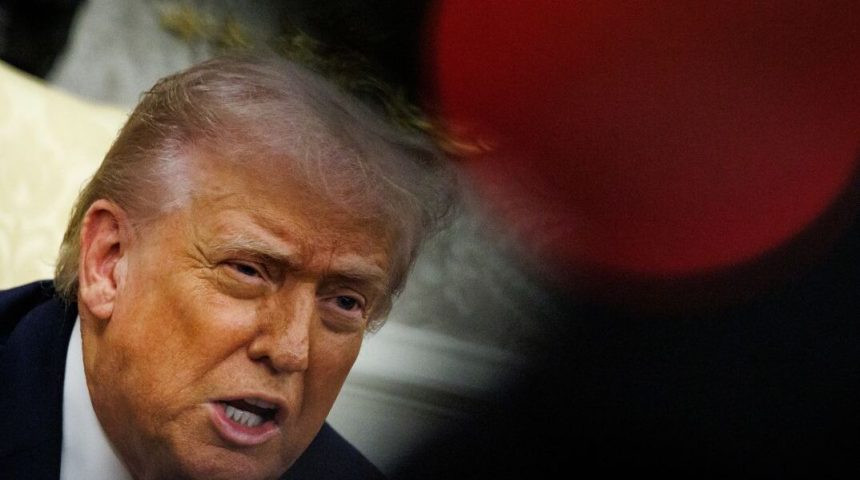
US President Donald Trump made a new intervention on immigration and the situation in Europe , commenting on the riots that, according to reports, occurred over the weekend in cities in France and Italy . The US president linked the social tensions to the immigration policies of European states, reiterating his view that Europe risks facing serious consequences if it does not strengthen its border controls.
According to Italian media reports, Donald Trump , speaking to reporters, claimed that the protests that took place in the two European countries are linked to the immigration issue .
“In Italy, as in France, the protests are related to immigration,” he reportedly said, presenting immigration as a key factor in the social tensions observed in European cities.
The American president went even further, expressing the assessment that France and Italy are currently in a worse situation than in the past . His position is part of his general criticism of European policies for managing immigration and protecting borders.
His most characteristic aversion concerned the future of Europe itself.
“If Europe doesn’t close its borders, it’s over,” he reportedly said, using particularly emphatic language to underscore his position in favor of tighter border controls.
This intervention brings back to the forefront one of the key positions of Trump’s policy, according to which immigration control is a central issue of national security, social cohesion and state sovereignty .
For the American president, immigration policy is not limited to the management of entry and asylum applications. It is linked, as is evident from his public statements, to the ability of states to maintain control of their borders and to implement their decisions on the entry and stay of foreigners.
His reference to France and Italy is of particular political interest, as they are two important states in the European Union, which face different challenges in managing migration.
Italy , due to its geographical location in the Mediterranean, is one of the main countries of entry for migrants and asylum seekers into the European Union. France , for its part, has been facing political and social controversies for years regarding the integration of migrant populations, security and the functioning of public services.
However, linking specific incidents of violence or protests to migration requires examining the real causes of each incident. The existence of social unrest does not in itself prove that it was caused by migration policy , even when the specific issue is at the center of public debate.
On a political level, Trump’s statement highlights the difference between his approach and European policies that seek to combine external border control, protection of the rights of asylum seekers, and implementation of international obligations .
The issue is complex, as it includes tackling irregular migration, the effectiveness of return procedures, the management of legal migration flows and the social integration of those who obtain the right to reside.
The phrase “if Europe doesn’t close its borders, it’s over” captures the particularly strict political position of the American president. It is not, however, a documented prediction for the development of the European continent, but a political warning with which he seeks to highlight the need to change immigration policy.
His statements thus bring back to public debate one of the most controversial issues in European politics: how states can ensure effective border control, address security issues, and at the same time uphold their legal and humanitarian obligations .
With his new intervention, Donald Trump is sending a clear political message to European governments , calling for stricter immigration policy and presenting border control as a crucial condition for Europe’s future stability.