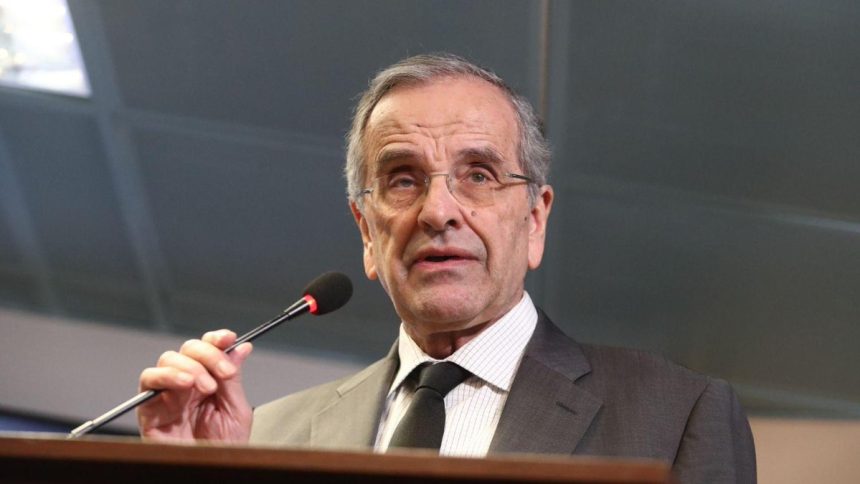
In a new, sharp intervention on the government’s accuracy and economic policy, former Prime Minister Antonis Samaras brings the issue of high indirect taxation back to the fore , calling for substantial reductions in fuel taxes, VAT and energy costs. At the same time, he directly criticizes Kyriakos Mitsotakis, arguing that the government maintains high tax burdens in order to ensure large fiscal surpluses, instead of using the available margins to relieve households and businesses.
The former prime minister’s intervention is not limited to a general complaint about the increased cost of living. On the contrary, it includes specific tax proposals , which he links to a different perception of the role of the state in the economy. At the core of his argument is the position that accuracy is not exclusively a consequence of international economic and geopolitical developments, but is also substantially influenced by the decisions of each government .
“Accuracy is not only a result of international developments. It is also a matter of government policy,” emphasizes Antonis Samaras, accusing the Mitsotakis government of not effectively addressing inflationary pressures. In fact, he characterizes the government’s economic approach as “managerial” and “neoliberal,” arguing that maintaining high taxation contributes to the creation of surpluses and the reduction of public debt as a percentage of GDP.
This is a political statement of particular importance, as the former prime minister attempts to move the discussion from the level of international appreciations to the field of national economic choices and fiscal priorities . In his view, the question is not only why prices are increasing, but also why the government does not intervene more in taxation, in order to limit the burden that reaches the final consumer.
Antonis Samaras contrasts the government’s economic policy with the concept of social liberalism , which he invokes as a key element of his own political philosophy. As he points out, a free economy does not exclude state intervention, especially when citizens’ purchasing power is limited and businesses face increased operating costs.
“Social liberalism, which I believe in, requires state intervention to relieve households and businesses. And this is a fundamental political difference,” he says characteristically.
With this formulation, the former prime minister seeks to highlight a different approach to the management of public finances , placing greater emphasis on direct tax relief. His position is that fiscal stability and social protection should not be treated as mutually exclusive goals.
Particular emphasis is placed on the cost of fuel , which directly affects both the movement of citizens and the production, transport and distribution of goods. According to Antonis Samaras, a significant part of the final price of gasoline and diesel results from the tax burden and not exclusively from the value of the fuel itself.
“More than half of what you pay at the gas station is a tax on fuel. You don’t pay ‘oil’, you pay a tax on oil,” he argues, using a characteristic phrase to describe the burden of indirect taxes.
At the heart of his proposal is the reduction of the Special Consumption Tax on unleaded gasoline , which in Greece amounts to 70 cents per liter . The former prime minister contrasts this amount with the European minimum level, which is around 36 cents per liter , arguing that there is significant scope for tax de-escalation.
The difference between the two amounts is a key element of his argument. According to him, Greece has chosen to keep gasoline taxes significantly higher than the minimum set by the European Union, which allows the government, if it decides to do so, to proceed with reductions.
The reduction of the Special Consumption Tax could directly affect the retail price of fuel , provided that the tax benefit is passed on to consumers. At the same time, such an intervention would have a fiscal cost, which would depend on the amount of the reduction and the quantities of fuel consumed.
Antonis Samaras also calls for a reduction in VAT on fuel , which is currently applied at the standard rate of 24%. He cites the European Union’s general minimum VAT rate of 15%, arguing that there is scope for further reduction of the tax burden.
However, the possibility of reducing VAT on specific product categories is determined by more specific European rules. Therefore, the reference to the general minimum rate of 15% is not sufficient in itself to document what exactly the reduction can be applied to fuel. The issue requires a specialized legal and fiscal assessment.
In addition to gasoline and diesel, the former prime minister also refers to the need to reduce the cost of electricity , noting that energy accuracy is a significant burden on Greek households and businesses. In this specific intervention, however, he does not present in detail the measures by which such a reduction could be achieved.
The second major section of his proposals concerns the general de-escalation of VAT . Antonis Samaras calls for the maximum rate to be reduced from 24% to 23% , restoring the rate that was in effect during his own government.
This proposal concerns a wide range of goods and services and, if implemented, could lead to a reduction in the tax burden on consumers. The actual effect on final prices would, however, depend on the behaviour of businesses and the conditions of competition in the market.
At the same time, the former prime minister suggests transferring more products and services from the standard VAT rate to the reduced rate of 13% , giving catering as a typical example.
The reference to this specific sector is not accidental. Catering constitutes an important part of Greek small and medium-sized entrepreneurship , while it is directly linked to tourism activity and employment. Its tax burden affects both the operation of businesses and the prices paid by consumers.
It is necessary, however, to clarify that not all catering services are currently subject to the 24% rate . Different rates already apply to different categories of products and services. Consequently, Antonis Samaras’ proposal should be specified as to the individual categories it seeks to include in the 13% rate.
One of the main arguments used by the former prime minister is the experience of the period during which he was prime minister. He argues that corresponding tax interventions were carried out in much more difficult conditions than today, when the Greek economy was under memorandum supervision.
“Some people tell us that these things can’t be done. And I tell you that they can be done. I did them when we were in government,” he says, recalling the fiscal pressures the country was facing at the time.
Antonis Samaras points out that at that time there were memoranda, fiscal deficits and restrictions from the troika , while today, according to his argument, the country has greater scope for exercising economic policy.
In fact, he argues that the tax cuts implemented during his own administration did not cause a loss of public revenue, but were accompanied by an increase in it.
This position is part of the former prime minister’s political argument. Its assessment requires taking into account the economic conditions of the time, changes in consumption and other factors that affected state revenues. Accordingly, the implementation of tax cuts today does not automatically guarantee that the same fiscal results will result.
Beyond the technical parameters of the proposals, Antonis Samaras’ intervention highlights a substantial political disagreement on how to utilize the country’s fiscal potential .
The former prime minister argues that the government prioritizes creating high surpluses and reducing public debt, while it could allocate a larger portion of the fiscal margins to reducing indirect taxes.
On the other hand, maintaining primary surpluses is linked to public debt servicing, fiscal credibility and the need to finance government liabilities. Any change in tax policy therefore requires an assessment of its impact on public finances.
The crucial question is whether fiscal stability can be combined with a more substantial relief for citizens from indirect taxes. The answer depends on the scope of the interventions, their cost, the potential for revenue replenishment and their real impact on the market.
In his political dimension, Antonis Samaras attempts to present accuracy as a field in which different economic perceptions are reflected. His own proposal is based on more active state intervention through taxation , with the aim of reducing the cost of living and strengthening purchasing power.
At the same time, his criticism of Kyriakos Mitsotakis takes on particular weight due to the former prime minister’s political career and the position he has played in the center-right. His reference to social liberalism is not simply an economic term, but also an attempt to define the political principles on which he bases his disagreement.
His intervention also brings back to the public debate a timeless question about the Greek economy. How much of the cost of everyday consumption is due to international prices and how much to taxation imposed by the state? And, most importantly, what part of this burden can be reduced without creating new fiscal problems?
The proposals on fuel, VAT and energy provide a concrete basis for such a discussion. To be fully appreciated, they need to be accompanied by detailed costing, a clear identification of tax changes and an assessment of their impact on final prices .
“I did it in much worse conditions. And it can be done again,” concludes Antonis Samaras, summarizing the central point of his intervention.
With his new public stance, the former prime minister directly raises the issue of tax policy as a means of addressing accuracy and questions the priorities of the Mitsotakis government. The debate he opens concerns not only the level of taxes, but also the ability of economic policy to balance the need for fiscal stability with the protection of citizens’ purchasing power.