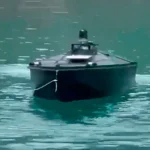


The United States and Iran are in a verbal confrontation after the Iranian navy announced that it had fired warning missiles and drones at American warships in the Gulf of Oman . CENTCOM responded categorically that this is false and that no such incident occurred. Two narratives, one sea, and a tense environment in which even the truth becomes a battlefield.
The Iranian navy , through state media, claimed that its actions were in response to what it described as harassment of shipping by the US Navy, as well as seizures of merchant ships and oil tankers. Iranian sources said that US warships were targeted and that their forces were forced to leave the area. It was a version that portrayed Iranian deterrence success in sensitive waters.
CENTCOM completely rejected this version, calling it “ false .” “Iranian forces did NOT attack or open fire on U.S. warships,” the command announced, adding that such an action would constitute a “flagrant violation of the ceasefire.” CENTCOM emphasized that U.S. forces continue to operate freely in regional waters and enforce the current blockade against Iran. Essentially, neither the presence of U.S. ships in the area nor their character is disputed. However, it is categorically disputed whether there was Iranian fire.
The reason for the escalation of Iranian sentiment seems to have been given a little earlier. The US Indo-Pacific Command announced that US forces conducted a “naval interception and inspection” of the sanctioned and nationalityless tanker M/T DAVINA in the Indian Ocean overnight. CENTCOM clarified that it “will continue global naval enforcement to disrupt illicit networks and intercept vessels providing material support to Iran, wherever they operate” — a phrase that clearly signals the extension of enforcement beyond the Persian Gulf and the Straits, reaching as far as the Indian Ocean.
This operation is part of a blockade that is producing numerical results. According to the latest figures provided by CENTCOM, since the blockade began, 127 commercial ships have been diverted, 6 have been impounded , and 36 humanitarian aid ships have been allowed to pass. The number 127 (it was still 122 yesterday) captures the pace at which the naval pressure is intensifying — and partly explains why Tehran is choosing this particular moment to issue statements that, even if they are disputed, send a message of determination.
The geopolitical context of the Gulf of Oman does not allow for complacency, regardless of how one defines the truth of this episode. The gulf is the naval gateway that connects the Strait of Hormuz with the Arabian Gulf and ultimately with the oceans. A passage through which more than a fifth of the world’s oil production is transported. The presence of American and Iranian naval forces in such a limited maritime space creates de facto conditions in which the possibility of a wrong reaction or misunderstanding of escalation cannot be ruled out.
What makes the assessment of today’s incident particularly difficult is the direct, complete contradiction between the Iranian and American versions. These are not different interpretations of the same event, but radically conflicting narratives about whether the event took place. Such contradictions are not unprecedented in the history of Iranian-American naval incidents, since in the late 2010s, similar dispute arose repeatedly regarding incidents in the same gulf. But in a period of active conflict and nominal “ceasefire,” this very dispute increases the risk of misunderstanding. If each side lives in a different operational reality, the ground for unintended escalation becomes more fertile.
These incidents are set against a backdrop in which negotiations for a nuclear deal and an extension of the ceasefire are taking place alongside exchanges of fire, ship seizures and now disputed naval incidents. The Iranian narrative serves internally as evidence of resistance to the blockade, regardless of whether it corresponds to actual events. The American objection reflects a need to prevent the impression that its own forces are being forced into retreat. And between the two, the Gulf of Oman remains what it always has been, namely a maritime arena where even truth becomes an object of negotiation and power.