

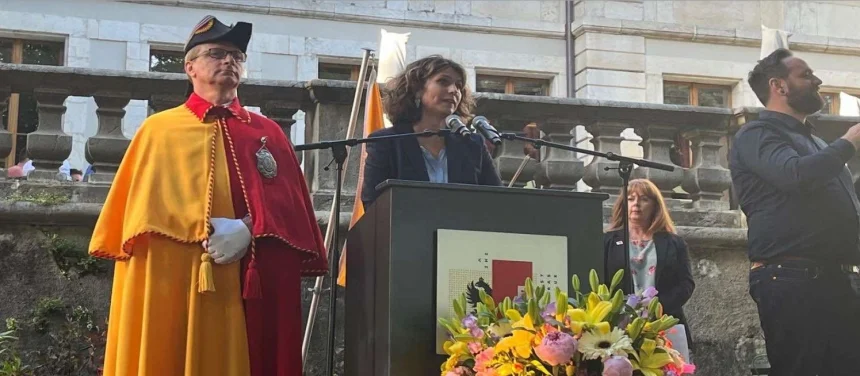
Against the backdrop of Geneva ‘s Vieille-Ville , Greek-born Christina Kitsos officially assumed her duties as mayor of the city . Her inauguration ceremony began with the Geneva Anthem , included references to Constantine Cavafy , and ended with a spontaneous syrtaki on the famous Promenade de la Treille , while members of the Greek community kept alive an unexpected Greek presence in the official ceremony of one of Europe’s most cosmopolitan cities.
The Greek embassy in Switzerland rushed to publicly congratulate the new mayor, describing her in a post as “the same Mrs. Christina Kitsos.”
Elected to the Conseil administratif (Executive Council) of Geneva in 2020 and re-elected in 2025, Kitsos is taking on the role of mayor for the second time in a system where the position rotates annually among the members of the Council. She succeeds Alfonso Gómez of the Greens, while the position of deputy mayor is taken over by ecologist Marjorie de Chastone . Her term runs from 1 June 2026 to 31 May 2027 .
Kitsos has chosen “shared time” (“temps partagé”) as the thematic axis of her mayoral year. The choice is not accidental. In a world that is accelerating — rhythms, expectations, interactions — she herself speaks of “time hunger” as an emerging social phenomenon and of the need for society to reassess its relationship with time. In this context, she plans to create “time offices” (“bureaux du temps”) , an artistic and social initiative that will listen to citizens’ difficulties in managing daily rhythms — and at the same time commits to 164 new childcare positions within the year. The contrast is revealing: an office usually associated with protocol and official events is used as a platform for goal-setting with a deeply social background.
Kitsou’s biography itself is a story that reflects Greek immigrant life in Europe. Born in 1981 in La Chaux-de-Fonds, Switzerland, she holds dual citizenship — Greek and Swiss — and her parents came to Switzerland in 1972 as immigrants, at a time when the Greek presence in that country was beginning to shape its community ties. Her family roots are strongly Greek and historically deep: on her mother’s side, her origin dates back to Thessaloniki , with earlier connections to Eastern Thrace and Constantinople , while her father comes from Edessa , with roots in Macedonia and Imbros . Geographies deeply charged in the collective Greek memory.
Her academic background reflects an intellectual curiosity that refuses to be limited to one subject. She studied Philosophy, French Literature, Communication and Journalism at the universities of Neuchâtel and Sorbonne , and later obtained an Executive MBA from HEC Genève . Before devoting herself to politics, she worked in education , communication and public administration — a triptych that gave her practical knowledge of how institutions work from the inside.
Her political career began very early. A member of the Youth Parliament since the age of 13 , she joined the Socialist Party of Switzerland , served as a parliamentary assistant in Bern, a member of the Grand Council of Neuchâtel (2005-2008) and a member of the Geneva City Council (2015-2020). A gradual, methodical ascent that was not based on impressiveness but on accumulated institutional experience.
The prominence of the Greek element in the inauguration ceremony was spontaneous and multi-significant. The reference to Cavafy was not a formality, since the Alexandrian poet who honored the Greek spirit in the diaspora is a natural companion for a woman who embodies precisely this tradition. And the syrtaki on the Promenade de la Treille — one of the most symbolic routes in Geneva, was not a show but an expression of identity before the eyes of her community.
Geneva — a city-symbol of international diplomacy, headquarters of international organizations, a city that has hosted historic negotiations and defined the Western perception of human rights — gains for a year a mayor with Greek roots, Swiss education, French academic culture and a political inclination towards cohesion and solidarity . It is not just a personal success. It is a reminder that generations of Greeks who left , seeking life in foreign cities, left descendants who today represent these cities in their highest positions.