

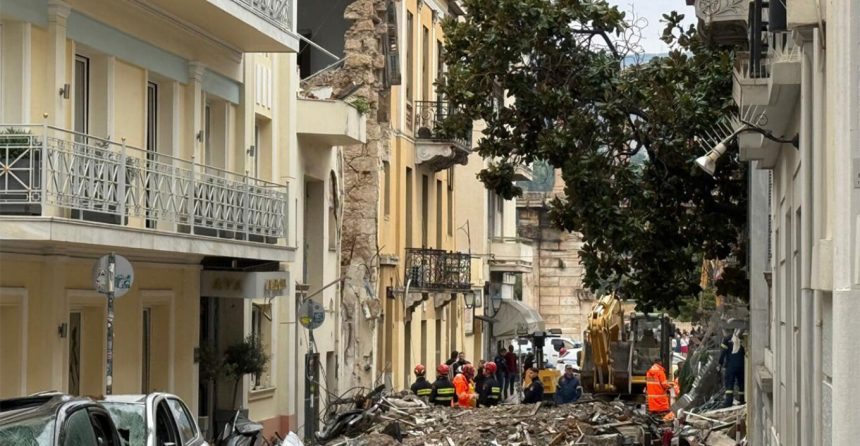
Twenty-four hours after the powerful explosion, the ruins in Plaka gave the harshest answers. The searches for the six missing were completed, and none of them had a happy ending.
In the early hours of Saturday morning, a 77-year-old Greek woman was found dead under the rubble, trapped in a bathtub. Shortly afterwards, her 78-year-old British husband was also found dead on the mattress, while the remaining four bodies were subsequently recovered.
The search and rescue operation was carried out on Lysikratous Street , with Fire and Rescue Services forces operating in the rubble with special equipment, thermal cameras and trained dogs. The 77-year-old was pulled from the first floor of the building, almost 24 hours after the explosion. The Directorate for Combating Arson Crimes is also at the scene.
During the operation, a woman’s bag containing personal belongings, two passports and the rental agreement for the accommodation were found, elements that had increased the anxiety about the fate of the occupants. At the same time, it was found that the group of tourists never showed up for their scheduled return flight at 15:30 the same day, a fact that confirmed the worst fears.
As stated by the mayor of Athens, Haris Doukas , most of the ruins have been cleared away, while the building is heading towards total disuse after the inspection by the Municipality’s technical service. There is a power outage in the entire block.
According to initial estimates by the Fire Department, the explosion was caused by a natural gas leak on the second floor. However, the relevant investigations have not been completed, neither by the Fire Department nor by DEPA and the specialist pyrotechnicians.
Speaking to Zougla.gr, Giorgos Tsaparas , a retired Hellenic Police pyrotechnician and explosion expert, described how one reaches this conclusion. “According to the first assessment from the photographic and video material that is available, it appears that the explosion took place on the second floor of this residence,” he said, noting that it is an old residence with limited statics and that blackness is visible on the ceiling of the second floor.
The description of the chain collapse is particularly illuminating. “The explosion hit the structural part of the building, namely the columns and the roof. The roof probably collapsed, along with some columns, and took everything with it,” he explained. “After the columns of the building exploded, the roof collapsed and collapsed. Then there was a sequence, the entire wall on the right that was touching the adjacent building, which was also old, disappeared,” he added, describing how the rubble from the neighboring stone-built building ended up crushing the building.
As for the cause, the expert was clear. “What I observe, I consider to be a gas explosion ,” he said, giving the scientific explanation. Natural gas, being lighter than air , tends to rise to the upper apartments. Therefore, wherever the leak occurred, the gas accumulated in the upper part of the building. “That’s why we see the upward expansion. The natural gas accumulated in the upper part and the explosion took place on the second floor,” he concluded.
Finally, the damage to neighboring buildings is also significant. The shock wave hit shops, windows, roller shutters and shutters, with technical inspections being extended to the wider area in order to determine which buildings can remain habitable. This question is crucial for a district like Plaka, where most of the buildings are old, adjacent to each other and constructed with methods from another era.