
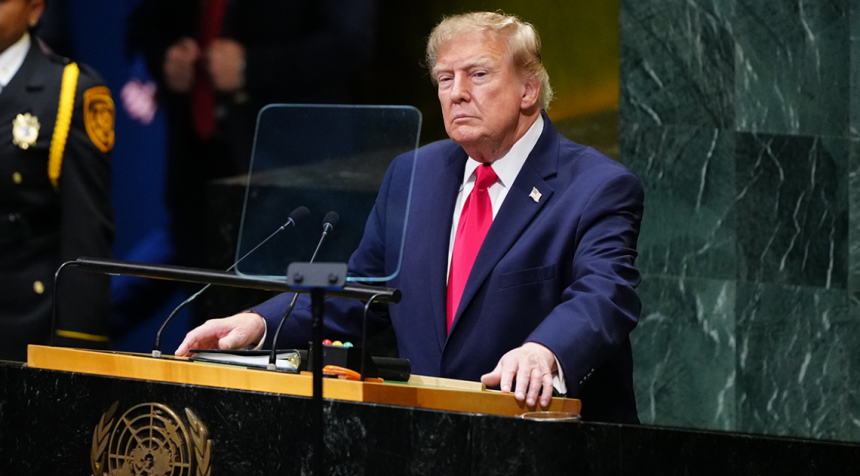
“America is back.” With this phrase, repeated almost as a slogan, Donald Trump gave the stamp of Washington’s intentions from the podium of the UN General Assembly , in a speech where praise for the American economy coexisted with some of the harshest warnings of the year towards Iran .
The annual Summit is in full swing in New York , with nearly 130 heads of state and government attending. In a period of intense geopolitical turmoil, major international crises dominate the agenda.
The American president began by emphasizing the achievements of his administration , with references to economic recovery, investment, social welfare, immigration and the fight against crime, while not failing to criticize the policies of his predecessor. “I can proudly tell you that America is back and our country is stronger today than ever,” he said, adding that “two years ago we were a dead state” and that now “the whole world benefits from America’s momentum.”
The change in tone towards the attendees was notable. This year he called them “great leaders,” when last year, from the same podium, he had warned them that their countries were “heading towards disaster.” The difference is not just stylistic. It suggests a Washington that is seeking, this time, to rally allies around its positions.
The reason becomes clear in the rest of the speech, where the burden fell on Iran. Trump called on the international community to remain united in order to economically isolate Tehran, describing the regime as “weak and desperate” and making it clear that “Iran will never obtain a nuclear weapon .”
The sharpest moment came with a pre-announcement that left all possibilities open. “I have a decision to make about Iran,” he said, noting that “big changes can happen quickly.” And he continued in particularly high tones. “From the first day of my return to the US administration, Iran stopped being the bully in the Middle East. They will never get nuclear weapons. We bombed them, but they continued to cause problems. In fact, they developed a missile that threatens Europe . I hope they take this seriously in the European Union.”
The reference to Europe was not accidental. It is a direct attempt to transform the Iranian threat from an American issue into a shared Western concern, so that Tehran’s economic isolation would gain wider support. In the same vein, the US president thanked the Security Council for the resolution against Tehran, accusing Iran of continuing to violate the terms even after the ceasefire agreement.
As for the future, he appeared confident of a diplomatic outcome, but with a clear political timetable. “I believe we will reach an agreement with Tehran, right after the US midterm elections . They are waiting to see how I do to make their decisions. But I am not worried. I will be here for the next 2.5 years.” And he concluded with a sentence that summarizes his entire strategy. “I am in a dilemma, should I make a deal with them or lead them to hell ?”
On the sidelines of the proceedings, diplomatic activity is equally intense. Shortly before taking the podium, speaking to reporters, Trump sent a brief but clear message to Vladimir Putin , calling on him to “end the war.” The statement comes ahead of his meeting with Volodymyr Zelensky , which will follow his talks with the leaders of Britain and Japan .
The speech, as a whole, moved between two poles. On the one hand, an image of American power that is offered to the rest as a point of reference. On the other, a question about Iran that the American president himself publicly formulated without answering. Between the agreement and hell, the decision remains, as he said, still on the table.