

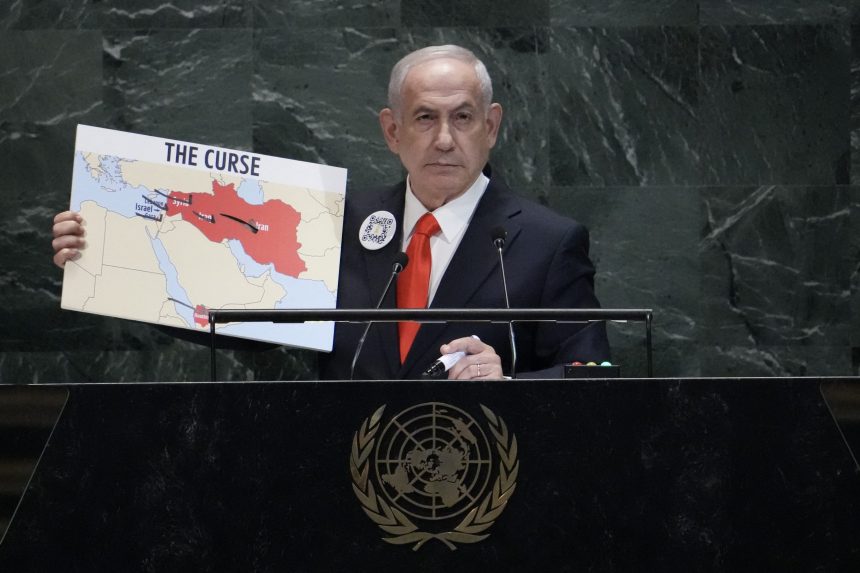
There is something that did not go unnoticed in Athens. From the podium of the UN General Assembly , Israeli Prime Minister Benjamin Netanyahu publicly stated, with names and descriptions, what the Greek side has chosen to avoid for years. He said directly that Recep Tayyip Erdogan threatens Greece , that he illegally occupies northern Cyprus , and called him a “tyrant” .
The Israeli prime minister accused Ankara of harboring Hamas and spreading false allegations against Israel, adding that the Turkish president has killed thousands of Kurds and imprisoned journalists. “He calls every day for the destruction of Israel. He says he will become the ruler of Jerusalem . No sir, you will not. It is our country, our city, our eternal capital,” he said.
The Israeli embassy in Greece also echoed this position in a post, calling Turkey a “hotbed of mass dissemination of anti-Semitic lies” and repeating the full list. Hosting Hamas leaders, murdering Kurdish civilians, denying the Armenian Genocide , imprisoning journalists and opposition leaders, illegally occupying northern Cyprus and regularly violating NATO member Greece. It added that Ankara “is now seeking to occupy Syria .”
The embassy particularly focused on the Greek side. “Greece is a close and strategic partner of Israel. The security, stability and prosperity of Greece are important to Israel. Israel stands by Greece and together we will continue to work for security and stability in the Eastern Mediterranean ,” it said.
And here arises the question that preoccupies the Greek public debate: Why did Netanyahu say from the highest international stage what the Greek government hesitates to say?
The first explanation is the most obvious and concerns the relationship between Ankara and Jerusalem , which is at a nadir. The Turkish leadership has adopted the most aggressive rhetoric against Israel in the entire West, hosts leading Hamas figures and has turned the Palestinian issue into a central axis of its external communication. For Netanyahu, therefore, Turkey is not a partner with whom he maintains a delicate balance. It is an adversary.
The second explanation is a rhetorical strategy . Israel is facing intense international criticism for the war in Gaza. Instead of responding defensively, its prime minister chose to shift the burden to its accusers, presenting them as regimes with a heavy history of their own. In this logic, Greece and Cyprus were not mentioned by chance. They functioned as an argument , as proof that Turkish behavior does not only concern Israel but also affects EU and NATO member states.
The third explanation, and perhaps the most essential, concerns the different positions of the two countries. Greece and Turkey are neighbors, allies within the same Alliance, with open channels of communication, trade relations, migration cooperation and a framework of mild relations that Athens seeks to maintain. Greek foreign policy, regardless of governments, has chosen the language of international law and not personal characterizations, precisely because it knows that every word returns the next day to the Aegean. Israel does not bear this burden. It does not share borders with Turkey, does not have to manage overflights and is not at risk of a heated incident.
Finally, there is the internal dimension . Netanyahu is also addressing an audience within Israel, where the tough stance towards Ankara is viewed positively.
But what does this position mean in practice for Greece? In itself, nothing immediate. It does not change associations, does not bind third parties and does not create obligations. However, it has the value of being recorded . The Turkish threats against Greece and the occupation of Cyprus were heard before almost 130 leaders, in a meeting that is being recorded and archived. And, on a second level, it confirms that the Greek-Israeli relationship, which in recent months has been strengthened with the “Achilles Shield” and with joint naval exercises, now also has a public political expression.
The question of whether Athens should speak with the same intensity remains open and divisive. One side argues that the systematic avoidance of characterizations is perceived as weakness. The other counters that Greece is winning internationally precisely because it appears as the side that invokes law and not adjectives. What is certain is that what was said yesterday in New York was said by someone who will not have to deal with it in the Aegean.