
As US-Iranian negotiations remain deadlocked, the Strait of Hormuz has once again become a battlefield for direct military conflict. In the space of a few hours, four Iranian drones were shot down by US forces, US strikes on Iranian radar sites, Iranian warning shots were fired near the Strait, and another seizure of a merchant ship headed to an Iranian port was announced. Meanwhile, on the air, Donald Trump was giving an interview to NBC News comparing the conflict to the Vietnam War.
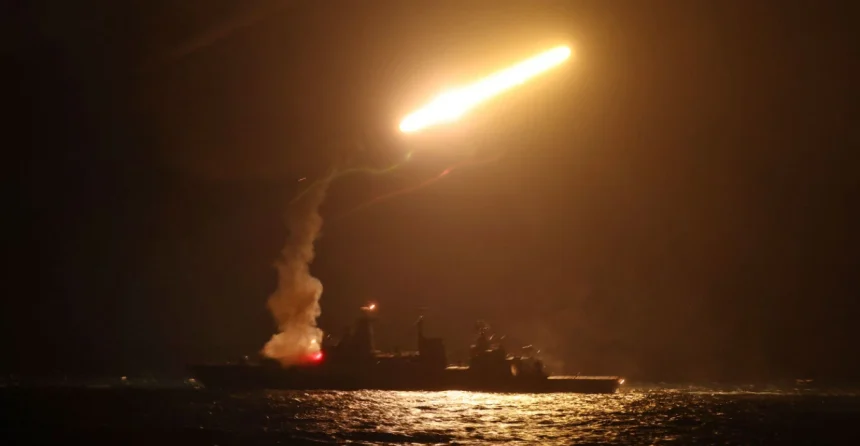
The incident began in the sea area beyond Larak Island , off the strategic port of Bandar Abbas . Iran’s semi-official Mehr news agency reported that Iranian forces had taken “ precautionary measures ” near the Straits, linking the firing to a redeployment of US warships in the area. The Iranian navy also said it had fired missiles and drones at US ships in the Gulf of Oman, claiming that the ships had “left for the Indian Ocean” and that if they returned, “longer-range missiles would be used,” a threat that CENTCOM did not confirm.
What CENTCOM confirmed was different and clear: US forces shot down four Iranian suicide drones that were launched towards the Strait of Hormuz. “The attack drones posed an immediate threat to navigation in the area,” the command said, adding that US forces then struck Iranian coastal surveillance radars in the Goruk region and Qeshm Island , “to deter further attacks.” CENTCOM announced that it would continue to respond to “unprovoked Iranian aggression” within the framework of the right of self-defense.
The choice of targets is not accidental. Qeshm is located at the entrance to the Strait of Hormuz and Western analysts call it Iran’s “ unsinkable aircraft carrier .” It is an island with fortified tunnel networks, forward drone units and anti-ship missile batteries that monitor the movements of the US 5th Fleet. Goruk , further inland, hosts radar infrastructure that feeds targeting data to the same network. A blow to these stations is not a simple response to an incident, but rather a disruption of the sensory infrastructure that allows Iran to monitor and threaten shipping in the Straits.
Meanwhile, CENTCOM announced that it had impounded the Gambian-flagged M/V Lian Star after it ignored more than 20 warnings while heading to an Iranian port in the Gulf of Oman. This is yet another enforcement of the blockade that has been in effect since April 13 and has so far diverted more than 127 commercial vessels.
As these events unfolded, Donald Trump gave an interview to NBC News in which he captured both his strategic thinking and its limits. The comparison he chose was revealing: “I’m moving very fast. I’m in my third month . The Vietnam War lasted 19 years. I’m only in my third month.” This reference — chosen to minimize criticism of the length of the conflict — simultaneously poses a question that he himself does not answer: what is its horizon?
The US president also presented specific numbers on the dismantling of Iranian capabilities: “Most of the drone production facilities have been destroyed, most of the launch sites have been destroyed, and most of the missile manufacturing areas have been destroyed.” And then a number that stands out: “I would say, as a percentage, they have maybe 21% to 22% of their missiles . That’s a lot of missiles, but it’s not what they had when we first attacked.” The fact that even 21% of the initial Iranian missile force constitutes a threat enough to cause continuous incidents partly explains why the conflict is not being brought to a quick end.
As for why there is still no agreement, Trump expressed understanding but also pressure: “It’s very difficult for them. They are strong, they are proud. There are things they never thought they would have to do and now they have to do them. They have no other choice .” This is a formulation that wants to convey an inevitable collapse of the Iranian negotiating position, but today’s incidents remind us that even a militarily weakened Tehran remains capable of causing serious incidents in the most critical waters of the planet.
The way the two sides experience this phase could not be more different. For Washington, the incidents are manageable episodes in a campaign that is successfully unfolding. For Tehran, every drone launched and every “warning shot” announced is a message to the domestic public that the resistance continues. Between these two narratives, the Strait of Hormuz remains the world’s largest energy hub — and a war zone that has yet to find a path to calm.