
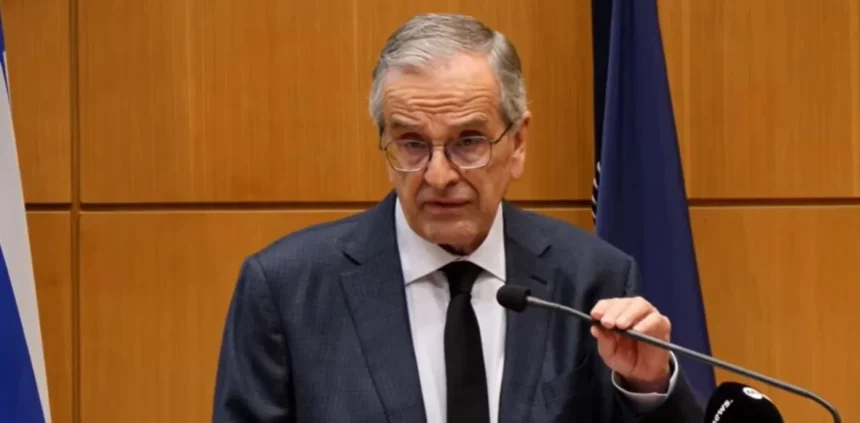
“I have gained great strength and wisdom by listening to the people and that is how I have made my decisions. But allow me to announce them when and as I should ,” said former Prime Minister Antonis Samaras immediately after his speech at an event in Heraklion, Crete. A phrase that does not confirm a date but leaves no doubt about the direction : decisions have been made, an announcement will be made. The “if” has been replaced by “when.”
The speech that preceded it was for the most part a harsh criticism of the Mitsotakis government , expressed in the manner that Samaras has been cultivating in recent months: a combination of historical reference, thematic agenda, and personal overtones.
The former prime minister described the country as “at risk” due to the absence of “center-right representation” , accused the government of changing doctrine and of “common policy with SYRIZA” in the so-called woke agenda , and reached the comparison that immediately became a signal: “Today’s Tsipras-Mitsotakis image is reminiscent of the verse from Miliokas’ song: “how much you have changed, how much I have changed, clothes together that were washed and turned pink””.
The thematic criticism focused on three main axes. The first was foreign policy . Antonis Samaras referred to the Turkish-Libyan memorandum, the Turkish Navtex and the submarine cables, accusing the government of abandoning the country’s positions with “the so-called appeasement “. He was asked “can there be a policy of “calm waters”, while there is a storm ?” and stressed that Greece should not be the “useful idiot” in the region. He also referred to the Prespa Agreement , attacking SYRIZA on the name issue: “We gave up the veto”, he said, while also raising the issue of the Greek minority in Albania as an example of insufficient protection of national interests.
The second axis was the internal political image of ND. Presenting opinion poll data, he emphasized: “Today, what percentage does ND have: 22, 23, 24, 25%? To be self-reliant , you have to go to 36 and 37%” and asked himself directly “really, am I responsible for the accuracy, I am responsible for homosexuals, I am responsible for the insecurity, I am responsible for the farmers, I am responsible for the arrogance?” — reversing the narrative that he himself is the cause of ND’s low percentage, and attributing the deterioration to the government itself. He spoke of a “party of one” and of “insults, mudslinging and vile personal attacks” by ND officials.
The third axis was more institutional and concerned the media and polling companies. Samaras attacked those he considered to be using political tools outside the nodes: “I heard a director of a polling company tell Mr. Androulakis that “if he continues like this, he will find all the companies against him”. Have we reached the point where polling companies openly threaten politicians and parties?” he wondered, describing the dilemma of “who else could govern” as arrogant and pointing out that “governments and parties are not appointed, they are elected by society ”.
When asked about his age (75 years old) and the statement by many that he should “sit quietly”, his answer was perhaps the most revealing about the mentality that drives him: “Fighting for the land is not a profession and there is no pension. They follow you until your last breath .”
The choice of Crete as the scene of this appearance was not accidental. The island is historically a strong center-right vote bank, and the visit to Arnaoutakis highlighted the building of networks outside Athens. Samaras is no longer moving as a past looking back on his actions, but as a political actor building the next step with familiar tones and a still unknown timetable. “I will announce my decisions when and as I should” was the phrase of the day. “When” is now what is expected.