
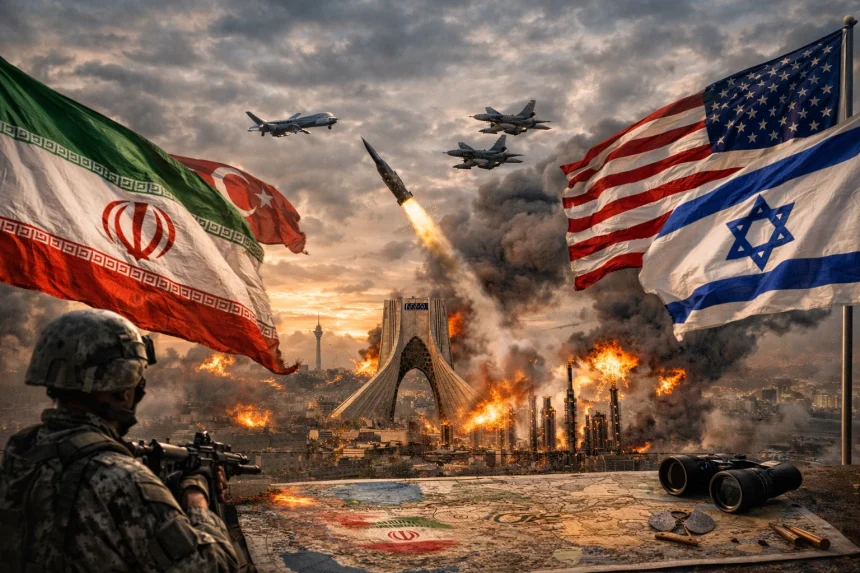
What is taking shape around Iran is not yet another regional crisis . It is not yet another episode in the long chain of Middle Eastern tensions. It is something much bigger. It is an attempt at a historic realignment of power , a plan that, if carried through to completion, will change not only the regime in Tehran , but the entire geopolitical map of the region and with it the balances between the United States, Israel, Turkey, China and the Arab world.
To understand what Americans ultimately want in Iran, one must first discard naive readings of “humanitarian sensitivity,” “exporting democracy,” or “targeted deterrence.” In great powers, and especially in the United States, strategy is not written in terms of sentimentality. It is written in terms of historical memory , geopolitical power , presidential legacy , and global influence . And in American memory , Iran is not just a hostile country. It is an open wound , a national humiliation that has never truly been forgotten.
The seizure of the American embassy in Tehran and the 444 days of hostage-taking were not simply recorded as an episode of international tension. They were deeply inscribed in the psychological and political substratum of the United States as an embarrassing stain , as a moment in which the American superpower appeared incapable of protecting its prestige. Anyone who believes that such events fade with the passage of time does not understand how states that think in terms of decades work. Great countries do not forget. They wait . They record. They return when they believe that the circumstances allow it. And when they return, they do so not to simply close an account, but to rewrite the rules of the game.
In this context, Iran for Washington is not just a hostile player. It is a node of problems that, if neutralized or transformed, can allow the US to claim to have simultaneously solved a series of strategic issues. From the nuclear threat and Islamic terrorism to the security of Israel , the stability of the energy market and the containment of Chinese penetration in the Middle East. Simply put, Washington does not see Iran as an isolated target. It sees it as a geopolitical key .
There is, however, a second dimension, just as important, which is the legacy of the presidency . In American political culture , history does not remember a president only for his speeches or for the management of everyday life, but for the great breakthrough that sealed his name. Nixon was stigmatized by Watergate , but history continues to recognize him for opening up to China and closing the cycle of Vietnam . The idea of a “presidential legacy” is not a theoretical exercise. It is a driving force for decisions. And for a president who does not have unlimited political time in front of him, a decisive victory on the Iranian front could be presented as his great stamp on history.
This very logic turns Iran into something more than a military or diplomatic target. It turns it into a tool of historical infamy . An American success there could be presented as proof that a particular leadership did not simply manage a crisis, but changed the world , restored US deterrence and restored American hegemony in a region that had become a contested field. And within the domestic political game, this narrative would not be negligible at all. On the contrary, it could become the foundation on which the next day of an entire political current, with successors, continuators and would-be heirs, would be built.
The narrative that will be sold to the American electorate is almost ready now. That the US has finished the job , that it has neutralized the regime that for decades has been identified with anti-Americanism , hostage-taking , anti-Western aggression , nuclear ambitions , and systematic support for terrorist networks . In such a narrative, Iran will not be presented simply as a defeated adversary, but as the last great link in a chain that begins with 9/11 and reaches all the way to Hamas, Hezbollah, and the Houthis. Whether or not this fully reflects the complex realities of the region is politically of immense importance. For in democracies, strategic victories translate into clean slogans , not academic footnotes.
Those, therefore, who limit American goals to “crushing the mullahs” probably only see the first level. The truth is harsher and deeper, as the US does not simply want to harm the existing regime. They want, if given the opportunity, to transform Iran and pull it, even if gradually, into a new architecture that will be compatible with Western strategic interests. We are not necessarily talking about a smooth, fast or linear process. We are talking about a will to reorient a country of enormous geographical, cultural and energy importance. This, obviously, is not done with declarations of goodwill. It is done with pressure , bombings , suffocating military attrition , economic exhaustion and, if necessary, by building new relationships within the country itself.
Those who are shocked by this statement should remember that the West has never hesitated, when it judged that vital interests were at stake, to use prolonged military force until it imposed a result. The case of Serbia reminds us that even the rhetoric of “human rights” and “progress” did not prevent a Western leader (Clinton) from bombing for months until the opponent buckled. What changes each time is not the essence of power, but the wrapper of its legitimization . And today the wrapper is the fight against terrorism , the prevention of nuclear danger , the stabilization of the region and the security of Israel .
These are precisely the grand strategic objectives that make Iran so pivotal. First, the weakening or fall of the Iranian regime would deprive the network of pro-Iranian organizations of their main state sponsor . Hezbollah , Hamas , the Houthis , and other players in the “proxy conflict” are not just ideological relatives of Tehran, but are links in an entire strategic chain that has allowed Iran to extend influence far beyond its borders. Neutralizing this center means that Washington and Israel believe they can completely eliminate the regional Islamist threat as they perceive it.
Second, Iran is a critical front in the competition with China . Chinese penetration in the Middle East is not just about investment, technology, and trade. It also involves forging relationships with regimes that challenge American primacy. A weaker, more controlled, or even Western-oriented Iran would drastically limit Chinese influence in a space where energy , sea routes , land corridors , and strategic passages intersect.
Third, there is the energy hard core. The smooth flow of oil , the security of shipping lanes , and the avoidance of a permanent conflagration in the Persian Gulf remain fundamental issues for the global economy. An aggressive or unpredictable Iran poses a constant threat to this balance. In contrast, an Iran integrated into a more predictable system, even if it does not become an “ally,” could cease to function as a source of systemic destabilization .
Fourth, and perhaps most immediately, is Israel’s security . For Israel, the Iranian regime is not just an annoying adversary. It is the heart of a strategic arc that arms, guides, finances, and ideologically fuels forces that threaten it directly or indirectly. The Israeli perspective is crystal clear. Without neutralizing the Iranian threat, there can be no lasting security . And at this point, perhaps for the first time so sharply, the American and Israeli goals seem to coincide almost perfectly.
From this perspective, the next day does not only concern Tehran. It also concerns Turkey . Because if Iran ceases to function as the main regional revisionist pole, then the entire power system will seek a new point of balance. And there Ankara will find itself faced with an unpleasant reality. As long as the Iranian problem existed, Turkey could blackmail, balance, maneuver and remain “necessary”. However, if the US feels that it has acquired new strategic leeway, tolerance towards Ankara’s neo-Ottoman games, blackmail, double language and peculiar hostile autonomization may be sharply limited.
In other words, American pressure on Iran does not only portend upheavals in Tehran. It may also herald the end of the era in which Erdogan’s Turkey believed it could challenge the West without significant cost. If Washington can reshape the region with less need for the Turkish intermediary , then Ankara will cease to be a “problem to be tolerated” and may become a problem to be contained . This is one of the most critical and perhaps most underrated parameters of the conflict.
In this new setting, the Kurds reappear as the great factor that everyone used and almost everyone betrayed. But if the next day requires a land dimension, stabilizing forces, local bases and a reliable anti-Islamist pillar, then the Kurds will return to the center of planning. And there the possibility of a form of Kurdish state entity , closely linked to the US, ceases to seem like a distant scenario. On the contrary, it can develop into another security link in the new strategic chain envisioned by Washington and Tel Aviv.
Of course, here we come to the most difficult and essential question: Can the US succeed? The answer cannot be naively triumphant. The American history of military interventions is full of failures , pitfalls , prolonged disasters and tragic side effects . Iraq, Afghanistan, the “Arab Spring”, and earlier Vietnam, are monuments to strategic hubris. Each time the US believed that overwhelming force was enough to impose political order. And each time it discovered that social, ethnic, religious and historical reality is much more resilient than the maps of the staffs.
That is why anyone who speaks of an “easy solution” in Iran is either deluding themselves or consciously misleading. Iran is not an empty box of power. It is a large historical country , with a deep national consciousness, cultural depth, state tradition and complex internal balances. The fall of a regime does not automatically entail the pro-Western transformation of an entire society. There is always the risk of a vacuum, of dissolution, of a civil war phase, of the emergence of new fanaticisms or of the country turning into yet another crater of destabilization.
And yet, despite all this, in the current circumstances there is one element that differentiates the scene, since Israel does not stand simply as a supporter or a benefited observer. It stands as an active, persistent, methodical and effective partner , with a clear understanding of what is at stake and with a strategic determination that does not allow for easy retreat. This does not mean that the risks of failure are eliminated. It does mean, however, that the chances of serious, organized and prolonged pursuit of the goal are increased. For for Israel, the stakes are not a temporary public relations success. It is the creation of an environment of lasting security , perhaps for the first time on such a large scale since its founding.
If this strategic architecture is completed, the Middle East will not simply be “different.” It will have entered a new era where Iran will not be the core of the revisionist threat, Turkey will not enjoy the same immunity, the Kurds will have an upgraded role, China will have been contained, and Israel will attempt to capitalize on an unprecedented strategic breather. This is the grand plan. This is, behind the words, the real stakes .
So what do the Americans really want in Iran? They don’t just want a military victory . They don’t just want punishment . They don’t just want regime change . They want something much more ambitious and much more effective. They are trying to close a historical account, restore the prestige of American power, provide a presidential legacy in an era of domestic political polarization, crush the core of the anti-Israel arc , stop Chinese expansion, redraw the map of the region, and create a new system of balances friendly to the West.
Whether they will succeed remains open. That they will try to do it until the end is almost certain. And anyone who does not see that behind the bombs, the statements and the diplomatic moves a plan for a new regional order is being built is simply watching events from the surface. The real battle is not just for Tehran. It is for who will write the rules of the next era in the Middle East and the entire world.
GEORGE ANTON