

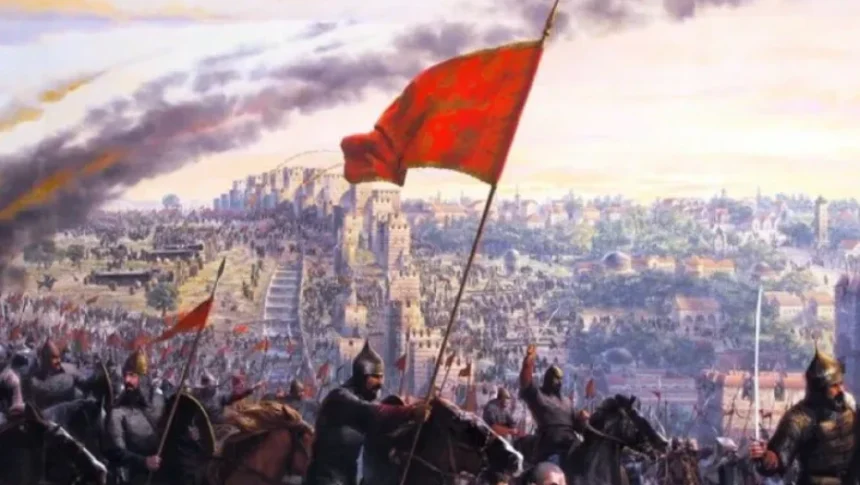
A US congressman’s post about the Fall of Constantinople may seem unexpected at first glance. However, this move was made by one of Donald Trump ‘s most ardent allies in Congress, on the occasion of the anniversary of May 29 , and immediately gained particular resonance both in the diaspora and in circles that follow historical memory in American political life. Republican Congressman Mike Collins chose to honor the last emperor of Byzantium with a painting and a post on social media, revealing his deep admiration for a leader who chose to die fighting rather than surrender.
“On May 29, 1453, Constantinople fell to the Ottoman Turks . After a two-month siege, the city finally fell, marking the end of the Byzantine Empire . The last Byzantine emperor, Constantine XI Palaiologos , was last seen throwing down his imperial insignia and engaging in hand-to-hand combat after breaching the city walls,” Collins wrote, accurately describing a scene that has become a legend in historical memory .
And indeed, the last act of Constantine XI belongs to the most dramatic moments in world history. On that morning of May 29, 1453, when the walls that had withstood centuries finally gave way under the onslaught of Sultan Mehmed II , the emperor cast off the symbols of his valor and plunged into battle anonymously, like a common soldier. His body was never found with certainty, and this inability to provide definitive proof fueled a legend that survives to this day: that the last emperor did not die, but was transformed into marble and will return. For the Greek collective memory , May 29 remains one of the most deeply charged anniversaries — a day of mourning but also of heroism, inextricably linked to the collective sense of identity and historical continuity.
Collins is no stranger to American politics. He has represented Georgia ’s 10th congressional district in the House of Representatives since January 2023 and is a member of the Freedom Caucus , the radical conservative group that is the core of the MAGA movement in Congress. From the very first months of his term, he has built his political identity around his unwavering support for the “ America First ” agenda and his full alignment with Trump. In his private life, Collins is a co-owner of a transportation company, a context that has allowed him to cultivate the image of a businessman-politician who speaks the language of the working class — a trait that is particularly useful in Georgia’s rural and conservative communities . GovTrack.us Factually
The choice to post a painting about the Fall is not accidental and in the context of the current political situation for him. Collins abandoned his candidacy for re-election to the House of Representatives in order to run for the Georgia Senate , claiming the seat held by Democrat Jon Ossoff . With the general election expected in November, he is awaiting a crucial second round of primaries . In this context, he has hired top Trump advisers to strengthen his electoral mechanism, a sign that he is seeking the open and official guarantee of the presidential camp. Club for Growth
The choice of this specific date and topic for a public post opens a broader window of understanding. In American politics, historical memory is not usually expressed through references to the Byzantine Empire , Constantine Palaiologos, or the events of the 15th century. The fact that a Republican congressman, especially one with such strong commitments to the MAGA environment , chose to make this particular post cannot be analyzed solely as a matter of historical interest. It is related to the symbolic dimension that the legend of Constantine carries: a leader who refused to flee, who sank the symbols of power, and remained until the end — a narrative of sacrifice and resistance that transcends national borders and touches on broader political archetypes.
The Greek-American community is following such moves by American politicians with interest. For expatriates living in constituencies like Georgia — a state with a significant Greek presence through the Archdiocese and various associations — the anniversary of the Fall has a deeply emotional charge. Posts like Collins’s also function as intercultural bridges , signs of recognition of a historical tragedy that, for many Greeks around the world, remains an open wound.
It is worth noting that May 29, 2026, carries heightened symbolic weight beyond the American political environment. On the same day, Greece celebrates legal victories — such as the definitive cancellation of the “Turkaegean” trademark — that some Greek officials have explicitly linked to the anniversary of the Fall , highlighting the continuity of the way in which Greek political identity negotiates with history. Congressman Collins, whether by design or by coincidence, chose to participate in this narrative in his own way — by paying tribute to an emperor who, 571 years later , continues to inspire.