

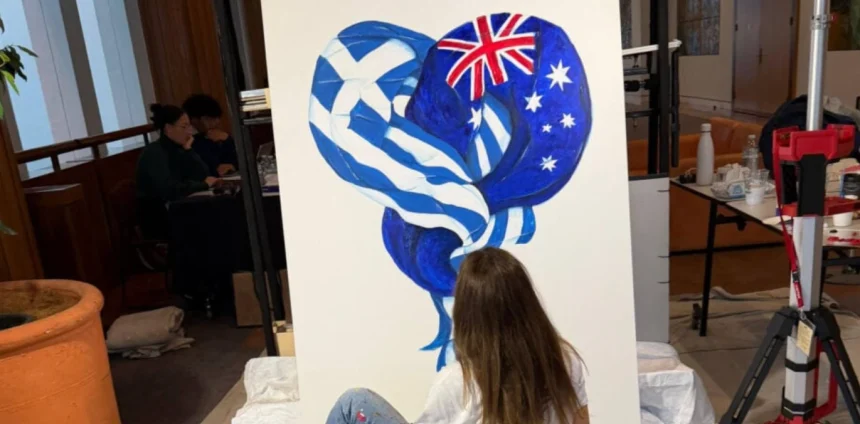
There are moments in cultural diplomacy that transcend formal declarations and directly touch the emotional core of a relationship. One such moment occurred inside the Australian Parliament , when Greek artist Caroline Rovithi began creating a living work of art in front of an audience in the iconic Mural Hall. An act that, beyond its artistic value, constitutes a historic milestone in the course of relations between Greece and Australia.
The initiative was carried out with the support of the Embassy of Greece in Australia and under the auspices of the Honorary Consul General of Greece in Queensland, George D. Mastrocostas . The Mural Hall — one of the most symbolically charged spaces of the Australian Parliament — welcomed politicians, diplomatic representatives and personalities of the Greek-Australian community in an event that moved towards the inseparable combination of culture and diplomacy .
The work is titled “Eternal Weave” and Rovithi began painting it inside Parliament before continuing its completion in her studio . The composition addresses themes of immigration , a sense of belonging , dual identity and the shared future of the peoples of Greece and Australia. At its center, the flags of the two countries are intertwined, emerging from an elaborate braid and ending in the shape of a floating heart . The upward movement of the intertwined flags symbolizes hope, continuity and the constant evolution of the Greek diaspora in Australia. The braid refers to the generations of Greek immigrants who arrived in Australia, carrying traditions, language and values, while the heart expresses the idea that the artist herself condenses into five words: “Two Homelands , One Heart”.
Rovithi described the experience as one of the most moving moments of her career. “When I arrived in Australia, I was moved by how much the Greek spirit remains alive here through families, stories and generations of people who continue to honor their heritage,” she said. “Creating a work inside the Australian Parliament and leaving a piece of Greece within these walls is one of the greatest honors of my artistic journey. The bond between Greece and Australia is built through history, migration, family and shared values,” she added.
On the side of official Greece, Ambassador Stavros Venizelos emphasized that the work uniquely captures the emotional bond between the two countries. “Art has always been one of the most powerful ways in which Greece expresses its identity, memory and humanity ,” he said.
But who is Caroline Rovithi? She is a conceptual and visual artist based in Athens. Born in Germany with Greek-German citizenship , she studied graphic design and advertising and began a full-time artistic career in 2002 , after previously working as a creative director in advertising and publishing environments. Her work spans paintings, illustrations, collages, sculptures and installations, drawing on the aesthetics of the 1970s and 1980s, pop culture and contemporary Greek identity. Her flagship project “All You Need is Greece” , under the auspices of the Hellenic Tourism Organization (EOT) , includes a book, short films and live artworks , including one on Mount Olympus and one inside the church of Agios Nikolaos at Ground Zero in New York — choices that reveal an artist who is not afraid of symbolically charged contexts .
Her presence in Australia is part of a significant exhibition tour that was carefully chosen in terms of both timing and audience. Rovithi made her Australian debut in Brisbane , as part of the celebrations of the 50th anniversary of Paniyiri — Australia’s oldest Greek festival. From there, the “Two Homelands, One Heart” tour continued to Canberra, where the historic moment took place at Parliament House, followed by Sydney and Melbourne — a route that maps the very geography of the Greek-Australian community in the country’s major urban centers.
The choice of the Mural Hall is not accidental. This particular space, with its strong visual presence and institutional weight in the Australian Parliament, functions as a multiplier of the message: Greek artistic expression does not enter as a parenthesis but as an equal presence in a space of state and national importance. Deep down, this movement touches on something deeper: the Greek-Australian community — one of the largest Greek diasporas worldwide, with dozens of generations of presence — is not content with simple remembrance. It wishes to leave an imprint on the common future of two countries that, although separated by thousands of kilometers, share common roots in hundreds of families.
“Eternal Weave” is, in this sense, the most apt title for a work that encompasses not only colors and forms, but a living history of people .