
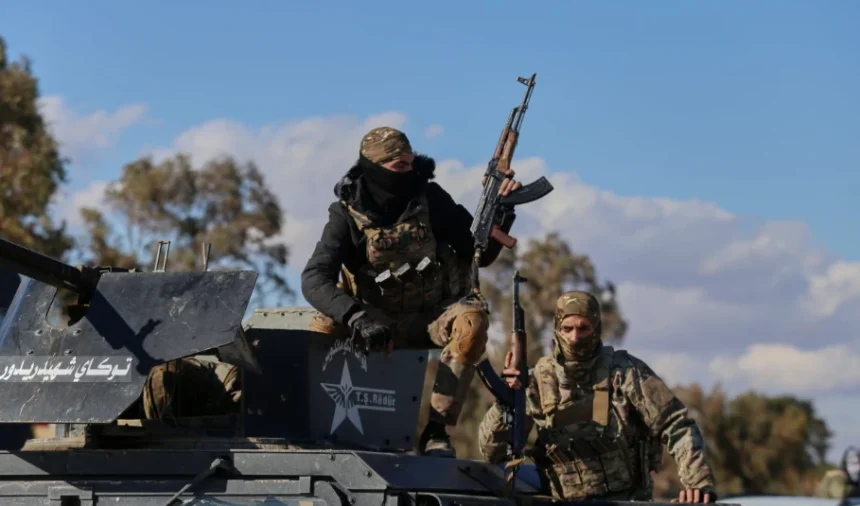
To the already explosive backdrop of the American-Israeli strikes against Iran, a new land front from the Kurdish factor is being added. According to information coming from circles within the Coalition of Political Forces of Kurdistan of Iran (CPFIK) , thousands of Kurdish fighters from organizations operating in Iraqi Kurdistan have crossed the border and launched operations inside Iranian territory , opening a new, particularly dangerous front for the regime in Tehran.
According to the same official, forces of the Kurdish Free Life Party (PJAK) crossed the border at midnight on March 2 , moving towards the mountainous areas around Marivan , on the western side of Iran. The Kurdish units reportedly took advantage of the area’s rugged terrain and set up fighting positions in the Zagros mountain ranges, creating a natural bridgehead for operations against Iranian security forces.
The same sources claim that Iranian forces temporarily withdrew from Marivan on March 3 , in order to reorganize defensive lines around the city and prepare for possible clashes. At the same time, there is talk of thousands of PJAK fighters who have already deployed deeper into the mountainous regions of the western country, using the geography of the region as a natural shield against Iranian military operations.
PJAK , considered one of the main Kurdish armed organizations operating inside Iran, has two main military structures: the YRK (Eastern Kurdistan Protection Units) and the HPJ (Women’s Protection Forces) . These structures are organized on the model of the Kurdish armed forces operating in Syria, which gives PJAK significant experience in urban guerrilla and mountain operations .
At the same time, i24NEWS producer Yulia Pompegailova, citing an Iranian Kurdish official, reported that Kurdish forces stationed in Iraq have launched a ground operation inside Iranian territory , with “thousands of fighters” already deploying combat positions since Monday, March 2.
This mobilization comes at a time when Washington appears to be seriously considering the role of Kurdish organizations as potential allies in pressuring the Iranian regime . According to a CNN report, the CIA is reportedly exploring scenarios of arming Kurdish groups , with the aim of strengthening a possible internal uprising in Iran.
At the same time, the Wall Street Journal reports that Donald Trump ‘s administration appears open to the idea of supporting armed organizations that could challenge Tehran’s authority from within the country.
According to information also reported by Axios , the American president recently had contact with Kurdish leaders in Iraq , regarding developments in the war between Israel and Iran and possible American policy options in the region.
The CPFIK official claims that most Kurdish organizations in Eastern Kurdistan appear willing to cooperate openly with the United States and Israel , as long as this leads to the weakening of the Iranian regime.
In addition to PJAK, other organizations are also said to be playing an active role, such as the Kurdish Democratic Party of Iran (KDPI) , various Komala factions, and the Kurdistan Freedom Party (PAK) . Although their forces are estimated at a few hundred fighters , several of them have significant combat experience from the conflicts against the Islamic State in Iraq and Syria , which enhances their operational value.
According to the same official, there are currently a few thousand trained militants in Eastern Kurdistan , who could be armed by the United States and Israel if there is a political decision for such a strategy.
The geopolitical narrative promoted by Kurdish circles presents Iran as a multi-ethnic state , in which Kurds, Baluchis, Azeris, Turkmens, and Arabs coexist. According to the same approach, a significant weakening of Tehran could pave the way for greater autonomy or even independence for these communities.
Within this context, the idea of a future Kurdish state is also being put forward, which could function as a strategic corridor connecting the Persian Gulf with Israel , creating new geopolitical balances in the Middle East.
The same official even claims that Kurds and Israelis are “natural allies” , emphasizing that these are two peoples who have experienced state uncertainty and the search for national identity for decades.
However, despite the dramatic nature of this information, it should be noted that there is so far no independent confirmation of the scale of the Kurdish mobilization. Neither the White House nor Israel have publicly confirmed plans to arm Kurdish organizations inside Iran.
However, if these reports are confirmed, the conflict could turn into a multi-front war with internal uprisings and external military operations , which would dramatically change the geopolitical map of the Middle East.
In a region already fraught with US-Israeli attacks on Tehran and Iranian threats of retaliation , the emergence of a Kurdish ground front inside Iran could be the most dangerous development yet for the regime of the mullahs in Tehran.