
Donald Trump is returning to the Iran front in his most direct manner yet. In a lengthy post on Truth Social, the US president doesn’t just outline a course of negotiations, but essentially dictates the terms of a deal to Tehran.
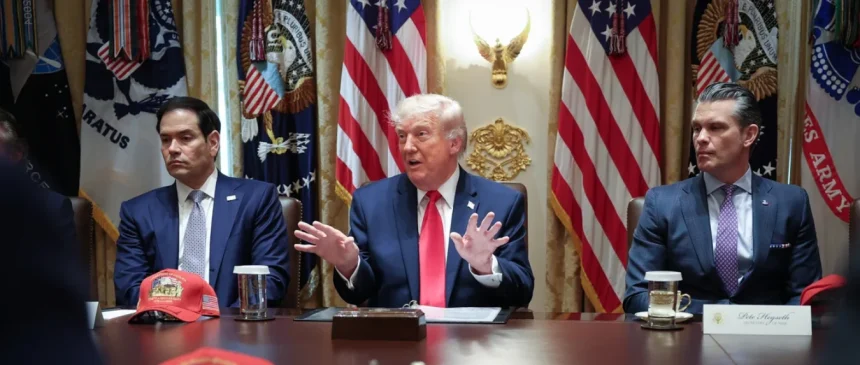
Two issues dominate his text and serve as the hard core of Washington’s demands: the opening of the Strait of Hormuz and the enriched uranium that, according to him, remains buried in underground Iranian facilities. At the end of his post, Trump announces that he will meet with his close associates in the Situation Room to make his final decision , giving the whole undertaking a tone of imminent criticality.
The first and most charged point concerns navigation. Trump calls for the Strait of Hormuz to be opened immediately, without tolls in both directions , so that ships can pass through without hindrance. In the same context, he refers to the sea mines that, as he claims, have been placed in the area. He claims that American forces have already neutralized many of them through controlled explosions with the help of specialized mine-sweeping equipment and adds, in his characteristic way, that “there are not many left.” Tehran, according to the post, is called upon to complete the removal or neutralization of any mines that may remain.
Related to the above is the issue of commercial ships that, as Trump describes, have remained stranded due to a naval blockade that, he says, will be lifted. In one of the most personal passages of the post, he addresses the crews directly, telling them that they can begin the process of returning to their families and sending greetings to spouses, parents and relatives. This style, which alternates between tough diplomatic demands and popular, almost theatrical appeal, is a constant feature of his communication tactics.
Above all, however, the American president sets the basic red line right from the start: Iran will never acquire a nuclear weapon . This is Washington’s long-standing position, which Trump reiterates here in an unequivocal manner. As for the already enriched material, the post introduces a particularly bold image. Trump sometimes calls it “nuclear dust” and claims that it is buried deep underground, almost under mountains that, as he says, collapsed after the attack by American B-2 bombers eleven months ago. This material, he says, will be retrieved by the United States and then destroyed under the supervision of the International Atomic Energy Agency (IAEA), in coordination with the Iranian side itself.
At this point, the post includes an unexpected detail. Trump claims that the US is the only country, along with China, that has the mechanical capability to retrieve the buried material. The reference to Beijing, without further explanation of the role it could play, is strange and leaves several questions, as China does not appear anywhere else in the text as part of the process.
Two more points close the list of American positions. First, Trump makes it clear that there will be no exchange of money “until further notice,” putting aside for now the sensitive issue of unfreezing Iranian funds. Second, he suggests that a number of smaller issues have already been agreed upon , without going into detail. Overall, the post reads less as an announcement of a deal and more as a public statement of terms just before a crucial internal meeting.
The reaction from Tehran was not long in coming. According to what was reported by the Iranian Fars agency, the Iranian side claims that Trump is distorting the terms of the agreement under development. Iran specifically states that the American president presented as a given Tehran’s commitment to open the Strait of Hormuz without tolls and to destroy its enriched uranium, while, as it claims, neither of these two points is included in the actual text of the talks. This is, in other words, a direct challenge to the image that Washington is trying to project.
Beyond the denial, the Iranian side is also setting its own conditions. It is asking the US to immediately release twelve billion dollars in Iranian assets as a condition for the talks to proceed, which is in direct contradiction to Trump’s statement that no money is expected to be exchanged. At the same time, Tehran is demanding a complete ceasefire in Lebanon on terms reportedly set by Hezbollah, thus broadening the scope of the negotiation beyond the narrow nuclear and maritime issues.
The same agency, citing sources with knowledge of the talks, describes the agreement as a matter still pending final approval within Iran. The same sources characterize Trump’s statements as a mixture of truth and inaccuracy and interpret them as an attempt by the American president to prematurely show a victory, before anything on the substance is finalized.
The picture that emerges, therefore, is that of a negotiation that is taking place equally at the negotiating tables and in the public sphere . On the one hand, Washington presents a list of demands as almost a fait accompli and addresses public opinion directly through social networks. On the other hand, Tehran attempts to refute this narrative and bring its own demands back to the fore. The importance of the Strait of Hormuz adds an additional layer of tension, as a large part of the world’s oil is transported through this passage, which turns any development into an issue with international economic implications .
With the Operations Room meeting announced and both sides presenting diametrically opposed versions, the coming period is expected to prove decisive. Whether the claims of an agreement are confirmed or denied will be seen not only by the official announcements but also by whether the Straits will remain open and secure. Until then, the only certainty is that the gap between what Washington says and what Tehran admits remains wide , and that any further move will be read carefully in both capitals.