

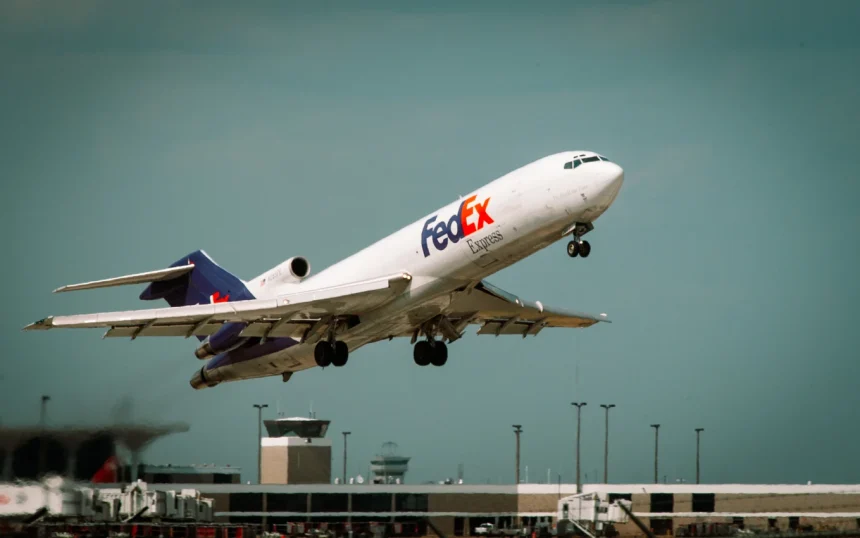
A worrying danger signal for the local economy and the strategic position of Thessaloniki is being emitted by productive actors, seeing the “Macedonia” airport gradually being deforested of critical international services.
After the noise and consequences brought by Ryanair ‘s withdrawal, the Northern Greek market is now called upon to manage a new, perhaps quieter but equally heavy blow: the definitive withdrawal of the multinational FedEx , one of the largest freight transport companies in the world, from the airport’s facilities.
This unpleasant development was brought to light by the president of the Thessaloniki Customs Brokers Association, Giorgos Kosmidis , during a critical meeting of tourism and market stakeholders convened by the Thessaloniki Chamber of Commerce , casting shadows on the narrative that wants the city to become a key logistics center for the Balkans.
The company’s decision to “lock down” the duty-free goods service office is, according to Mr. Kosmidis, an irreversible move. However, beyond the obvious reduction in airport services, this move is expected to create a chain reaction with the local community and entrepreneurship as direct recipients.
At the first level, it causes a huge loss of income for more than 500 customs agents operating in Thessaloniki, professionals who see their turnover shrink violently from one day to the next, which inevitably translates into job losses in the broader sector.
However, the problem does not stop at the narrow confines of customs agents. The disruption of this vital supply channel means that logistics are hampered, delivery times may change and, most importantly, transportation costs may skyrocket.
Companies in Northern Greece, struggling to survive in an already inflationary and stressful environment, will find themselves faced with a significant increase in their production costs . This condition brings about inevitable increases in the final prices of goods , which the ordinary consumer will be called upon to pay at the end of the day, creating a new cycle of precision in the local market.
The deepest trauma, however, from this development is the overall decline in the region’s competitiveness . The flight of multinational giants from basic infrastructure, combined with the degradation of the quality of services provided , creates a feeling of introversion.
As Mr. Kosmidis emphasized characteristically and with obvious bitterness in his statements to APE-MPE: “I do not judge the business move of a company, I judge the devaluation of Thessaloniki .” A phrase that encompasses the anguish of an entire city, which sees its development prospects impinging on business withdrawals that are slowly cutting it off from large, international trade networks.

