
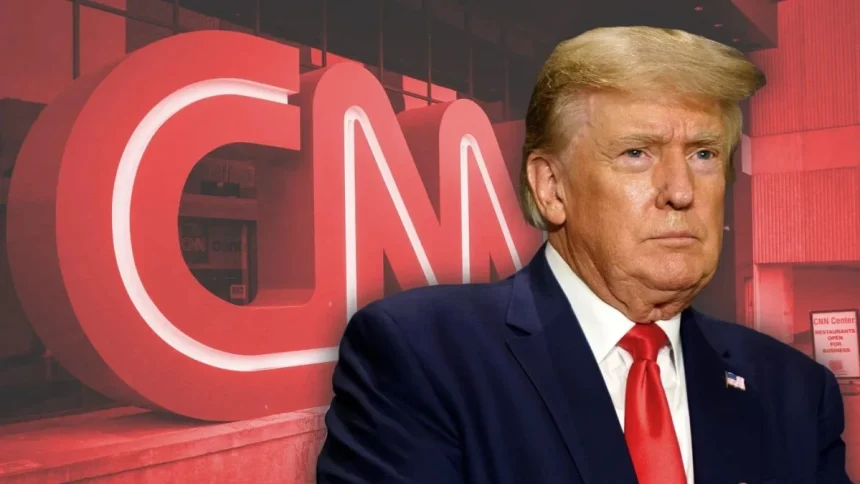
A few hours after he ended his Situation Room meeting without announcing a “final decision,” President Donald Trump opened a new front — this time against a television network. Through a post on the Truth Social platform, the American president rejected a CNN report on the draft agreement with Iran, accusing the network of misrepresenting its content. The goal was twofold: to correct — in his view — the impression created about the agreement, and at the same time to attack CNN on the basis of his doubts about the network’s course under the current ownership regime . The reason was specific. CNN reported that the draft agreement does not include any references to Tehran’s nuclear program — information that, if true, would amount to Washington’s acceptance that the nuclear issue is being referred to future negotiations, with no binding provisions in the current text. Trump directly refuted this version: as he argued, the draft explicitly makes it clear that Iran will not acquire nuclear weapons , while adding that a large part of the text is devoted to issues related to the nuclear program. The problem is that the truth about what exactly the draft contains remains disputed by many sides at the same time . The Iranian Fars news agency, in an immediate reaction to Trump’s statements, claimed that the draft agreement “does not contain any reference to the dismantling or destruction of nuclear materials,” while adding that “the most important part of the agreement” is “the immediate payment of $12 billion from frozen Iranian assets.” Tehran and Washington appear to be, in essence, negotiating different versions of the same text — or at least publicly presenting different versions. This “clash of perceptions” is also reflected in the internal data of the negotiations. According to American sources, the United States is asking Iran to suspend its nuclear program for a specified period — American officials seem to be seeking at least ten years — and to hand over its existing stockpile of approximately 440 kilograms of enriched uranium . For Tehran, this concession is an existential matter of national security and domestic policy — something that cannot be agreed upon in advance, without seeing the immediate cost. “They will not give him concessions at the beginning of the deal because they do not trust him,” said Sanam Vakil , director of the Middle East Program at Chatham House , adding that the Iranians have been “personally burned” by Trump — referring to the US withdrawal from the 2018 JCPOA. In the background, the picture that emerges is that of Trump driven by a simultaneous domestic agenda and international pressure. The rise in fuel prices since the start of the war has cost American consumers, according to a Brown University study, $37 billion in gasoline and diesel — a political burden that Trump himself cannot ignore, especially given the political climate. At the same time, the president has become increasingly impatient with the way Iranian negotiators are operating. “Look, I’ve dealt with them four or five times — they change their minds. They’re very dishonest people, the leadership,” Trump said from the Oval Office, expressing frustration with a process in which, in his own description, the parties come close to an agreement and then the Iranian approach takes everything back to square one. The ceasefire, in this tense negotiating atmosphere, appears to be creaking. Trump has described the truce with Iran as being under “massive life support,” in a phrase that captures the uncertainty about whether and how long it can last. The mutual accusations of violations — with the Revolutionary Guards striking a US base in Kuwait and CENTCOM calling the move a “flagrant violation” — create a climate in which the words “ceasefire” and “stability” sound increasingly out of touch with reality. Trump’s reaction to CNN is, after all, part of this whole. The communication management of such a complex negotiation — with conflicting information from American, Iranian and journalistic sources — is in itself a difficult undertaking. Any “leak” or interpretation of the content of the draft text affects the domestic politics of both sides, the mood of public opinion and the tough negotiating position that each is trying to maintain.
Trump vs. CNN on Iran deal: "They will never get nuclear weapons"
There are no comments