

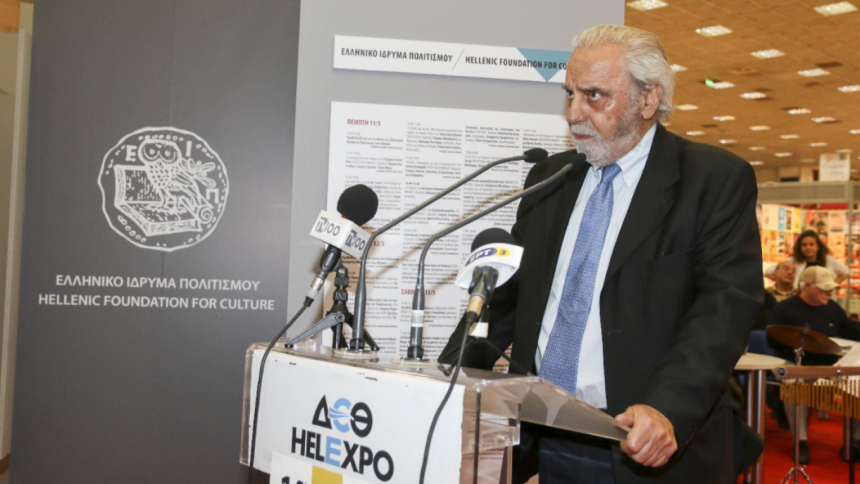
The Greek intellectual and academic community is poorer today, as Konstantinos Tsoukalas , one of the most important and influential sociologists, academics and thinkers of modern Greece, passed away at the age of 89. His civil funeral and cremation are scheduled to take place on Wednesday at the Ritsona crematorium , closing a rich life dedicated to a deep understanding of Greek society, institutions and modernity.
Born in Athens in 1937 , Konstantinos Tsoukalas came from a family with deep roots in the legal sciences and public affairs of the country. He was the grandson of the distinguished professor of Criminal Law at the Athens Law School, Konstantinos Tsoukalas, and the son of Angelos Tsoukalas , a well-known lawyer and politician who had served as a member of parliament for Athens with the Liberal Party, mayor of Athens with the support of the EDA, and Minister of Justice during the dictatorship (1970-1973). Within this intensely politicized and legal environment, he chose to chart an autonomous, radical and internationally recognized path in the field of social analysis.
His scientific background was multidimensional and of international prestige. After graduating from the Law School of the University of Athens , he pursued postgraduate studies in Philosophy of Law and Sociology at leading academic institutions abroad, such as the Universities of Heidelberg , Munich , Paris and Yale . In 1974, he was awarded a Doctorate in Letters and Humanities at the University of Paris. His first professional steps included practicing law in Athens (1961-1968), while at the same time he began his research work at the Athens Center for Social Research and at the emblematic French National Center for Scientific Research (CNRS) .
His academic career was exemplary and left its mark. From 1968 to 1985 he taught as a full professor of Sociology at the University of Paris , contributing decisively to the European dialogue of the time. In 1985 he returned to Greece academically as a full professor at the Department of Political Science of the University of Athens , shaping generations of new scientists. At the same time, he inextricably linked his name with the institutional upgrading of research in the country, serving as scientific director (1981-1989) and later as chairman of the Board of Directors (1993-1996) of the National Center for Social Research (EKKE) . He also served as president of the Association of Greek Sociologists , a member of the Supreme Council for Research and Technology, and taught as a visiting professor at universities in the USA, France, and Mexico.
Beyond the university auditoriums, Konstantinos Tsoukalas assumed crucial responsibilities in the public and cultural sphere. He led the Greek delegation to the UN Summit on Social Development (1994-1996), was president of the National Museum of Contemporary Art (EMST) , a member of the Board of Directors of the Foundation for Hellenic Culture , a member of the Cultural Olympiad and the research council of the Olympic Museum of Lausanne. For over a decade, from 2000 to 2014, he offered his services as a regular member of the National Bioethics Committee . In 2025, his many years of invaluable contribution were sealed with the top honor of his election as a regular member of the Academy of Athens .
The death of Konstantinos Tsoukalas leaves an irreplaceable void in the public sphere. Through his rich writings, his insightful critical thinking and his penetrating insight into the pathologies and mutations of Greek society, he bequeaths an invaluable legacy of ideas that will continue to inspire and fuel scientific and political dialogue for many decades.

