

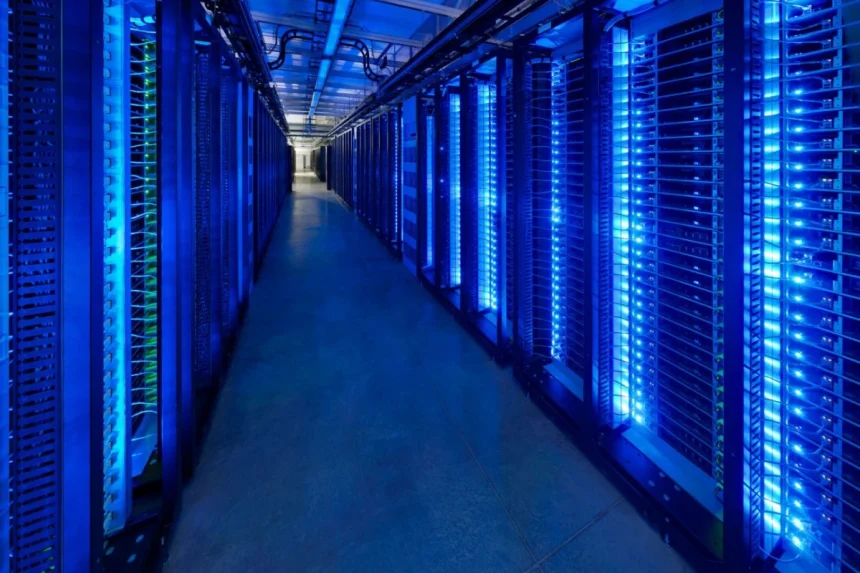
“DAIDALOS”, the new national supercomputer of Greece, is in the final testing phase before its final installation at the Lavrio Technological Cultural Park of the National Technical University of Athens (NTUA). Its transfer to Greece is scheduled for the summer of 2026, while its full operational operation is expected in the autumn of the same year.
The system has already been assembled at HPE’s facilities in the Czech Republic and is undergoing extensive technical testing to ensure its stability and performance under real-world workload conditions before being installed in Lavrio.
Next-generation supercomputing power
“DAIDALOS” is a complex infrastructure of highly energy-efficient water-cooled cabinets and incorporates more than 2,000 NVIDIA Grace Hopper (GH200) superchips, designed for demanding artificial intelligence applications and large-scale computational models.
According to measurements so far, its computing power is expected to exceed 89 quadrillion floating-point operations per second (89 PFLOPS in double precision). This is a performance that exceeds the capabilities of a typical professional or home computer by millions of times, allowing complex simulations and analyses to be completed in hours or days instead of weeks or months.
Its installation marks the first time that such a powerful computing system will be hosted in Greece, placing NTUA and Lavrio on the map of Europe’s top regional computing hubs.
The core of the AI Factory “Pharos”
“DAIDALOS” will be the “heart” of the AI Factory “Pharos”, an integrated ecosystem of services that will provide:
- Computing power in universities, research centers, startups and public institutions
- Support in data management and anonymization
- Creating AI-ready datasets
- Defined access and compliance frameworks
- Technical and scientific guidance
Pharos’ goal is to make supercomputing infrastructure accessible to a wide range of users, reducing the cost of developing artificial intelligence applications and accelerating the cycle from idea to working prototype.
Impact on economy, research and public sector
For Greek startups and SMEs, access to national supercomputing infrastructure reduces dependence on expensive commercial cloud services abroad. At the same time, it accelerates the training and optimization of artificial intelligence models in areas such as:
- Health
- Energy
- Environment
- Public services
- Processing of Greek language and cultural heritage
In the public sector, infrastructure utilization can enhance crisis management, energy network optimization, and big data analysis for strategic planning.
Funding and European dimension
The project is implemented under the auspices of GRNET and is financed in two phases:
- Phase A: 29.2 million euros (including VAT), through the Recovery Fund and Public Investment Program
- Phase B: up to €12.68 million (excluding VAT), through the EuroHPC Joint Undertaking
“DAIDALOS” is part of a wider European network of AI Factories and computing hubs, strengthening Greece’s position as a regional technology hub in Southeastern Europe.
Challenges and conditions for success
The operation of such a system entails increased energy requirements and the need for reliable cooling and power infrastructure. At the same time, a critical success factor is investment in human resources, proper data governance and fair access mechanisms.
The long-term sustainability of the venture will depend on the ability to attract partnerships, the creation of high value-added services and the continued integration of the infrastructure into the European technology ecosystem.
“DAIDALOS” aspires to be not just a supercomputer, but a strategic pillar of digital dominance and innovation for the country.