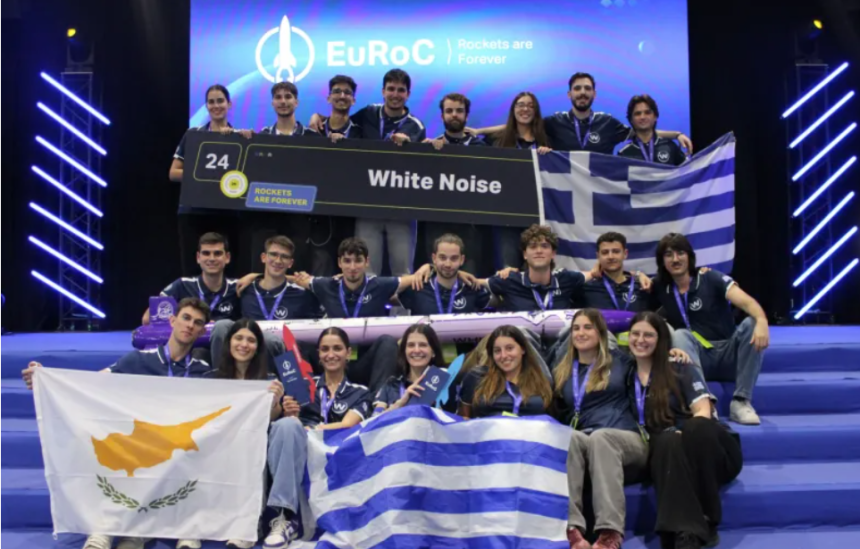
With a successful launch, two awards and sixth place in the overall standings , the White Noise NTUA student team of the National Technical University of Athens completed its participation in the European Rocketry Challenge, EuRoC 2026 , in Portugal. The Aurora research rocket, the result of months of work by undergraduate students from different specialties, went from the design and testing stage to actual flight, carrying a scientific experiment for the study of microparticles in the atmosphere.
The Greek team won the “Rookie of the Year” award, as the best debutant team, and the “Payload Award” for its research payload. The two awards were confirmed by the Portuguese Space Agency , the organizer of the competition. This year’s competition included a separate category for newcomers for the first time, offering space to new entries in a demanding technical evaluation environment.
Aurora is a solid-propellant rocket, about three meters high, with a design goal of reaching an altitude of 3,000 meters . The students took charge of its development from the initial design to construction, testing and launch. The success in Portugal sealed this course, during which different technical specialties had to work together to operate an integrated system.
A significant part of the work involved the flight electronics and telemetry systems , which were developed by the team itself. At the same time, the rocket was equipped with an active aerodynamic braking system, the so-called airbrakes , to control the maximum flight altitude. According to the official presentation of the project, the system adjusts its operation using data from the flight computer, aiming to more accurately approach the desired altitude.
The recovery system holds a special place in the design. As the team describes, it includes four movable carbon fiber covers , known as fairings, which open at maximum flight altitude and allow the deployment of parachutes. This particular arrangement was one of the students’ characteristic choices, integrating the rocket’s return process into the overall design of the vehicle.
Aurora’s interest extends to the scientific mission it was designed to support. White Noise built a research payload to study airborne microparticles , with a particular focus on the detection and characterization of microplastics . The mission thus linked aerospace systems development to an environmental research question.
The experimental setup combines environmental measurement sensors with digital holographic microscopy , known internationally as Digital Holographic Microscopy, DHM . According to the experiment description, the technology is used for the optical recording of microscopic particles. The design also includes the use of machine learning algorithms for their recognition and classification.
During the flight, the payload collected data on environmental conditions and microparticle concentrations , creating material for further processing and study. The Payload Award recognizes the research proposal and its implementation. The results of the data collection form the basis for the continuation of the experiment, without a comprehensive conclusion on the presence or composition of microplastics being announced in the available material.
The sixth place in the overall ranking completes the picture of a successful first appearance of the team in this competition. The double award highlighted both the overall effort of the first-time participant and the scientific object carried by the rocket.
The size of the event adds weight to the result. The seventh edition of EuRoC concluded on October 21 in Constanta , bringing together around 700 students from universities in 13 countries . In four days of launches, 12 rockets took off from the Santa Margarita military field, where the teams tested the systems they had developed in practice.
White Noise NTUA was founded in 2017 and is active in the design and development of aerospace systems. The award for the best debut team refers to its presence in the competition, while it already has a long history as a student initiative. Its composition includes undergraduate students of different specialties, who transfer their knowledge to joint technical projects.
In the construction of Aurora, the team acknowledges the significant support of the School of Mechanical Engineering of the NTUA and the Machine Elements Laboratory , under the direction of Professor Vasilios Spitas . This collaboration integrates the student effort into the university environment that supports it, offering a connection between education, laboratory work and applied research.
Behind the distinctions lies the experience of a team that had to transform designs and calculations into construction, combine subsystems and test them in real conditions. The Aurora flight gave the students a measurable result of their work and research data for the next stage. The two European awards add recognition to this effort, highlighting the potential of Greek university engineering and student collaboration .