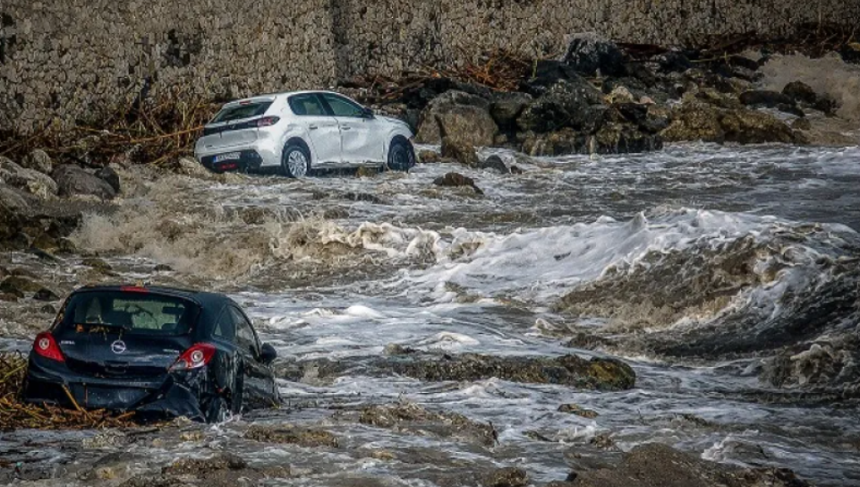
The severe bad weather that is hitting Rhodes had a tragic ending , as a 62-year-old man lost his life in the Stegna area of Archangelos, when, according to initial information, he was swept away by the rushing waters of a torrent in his attempt to protect his car. The vehicle ended up in the sea, while the man was recovered dead by Coast Guard officers.
The incident occurred on Wednesday, October 14, when heavy rainfall had caused widespread flooding in many areas of the island. According to available information, the 62-year-old, who was originally from Veria and worked at a hotel unit in the area, noticed that the water level in the nearby stream was rising dangerously and attempted to move his car.
During this attempt, he was reportedly surprised by the force of the water, resulting in him being swept away. The exact circumstances of the accident are being investigated by the competent authorities. It is clarified that the man was not on his way to or from work , but had attempted to move the vehicle away from the point where it was located.
The Coast Guard, Fire Department and Hellenic Police forces were mobilized in the area, with the participation of nine firefighters and three vehicles. A high-speed boat of the Fire Department, which was operating near the coastline, also assisted in the searches.
The death of the 62-year-old is the most serious consequence of a wave of bad weather that caused extensive damage in Rhodes and significant problems in other areas of the country, mainly in Evia, Skiathos and eastern mainland Greece .
In Rhodes, torrential rains turned roads into torrents, swept away vehicles, caused landslides and imposed traffic disruptions. The situation was particularly difficult in the areas of Ialyssos, Afantou, Faliraki and Archangelos , where water covered parts of the road network and dozens of cars were immobilized.
According to the meteorological information, until the early hours of the morning, approximately 218 millimeters of rain had been recorded in Rhodes, an amount that explains the intensity of the flooding phenomena. The large concentration of water within a limited period of time burdened the streams and the drainage network, creating dangerous conditions both in residential areas and on the provincial road network.
In Archangelos , authorities were forced to stop traffic on the road to Malona , in the Aithonas area, when a large rock broke loose and landed on the road, causing damage to the road and the protective parapets. The bridge connecting the main road to the settlement was also temporarily closed as a precaution.
In the same area, another car, without occupants, was swept away by torrential waters, while in Stegna the appearance of a double water turbine was recorded. No additional damage was reported from this specific phenomenon, however the images captured the intensity of the atmospheric instability that prevailed on the island.
Strong electrical discharges also caused problems. In Ialyssos , lightning caused a fire in a house, without any serious consequences being reported, while another lightning discharge put the electrical system of ERT South Aegean out of operation, temporarily interrupting the station’s broadcast.
The bad weather also significantly affected the functioning of the city. Municipal transport routes were temporarily suspended , including to the port of Akantia and on the Rhodes – Faliraki line, while citizens were urged via 112 to limit their travel to absolutely necessary ones.
A similar appeal was made by the mayor of Rhodes , Alexandros Koliadis , asking residents to avoid unnecessary travel and comply with the instructions of the Civil Protection services.
For security reasons, schools remained closed in Rhodes and Symi , while the operation of municipal sports facilities, the municipal conservatory and municipal workshops was suspended.
From 12:30 noon, it was also decided to suspend the operation of important archaeological sites and museums, including the Acropolis of Lindos, Ancient Kamiros, the Acropolis of Ialysos-Filerimos, the Archaeological Museum of Rhodes and the Palace of the Grand Master . At the same time, the scheduled meeting of the Municipal Council was canceled.
The extent of the problems is also reflected in the data from the Fire Department . By 16:00 on Wednesday, 113 calls had been recorded in Rhodes , with the Fire Department carrying out 64 water pumping operations and 13 people being transported to safe places .
In total, in Attica, Evia and Rhodes , the Fire Department Operations Center had received 204 calls from late Tuesday night to Wednesday afternoon, a fact that demonstrates the geographical extent of the problems.
The situation in Evia is also particularly worrying , where the overflowing of rivers and streams caused extensive flooding, with the authorities proceeding to send successive warning messages via 112.
In the Municipality of Dirfyon – Messapia , the residents of Makrykapa were asked to evacuate to Psachna as a precaution, while later a new message was issued for the Psachna area, with instructions to evacuate to Nea Artaki .
The change in instructions within a short period of time reflects the rapid evolution of flood phenomena, as the rise in water levels created successive problems in different settlements.
In the Mantoudi area, the river overflow resulted in large quantities of water and debris moving towards the road network. Tree trunks were swept away by the rushing waters in the direction from Prokopi to Mantoudi , while a collapse of an auxiliary bridge was also reported in the Kyparissi area, at the “Dead” location.
Civil Protection services remained on heightened alert, as the continued rainfall created the risk of new flooding, even in areas where the intensity of the phenomena had begun to subside.
Significant flooding was also recorded in Skiathos , where main roads turned into torrential torrents. On Papadiamanti Street, one of the island’s best-known streets, the force of the water caused damage to the paving, while two parked cars were swept away .
According to the mayor of Skiathos, the greatest intensity of the phenomena occurred from midnight to two in the morning. The Fire Department had to intervene to rescue a driver , while water was pumped into a hotel facility and a boat.
Residents and visitors to the island had previously received a message from 112, instructing them to limit their movements due to the dangerous weather conditions.
In Attica , the bad weather mainly caused fallen trees, local flooding and traffic problems. The Fire Department received 57 calls , carrying out 40 tree fellings and two water pumping operations .
In Oropos , authorities stopped traffic at two key points, on the Markopoulos beachfront and on the Markopoulo-Malakasa provincial road. In the latter case, the overflow of a stream near the “Phaeton” Museum made the passage of vehicles dangerous.
The Municipality of Oropos called on drivers to use the provided detour routes and not attempt to cross flooded areas, even when the water level appears limited.
At the same time, the flow of water in the Kifissos River increased due to the ongoing rainfall in the northern suburbs and in the areas of Parnitha, Malakassa, Kifisia and Amarousi. According to the available information, the river level remained at safe levels, with the competent services monitoring the development of the phenomenon.
Regarding the further development of the bad weather, meteorological estimates speak of a gradual decline in the intense phenomena , with the main focus shifting towards the Aegean Sea and especially its eastern parts.
However, the weakening of the storms does not mean that the risks are immediately eliminated. In areas where heavy rainfall has already been recorded, river levels may remain elevated, while landslides, debris flows and damage to the road network continue to pose serious problems.
The tragedy in Stegna, Rhodes, highlights in the most painful way the danger posed by flash floods. A stream that does not normally cause concern can, within a few minutes of heavy rainfall, turn into a torrential torrent, capable of sweeping away even vehicles.
The incident highlights the need for early warning, effective surveillance of dangerous points and strict adherence to Civil Protection instructions. The protection of human life must precede any attempt to salvage assets.
At the same time, the extent of the flooding phenomena brings back to the fore the issue of flood protection, stream maintenance, the adequacy of drainage infrastructure and road safety . These are issues that require systematic treatment, beyond emergency interventions every time a severe weather phenomenon occurs.
With one person dead, dozens of rescue and water pumping operations, damaged infrastructure and entire regions on alert, the severe weather of October 14th is leaving behind serious consequences. Repairing the damage and safely returning to normalcy are now the main priorities for local authorities and Civil Protection services.