

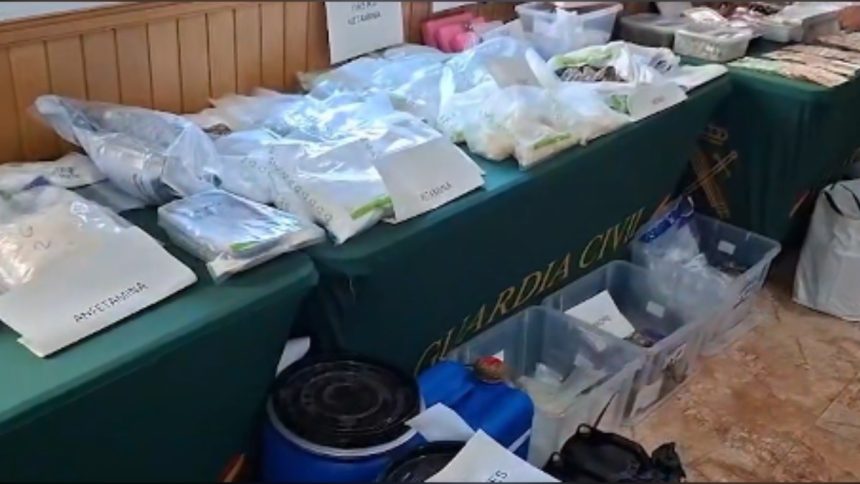
A 100-gram package of drugs seized in Ghana was enough to unravel the tangle. At the other end of the thread was found an extensive international drug trafficking network, which used conventional postal services and courier companies to send packages to more than 45 countries . The circuit was dismantled by the Guardia Civil in Spain.
In a large-scale operation based in the province of Valencia , five Spanish nationals were arrested, while 172.5 kilograms of various drugs, 41 kilograms of chemical ingredients and 26,000 euros in cash were seized. According to the investigation, the organization had carried out more than 1,500 international shipments since 2025, receiving orders through encrypted applications .
The exchange of information with the Ghanaian authorities mobilized the Organized Crime and Drugs Team of the Guardia Civil, which gradually identified the entire chain. The most important finding was a fully equipped laboratory for the manufacture, packaging and storage of drugs, in the areas of La Costera and Canal de Navarre .
The operating model resembles more of an e-commerce company than a traditional chain. Orders arrived via encrypted messaging platforms from customers around the world. Members of the organization then packaged the substances and shipped them via mail and courier, with shipments almost weekly .
The geographical reach is impressive. The parcels reached almost all Spanish provinces and more than 45 countries, including Italy , Hungary , Romania , the United States , Australia , Thailand , Taiwan and Sri Lanka .
During the raids carried out on 9 September at properties in the areas of Anna and Alcudia de Crespins, 116.5 kilos of ketamine , 18.4 kilos of methamphetamine , 6.9 kilos of cocaine , 8.8 kilos of hashish , one kilo of heroin and 20,000 doses of LSD were seized. 20.85 kilos of other substances, 25 kilos of adulterant material and 41 kilos of manufacturing chemicals were also found, as well as precision scales and packaging tools.
The disruption is the result of extensive international cooperation . In Romania and Hungary, pending packages were identified and seized, and a recipient was arrested. Coordination with the Dutch authorities was carried out through Europol , while the assistance of the Spanish postal service Correos was also crucial in identifying and blocking the suspicious shipments.
The five arrested, three men and two women, all Spanish nationals aged between 18 and 44 , were brought before the courts. They were charged with drug trafficking , participation in a criminal organization and identity theft . By court order, the four were remanded in custody, while the fifth was released on bail.
The case highlights a shift that is increasingly worrying law enforcement. Trafficking no longer requires border crossings, carriers or physical encounters. It requires an encrypted app, a lab in a rural area and the exact same distribution network that any legitimate business uses to send a package.