

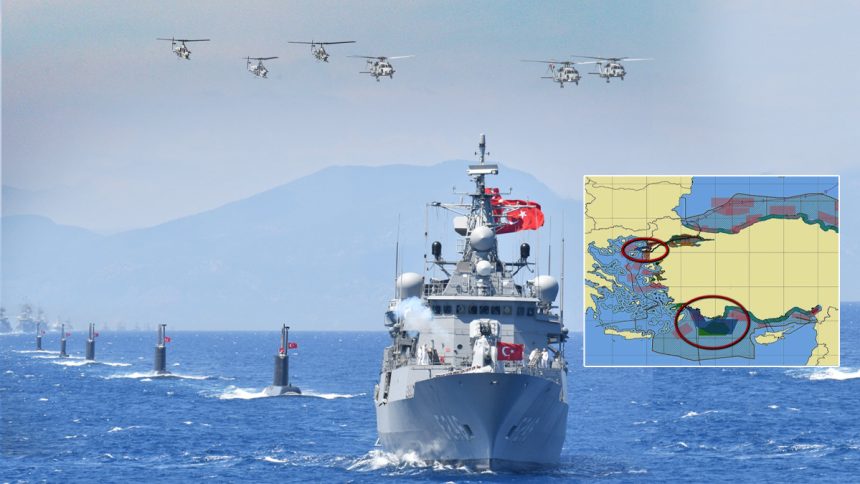
Ankara is triggering a new cycle of tension in Greek-Turkish relations, bringing back to the fore the theory of “gray zones” in the Aegean, on the occasion of the publication of the new Special Spatial Planning Framework for Tourism by the Greek government.
In a lengthy and aggressive statement on Thursday (20/08), the Turkish Ministry of Defense openly disputes Greek sovereignty over islands, islets and rocky islets in the Aegean Sea, claiming that Athens’ spatial plan includes areas “whose sovereignty has not been transferred to Greece by international treaties” .
In the same text, the Turkish side accuses Greece of attempting to create “faits accomplis” in the Aegean through environmental and spatial planning initiatives. It also states that Turkey will not accept “any unilateral action” and demands that planned interventions in the region be preceded by understanding and bilateral dialogue .
The announcement is part of a systematic escalation over the past four days . During this time, Ankara announced its own marine parks and questioned the Greek Spatial Planning Framework for Renewable Energy Sources in the Aegean, transferring the confrontation to areas that were until recently considered technical.
This is not the first time that the Turkish side has exploited issues of spatial planning or environmental protection as a vehicle for projecting claims, since the recent announcement of marine parks followed the same logic.
Athens’ reaction was immediate and categorical . Diplomatic sources clarified that Greece fully exercises its sovereign rights under International Law and the Law of the Sea . As it is emphasized, spatial planning within Greek territory is an exclusively internal and sovereign issue of the country, while the complaints of the Turkish side are characterized as completely unfounded and rejectable in their entirety.
This new phase essentially poses an imperative management question for the Greek side. How will it deal with a Turkish provocation that is no longer limited to military or institutional fields , but extends to every planning initiative that Athens undertakes within its territory?

