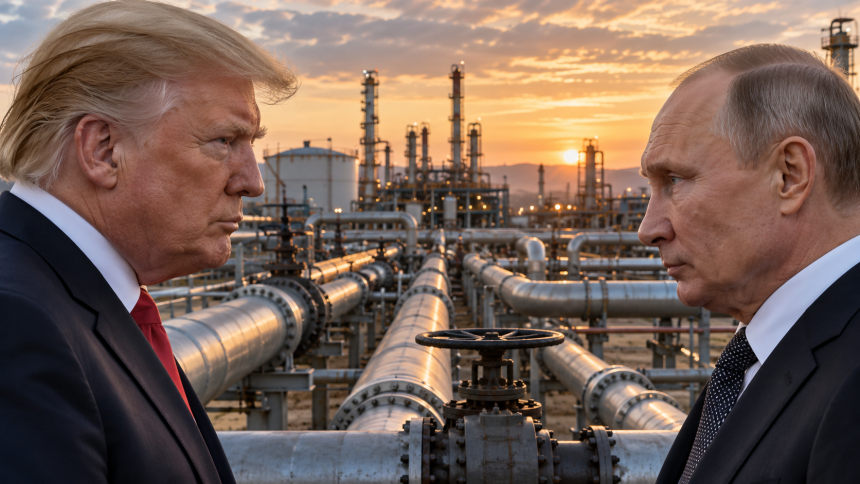
An energy deal that would have seemed unthinkable just a few months ago was announced by Donald Trump after a phone call with Vladimir Putin . Russia, according to the American president, will immediately make large quantities of diesel oil available on the American and global markets, with the aim of stopping the explosive rise in prices. In the first phase, more than 300,000 tons of diesel will be “dropped” on the markets, while much larger deliveries will follow in the coming months.
Trump described the conversation with his Russian counterpart as “very successful” and was quick to share the news with his audience through a post on Truth Social, with the familiar celebratory tone and capital letters that accompany his major announcements.
A timeline in four steps
The deal, as described by the US president, is evolving in successive waves. After the immediate availability of the first 300,000 tons, Moscow will supply the market with another 500,000 tons in November and another million tons “immediately thereafter.”
But the most ambitious part comes at the end. Depending on the state of Russian refineries , Russia could deliver another 3,000,000 tons in a short period of time. If all the quantities mentioned by Trump are implemented, Russian deliveries will exceed 4.8 million tons in total, a volume capable of significantly changing the picture of a market that has been suffocating for months.
The reference to the state of the refineries is not accidental. It is precisely the point that hides the biggest question mark in the agreement.
The market thirsty for diesel
To understand the weight of the announcement, one need only look at prices. Diesel has reached record levels , putting pressure on American farmers, transport companies and ultimately the entire price chain. The crisis has many causes, but the central one is Russia itself, one of the largest producers of petroleum products in the world.
Ukraine’s drone attacks on Russian refineries have knocked out a significant portion of production. Moscow responded in July with a ban on gasoline and diesel exports , which it extended for another six months to secure its domestic market. Analysts estimate that about 800,000 barrels of diesel per day have been lost from the global market.
In recent weeks, Trump has repeatedly called on Volodymyr Zelensky to stop the attacks on Russian diesel facilities, claiming they are causing a global shortage. Today’s announcement seems like the other side of the same strategy, as this time the solution is being sought directly in Moscow.
The Strait of Hormuz in the equation
The US president did not stop with the Russian side. In his post, he linked the agreement to what he described as “complete control” of the Strait of Hormuz , the sea passage through which a large part of the world’s oil passes.
With full control of the Straits and this announcement about Russian energy, Trump wrote, diesel prices for Americans and the entire world will fall at a record pace and very quickly. He added that lower prices, especially for farmers, ranchers and truck drivers , are his top priority. He did not fail to remind, once again, that Iran will never acquire nuclear weapons.
The reference to farmers and truck drivers has clear political overtones. With the midterm elections less than a month away, fuel costs have become one of the most sensitive issues for the White House.
The Kremlin confirms
The response from Moscow was not long in coming. The Kremlin confirmed that Russia is ready to supply oil and oil products to the United States and international markets. Putin, according to the Russian statement, believes that the entry of Russian oil into the American market will have a positive impact on the entire global economy.
The Russian side, however, gave a broader picture of the discussion. The call, it said, focused on the prospects for resolving the crisis in Ukraine , while the issue of Iran was also on the table. In other words, diesel may have dominated Trump’s post, but it was only one part of a much larger negotiation.
The questions behind the numbers
The announcement immediately raises reasonable questions. The first concerns sanctions . Washington still maintains restrictive measures against the Russian energy sector, while a bill for even stricter sanctions against Moscow is being promoted in Congress. How all this will be combined with the entry of Russian diesel into the American market has not yet been clarified.
The second question is practical. Russia has banned fuel exports precisely because its refineries are not fully sufficient even for domestic consumption. The clause on the condition of the facilities, which accompanies the 3,000,000 tons, shows that most of the quantities remain conditional.
The third question is geopolitical. For Kiev, strikes on Russian refineries are one of the few leverages it has. A deal that makes Russian diesel valuable to the American economy could further limit Ukraine’s margins and strengthen Moscow’s bargaining position.
What does it mean for the pump?
For consumers from America to Europe, the crucial question is whether and when the deal will show up in the price of fuel. The first 300,000 tons could provide an immediate breather to the market, but a meaningful de-escalation will depend on whether larger deliveries actually follow.
The markets will judge in the coming days whether this is a real turnaround or just another impressive announcement. However, one thing is already clear. Diesel has ceased to be just a fuel and has become a geopolitical card , currently in the hands of Trump and Putin.