Under a tent set up outside the Penonome hospital, where doctors continue to treat patients in the open, Panamanian President Jose Raul Mulino spoke Friday afternoon of a “great catastrophe.”
Hours after the 7.7-magnitude earthquake rocked the country, the president walked among the injured and the rubble and made a rare admission from a government official. No one was prepared, he said, and no one ever truly is.
His statement changed the tone of a day in which authorities had insisted on messages of calm. Moulineau clarified that there were no official reports of deaths , but he refused to rule out that the toll could change as crews reach isolated communities. Near the epicenter, he said, roads have been damaged and access remains difficult.
First the recording, then the help
The calls from Latin American leaders began in the early hours. Colombian President Abelardo de la Esperanza offered all necessary assistance, while Washington announced that it was mobilizing resources and personnel. But Mulino appears cautious. Before submitting any request for international assistance , the government wants to have a clear picture of what the country really needs. In the meantime, he has ordered all ministries and public agencies to mobilize to support the affected.
Where did the earthquake hit?
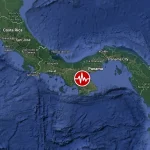
The quake struck shortly before 1 p.m. local time. The latest data places the epicenter about ten kilometers from the rural community of Pitalosa Arriba , in the province of Herrera , in the south-central part of the country near the Pacific coast. The focal depth is estimated at just 12.6 kilometers, which explains why the tremor was felt so strongly as far away as Panama City, San Jose, Costa Rica, and Cartagena, Colombia.
The magnitude changed several times throughout the day. Initial measurements indicated a magnitude of 8, while Panamanian authorities estimated the tremor at 7.2. The internationally accepted estimate is now 7.7 , making it one of the strongest ever recorded in the country.
The heart of destruction
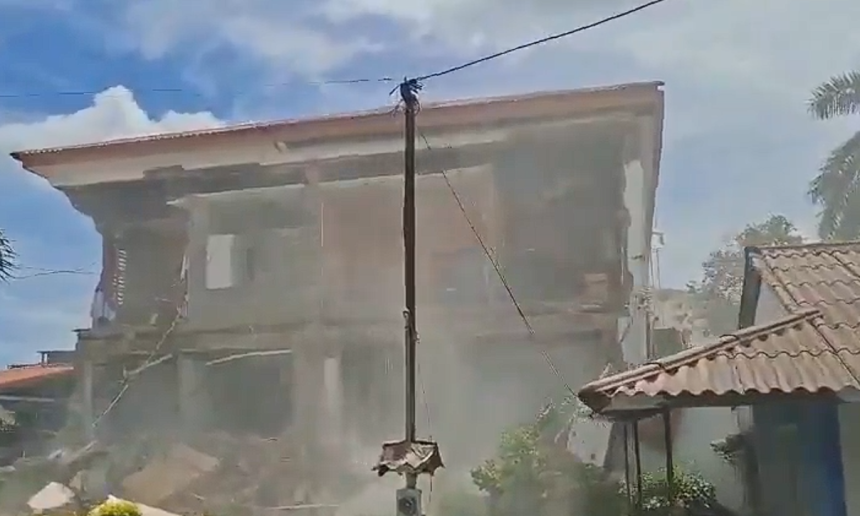
Penonome, the capital of Cocle province, became the symbol of the day. The Dos Continentes Hotel collapsed, fortunately without any injuries. The tower of the Cathedral of Saint John the Baptist collapsed and the debris crushed a car, while the Prefecture building was severely damaged a few minutes after employees had managed to get out.
In the provinces of Cocle, Los Santos, Herrera and Veraguas, there were reports of collapsed houses, cracks in churches and hospitals, damage to fire stations and police stations, as well as damaged sections of the road network. In Sona, Veraguas, the residence of former president Ricardo Martinelli also collapsed, who was quick to clarify that the losses were only material.
Injured people and communities without water
Interior Minister Ninosca Montalvo said 15 schoolchildren were transported with minor injuries and one person was rescued from the Aguadulce municipal market. The Civil Protection has not yet given a total number of injured people, but confirmed that there are no missing people .
The biggest practical problem at the moment is water . Several treatment plants have drastically reduced their operations and one of the most important is working at only 20% of its capacity. In many areas, electricity was temporarily cut off, while telecommunications are gradually being restored. The Civil Protection asks citizens to report communities that remain without electricity and communication.
A country on hold
Aftershocks have surpassed fifty in a few hours. The strongest, a magnitude 6.6, struck at three twenty-five in the afternoon near Rio Grande in Veraguas and brought residents back out onto the streets. Seismologists warn that the activity will continue, and many families in the interior of the country are preparing to spend the night outside their homes.
In the capital, life slowly returned to a fragile rhythm. Tocumen Airport, which had been closed and evacuated, reopened after inspections, after several flights were diverted to Colombia. The metro remained suspended for static checks, schools were closed in the afternoon and toll highways were opened free of charge until midnight. The Panama Canal continued to operate normally, with technical crews inspecting the facilities.
The tsunami that never came
For a few hours, the entire Pacific coast, from Mexico to Peru and faraway Easter Island, was under tsunami warning . On the island of Isla Canas, residents saw unusual waves crashing into their homes. Less than three hours later, US authorities deemed the danger had passed and the warnings were lifted one after the other.
The questions that arise
Panama is located where the Caribbean, Cocos and Nazca tectonic plates meet, and earthquakes are no stranger to its residents. The Puerto Armuelles earthquake in 1934 was a 7.6 magnitude, while a 7.4 magnitude quake in 1991 killed 23 people. Just last August, a 7.4 magnitude quake in neighboring Colombia left hundreds dead and was felt across Panama.
The country still lacks an early warning system for earthquakes, an issue that is expected to resurface in public debate. The president’s statement that no one was prepared may prove to be the most honest assessment of the day, but also the starting point for what needs to change.
Tonight, however, the priority is different. Rescue teams are trying to reach the villages around the epicenter, technicians are working to restore water and electricity, and Panamanians are waiting with bated breath for the next aftershock, hoping that the final toll will remain without human losses.