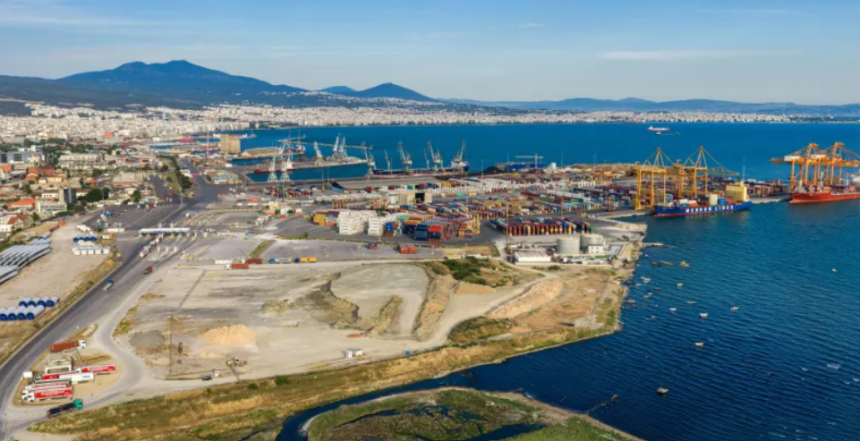
Eighty-two years later, war has returned to the bottom of the port. The discovery of approximately 1,000 World War II bombs at the bottom of the port, exactly where the extension of the 6th pier is being constructed, is causing great concern to the management of the Thessaloniki Port Authority and to Thessaloniki .
According to voria.gr , the bombs have a total estimated weight of between 15,000 and 20,000 tons and are located both under the caissons , which constitute the surface infrastructure of the expansion, and at the entry and exit point of the upgraded pier. The deepening of this specific point is what will ensure the unhindered approach of larger ships.
The discovery was made after a magnetic survey of the pier’s body. Of the approximately one thousand bombs, 80 weigh over 50 kilograms , which significantly increases the risk of the removal operation.
The Port Authority requests the immediate assistance of the State for their collection, as this is a project that far exceeds the capabilities of both the port and the construction consortium that has undertaken the expansion. Specialized services of the Armed Forces are expected to deal with the collection, possibly in collaboration with private individuals, in order to accelerate the execution of the project.
As for their origin, the most likely scenario is that the Germans “unloaded” them at sea during their withdrawal from Thessaloniki in 1944. This was a practice followed in many European ports in the last days of the Occupation, when retreating troops were getting rid of ammunition they could not carry.
The issue, however, is not only historical. Old ammunition submerged for decades is subject to corrosion , which makes their mechanisms more sensitive to vibrations. And it is precisely vibrations that all dredging and foundation work produces. The removal operation, therefore, requires specialized personnel, a studied process and a lot of time.
The practical question that arises concerns the timing of the project. The expansion of Pier 6 is the top investment in upgrading the port, the one that will allow it to welcome larger ships and strengthen its position in the competition of the ports of Southeast Europe. The intervention of an enterprise of such a scale will largely determine when it will be completed.