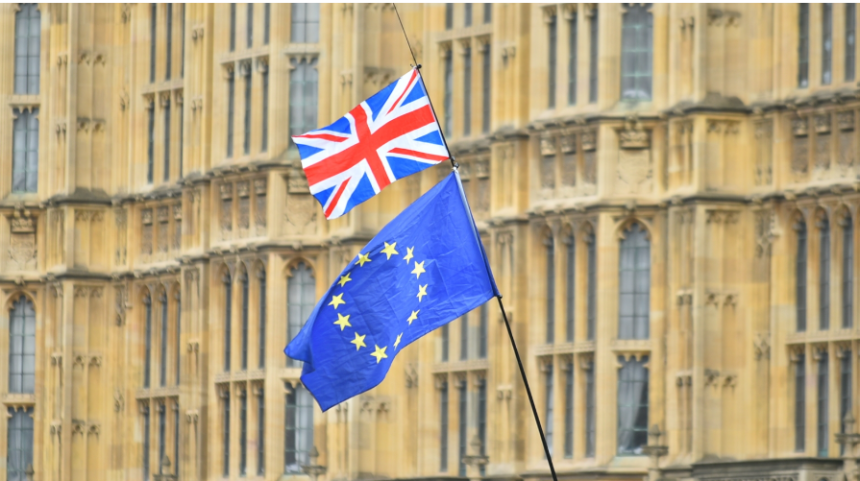
Majority say it was a mistake. Almost half say it should be fixed. A major new poll shows a Britain that has changed its mind about Brexit , bolstering those inside Downing Street who are calling for a re-opening of the debate on the country’s relationship with Brussels .
According to the Messina Group survey, 49% of respondents are in favor of full reintegration into the European Union , compared to 28.5% who disagree. This option emerged as the most popular among seven different relationship models that were put to the test. The survey was conducted among 11,461 people , from September 12 to 24, weighted based on the result of the 2016 referendum.
For the ruling party, however, the most crucial finding is another. All options leading to closer relations with the EU increase Labour ’s share by 4.3 to 7.4 percentage points , with the biggest gains coming from Green and Liberal Democrat voters. The biggest benefit is recorded in the scenario in which Prime Minister Andy Burnham committed to a new referendum and openly advocated for a return.
He has already taken the first step. In his first speech as Labour leader at the party conference on Tuesday, he announced a review of all options , later clarifying that full re-entry must be included. He has even said that he wants to see the country return to the EU “while it is still alive.”
As for how this would be done, public opinion is not unanimous. Almost one in three believes that a new referendum is required, more than one in six that a clear mandate through parliamentary elections would suffice, and a similar percentage that the decision could be taken by Parliament . There is also a differentiation in the time horizon. 25.9% want immediate reintegration, 22.9% within the next three years, 8.4% within a decade, while 23% do not want any closer relationship.
The political reality within the party, however, is more complex than the percentages. The prospect is causing intense concern among MPs representing regions that had voted for Brexit, with fears that bringing the issue back would give a boost to Reform . Notably, two out of three ministers , including Burnham himself, First Minister Louise Hay , Chancellor of the Exchequer John Healy and Foreign Secretary Ed Miliband , come from regions that voted for Brexit and had pledged to respect the result.
The objections were made public even before the speech. Deputy leader Lucy Powell argued that while relations on defence and security could be improved, going beyond the “reboot” plan inherited from Keir Starmer was “neither feasible nor desirable.” Trade Secretary Jonathan Reynolds spoke of “constitutional issues” that create uncertainty for businesses, while Home Secretary Shabana Mahmood noted that reintegration “is not a simple and straightforward matter” and that the costs could prove unacceptable.
The line that seems to be chosen is carefully plotted. Rather than questioning the choice of the voters of 2016, the burden of criticism falls on those who made big promises and did not deliver. As one minister told the Guardian, “Brexit clearly did not work and the promises that were made were not kept,” noting that Burnham must move without rekindling old divisions .
The survey also reveals clear red lines . Four in five want to keep sterling , while Brexit arguments around immigration control and national sovereignty still resonate. At the same time, more than two in three believe that, if the country had to choose, trade with the EU is more important than with the US or China, while 53.4% are in favour of remaining in the European Convention on Human Rights .
Above all, however, one name looms large. There is concern that a promise of renegotiation would politically revitalize Nigel Farage , who said on Thursday that Burnham had given him “the biggest boost of his career.” Senior Downing Street officials are already in contact with think tanks and pollsters to accurately gauge public support.
The general mood, however, is reflected in two figures that are difficult to dispute. 52.4% of Britons now believe that the country made a mistake by leaving, compared to 29.7% who insist on the opposite. And 54.9% characterize Brexit as a failure , while only 12.2% consider it a success.