

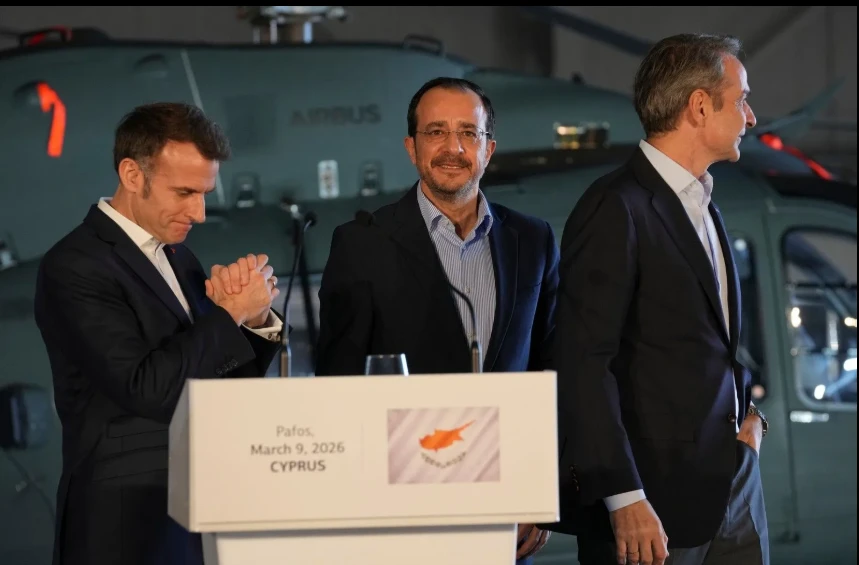
A strong message in every direction that Cyprus is not alone in facing the threats of regional instability was sent from the Andreas Papandreou Air Base in Paphos by the Prime Minister of Greece Kyriakos Mitsotakis , the President of France Emmanuel Macron and the President of the Republic of Cyprus Nikos Christodoulides , at a time when the war in the Middle East is escalating dangerously.
“When someone attacks Cyprus, they attack the whole of Europe,” said the French president, setting the tone for a common European stance. The Greek prime minister echoed this sentiment, stressing that “the Republic of Cyprus, as a member of the European family, is not and will never be alone.”
For his part, the President of the Republic of Cyprus underlined that the joint presence of the three leaders sends a clear message of unity: “Europe stands determined to ensure the security of its member states and to work for stability in the Middle East.”
Europe is called to awaken strategically
The three leaders placed particular emphasis on the need to strengthen European defense and diplomatic presence in the wider Eastern Mediterranean region.
The president of France announced the dispatch of two French frigates to the Strait of Hormuz , with the aim – as he said – of ensuring freedom of navigation and protecting maritime trade routes.
At the same time, he expressed his strong concern about the possible economic and energy consequences of the conflict with Iran , noting that the issue will be put on the table for discussions by the leaders of the Group of Seven .
Mitsotakis: “The European mutual defense clause is being activated in practice”
The Greek Prime Minister spoke of a “resounding message of unity and solidarity”, underlining that the security of Cyprus is an integral part of European security .
He noted that Greece rushed from the very beginning to contribute to strengthening the defense of Cyprus, while emphasizing that the stance of European countries such as France , Spain and Italy reflects the essence of European solidarity.
“In practice, Article 42(7) of the Treaty on European Union is activated,” he noted, emphasizing that every inch of European territory is inviolable .
At the same time, he clarified that the moves of European countries are purely defensive in nature and do not aim at military involvement, but at strengthening security.
Concern about energy crisis and migration flows
Kyriakos Mitsotakis warned that the conflict could cause serious repercussions on energy, navigation and international trade , which would affect the European economy.
He also stressed that conflicts often lead to population movements , calling on Europe to prepare for possible increased migratory flows.
Macron: Europe of defense moves from words to action
The French president stressed that his country’s military presence in the region expresses full solidarity with Cyprus , which – as he said – has been the target of attacks with drones and missiles.
He recalled that France has already deployed air defense and naval forces in the region, while announcing the preparation of a new escort mission to protect commercial ships in the Strait of Hormuz.
“Defense Europe is no longer just a slogan. We have moved on to implementation,” he said characteristically.
Christodoulides: The security of Cyprus is a collective responsibility
The President of the Republic of Cyprus thanked Kyriakos Mitsotakis and Emmanuel Macron for their presence, describing it as a strong symbolic and substantive message of European unity .
He stressed that Cyprus remains committed to its humanitarian role and is not involved in military operations.
“The security of Cyprus means the security of Europe. It is a collective responsibility,” he said.
He also recalled that his country has been experiencing the consequences of occupation for decades, noting that Cyprus knows better than many what war means.
At the end of their statements, the three leaders sent a common message to the region and to the international community:
Europe remains united, determined to protect its member states and work for stability in the Eastern Mediterranean and the Middle East.

