Thirty-two days of touring across the country. Few political leaders in the world would accept to personally shoulder such a burden, and even fewer would announce it with the ease with which Donald Trump did it. The American president enters the battle of the midterm elections on November 3rd , first and without a net.
The stakes are clear. The election will determine whether Republicans will retain control of the House of Representatives and the Senate for the next two years of the presidency. And Trump has chosen not to leave that fight to others.
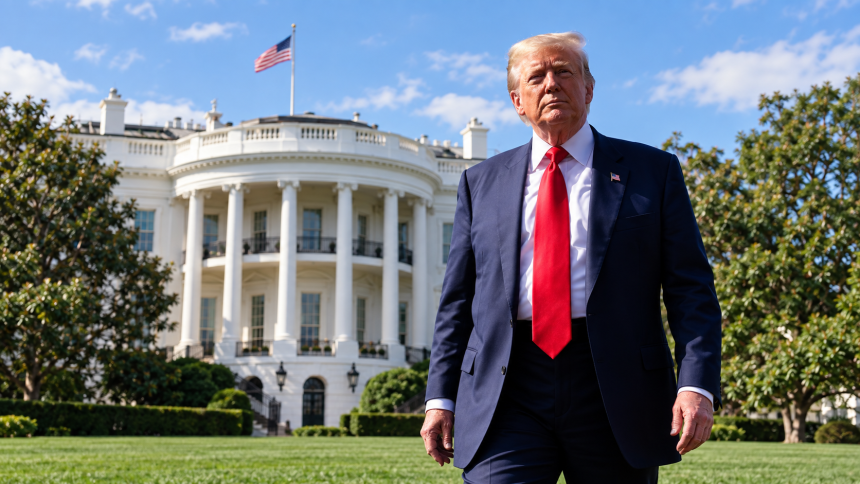
Speaking to reporters outside the White House, he appeared absolutely confident about his party’s prospects, rejecting scenarios of internal party disunity. “You love me and I love them,” he said, with House Speaker Mike Johnson at his side. The presence of the number two in the American political system next to him, at the exact moment of the announcement, was no coincidence. It was a picture of unity and institutional support.
Equally eloquent is the demand he himself described. “Just so you understand, everyone wants me to go. I’m a human being. Everyone wants me to make campaign appearances,” he noted.
It’s a rare occurrence in American politics. In historically difficult midterm elections, candidates typically avoid their party’s chairman. Here, the opposite is true, with requests for his presence exceeding the calendar days.
There is, moreover, a fact that is often overlooked in reading the measurements. The midterm elections are historically the most difficult electoral field for any ruling party in the United States, regardless of the person or the circumstances. The fact that the race remains open, and not predetermined, is in itself a sign of resilience.
Added to this is the experience of previous contests . Polls have repeatedly underestimated Trump’s momentum , mainly because they have difficulty capturing segments of the electorate that mobilize late and in larger than expected percentages. It is precisely this category of voters that a thirty-two-day personal tour can bring to the polls.
The first steps of the campaign are already set, with Texas and Ohio coming up this week. These are states with strong bases, where the president’s presence has a multiplier effect on the rally.
As for candidates who choose to focus on regional issues and their own achievements, the reading may be completely different from that of distancing. At the local level, emphasizing the works of each region is a classic and effective tactic, which works complementary to the national campaign and not in competition.
The point, ultimately, lies in the decision itself. Trump could have limited himself to a few appearances and distanced himself from a potentially unfavorable outcome. He chose the opposite. He chose to put his name forward, cross the country, and ask for votes face to face. It is a risky move, but one that in political terms can be read in only one way. As self-confidence .