

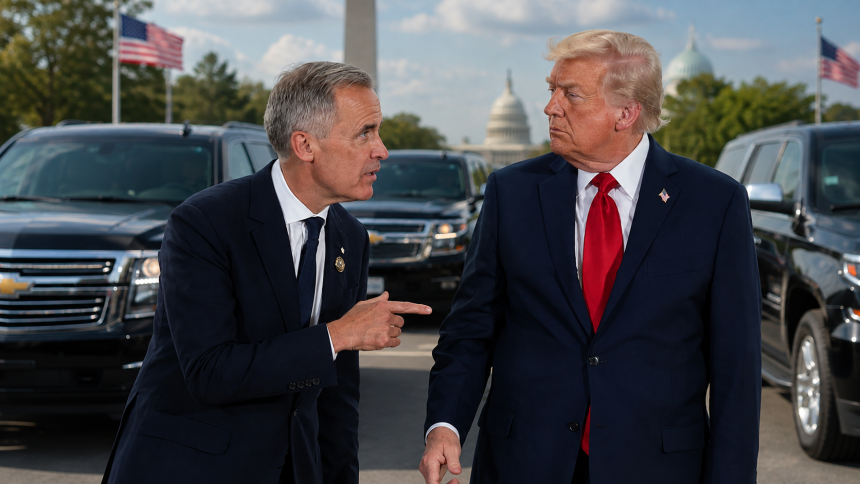
A new and particularly harsh escalation in the trade war between Washington and Ottawa was brought about by the announcement of US President Donald Trump , who announced through his post on Truth Social that from January 1, 2027, tariffs on Canadian cars, trucks, spare parts and steel products will increase to 50% .
The American president accompanied the announcement with an explicit exhortation to businesses: those that produce within the United States will have zero tariffs . “Canada will no longer be treated as a State,” he said, once again adopting particularly aggressive language towards the northern neighbor.
In the same post, Trump accused Canada of imposing excessively high tariffs on American agricultural products for years, a policy that, he claimed, has made life impossible for American farmers. He also repeated his complaints about the trade deficit, citing $60 billion at the expense of the United States, while noting that Canada conducts 95% of its trade with the American market. An argument with which he attempted to demonstrate the asymmetry of dependence between the two countries.
The announcement came out of nowhere. It followed the collapse of trade talks between the two sides on Friday night, when Canadian Prime Minister Mark Carney withdrew his country’s negotiating team, calling the terms proposed by the American side “uneconomic and unfair.” According to him, the talks foundered when Washington introduced new demands that concerned, among other things, Canada’s trade relations with third countries, the auto industry and the protection of Canadian culture and the French language. “In short, they asked for too much and offered too little,” he said.
The US side blames the failure on Ottawa. US Trade Representative Jamieson Greer argued that Washington had offered Canada sectoral concessions in steel, aluminum, automobiles and lumber, as well as cooperation on export controls, digital trade, critical minerals and supply chains, but new demands and backtracking from the Canadian side have upset the balance that had been achieved.
On Saturday, after the sinking, US tariffs of 50% went into effect on hundreds of Canadian products, from lumber and cement to wine and hockey sticks. The measures affect goods worth about $20 billion , or about 5% of annual Canadian exports to the US. Mr. Greer downplayed the impact on the US economy, saying the tariffs cover just 0.06% of total US consumption, but conceded that the consequences “may be different” for Canada.
Ottawa has already announced a response. Mr. Carney said Canada would match the U.S. tariffs “dollar for dollar,” with the countermeasures taking effect Sept. 8 and targeting sectors including steel, dairy, home appliances, farm equipment, pulp and paper and electronics. “We can’t control the storm coming from Washington,” he said Saturday.
The automotive sector is particularly important. The current US tariff on imported vehicles is 25% for non-US content, which means that the new announcement doubles the burden. On steel, by contrast, the tariff is already at 50%.
North American auto manufacturing is tightly interconnected, with components, raw materials, and completed vehicles crossing borders every day. A part can cross the border several times in different forms before it is finally installed in a new car, putting it at risk of being subject to multiple tariffs. A 50% tariff would dramatically increase costs for businesses and ultimately pass through to vehicle prices for consumers.
The dimensions of the bilateral relationship make the stakes even greater: Canada is the third largest source of imports for the US, with more than $380 billion worth of goods crossing the border in 2025.
Auto industry executives, however, are wary of the new threat. Speaking on condition of anonymity, they noted that the US president has previously announced high tariffs that have never been implemented, while a measure of this magnitude would provoke massive Canadian retaliation. They also pointed out that January is several months away and it comes after the November midterm elections , estimating that the announcement may be aimed at restarting negotiations rather than immediate implementation.
The White House, for its part, is sticking to its line. A spokesman argued that American workers, businesses and farmers have been undermined for decades by unfair Canadian trade practices, accusing Ottawa of rejecting a “generous and fair” deal in favor of unfettered access to the American market.
Asked about Canadian retaliation, Mr. Greer said that the government is preparing options for the president, without revealing them.

