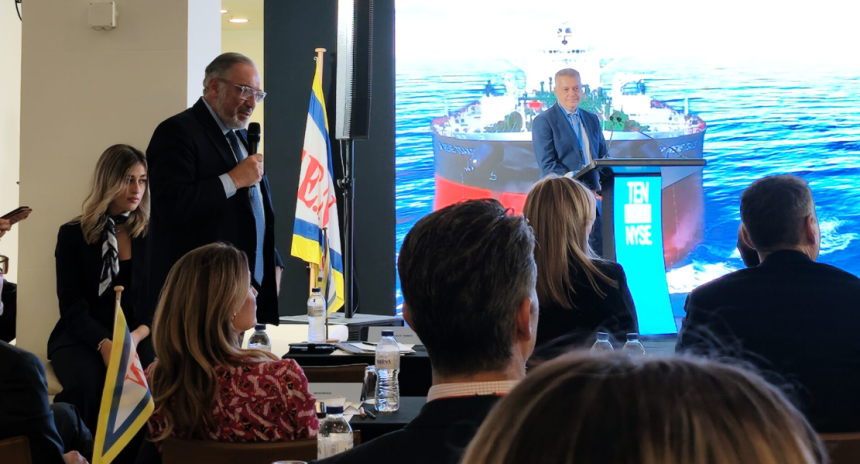
The dramatic change in conditions in global shipping, due to the escalation of geopolitical tensions and the increasing risks in international maritime transport , was highlighted by Nikos Tsakos , speaking at the annual Strategy Meeting of his shipping group.
The Greek shipowner described an environment in which the safety of crews, ships and cargo has become an absolute priority, now decisively influencing daily operational decisions.
His position reflects the new reality facing large shipping companies, as geopolitical conflicts, uncertainty in trade routes and increased ship protection requirements have changed the way an industry that is a key pillar of international trade operates.
Nikos Tsakos pointed out that shipping companies are faced daily with requests from partners and charterers to operate in high-risk areas , which creates additional responsibilities and significant operational pressures.
“Our goal — and to date we have achieved significant results — is above all the safety of our people on ships and in offices, the safety of our ships and the protection of cargo,” he emphasized, clearly defining the administration’s priorities.
As he explained, charter and operations executives are called upon to evaluate daily requests for voyages and commercial activities in highly volatile maritime areas. This process is no longer limited to assessing the commercial viability of a charter, but requires a continuous assessment of the risks that crews and ships may face.
Safety has transformed from one of the key parameters of shipping activity into a determining factor for making business decisions.
The head of the group focused particularly on the changes that have occurred in just one year, pointing out that current conditions differ substantially from those that prevailed during the corresponding meeting in October 2025.
This comparison takes on particular importance at a time when international maritime transport is directly affected by developments in the Middle East, tensions around strategic sea passages and the general rearrangement of trade and energy flows.
For companies active in the transportation of oil, energy products and other cargo, these developments create a complex environment.
Decisions on routing, accepting charters and safely executing voyages now require greater preparation, systematic monitoring of developments and closer cooperation between operational departments.
At the same time, increased exposure to risks can affect insurance costs, transport times and the overall economic efficiency of shipping activities.
The most important element of Nikos Tsakos’ intervention was the point that the administration now devotes most of its time to security issues and not to purely commercial decisions.
This is a fundamental change in the way shipping businesses operate. In a more predictable international environment, management can focus on ship utilization, trade agreements, investments and fleet development. However, when risks in maritime transport increase, security management absorbs a significant portion of administrative and operational resources.
This shift is taking on even greater significance for Greek-owned shipping , which maintains a leading position in international maritime transport and is directly exposed to changes in global trade.
Greek shipping companies operate in all major maritime markets and are called upon to combine commercial competitiveness with crew protection and compliance with an increasingly complex international regulatory framework.
In this context, the annual Strategy Meeting was not limited to assessing the group’s progress, but also focused on developments that are expected to influence the future of shipping.
Nikos Tsakos referred to the presence of four speakers with different approaches, who were to examine the directions of international maritime legislation and the changes taking place in the regulatory environment.
He made particular reference to the presence of Efthymios Mitropoulos , former Secretary-General of the International Maritime Organization (IMO) , underlining the importance of the discussion on the rules governing international navigation.
Maritime legislation is currently in a period of significant change, as businesses are called upon to adapt to new requirements regarding safety, environmental protection, energy transition and operational efficiency of ships.
The challenge for the industry is twofold: to maintain its competitiveness and at the same time respond to an environment of increased risks and stricter obligations.
The meeting also included the participation of two distinguished economists, with different assessments of the course of the international economy. Nikos Tsakos welcomed this divergence of views, humorously pointing out the habit of economists to examine more than one possible scenario.
The presence of economists at the Strategy Meeting reflects the need to take broader economic developments into account in the planning of shipping businesses. The course of global growth, energy demand, trade flows and international political decisions directly affect freight markets and companies’ investment choices.
Uncertainty makes it particularly important to consider different scenarios, as shipping investments have a long-term horizon and are affected by conditions that can change rapidly.
Nikos Tsakos also emphasized the need for the group to continuously adapt to new conditions, linking this strategy to the company’s progress over the last year.
His observation that the world has changed significantly since October 2025 captures the speed with which conditions in international shipping are now changing.
For large shipping companies, adaptability is not just about revising commercial plans. It includes strengthening risk monitoring mechanisms, assessing security conditions in each maritime area, and maintaining operational readiness in the face of unforeseen developments.
The protection of seafarers takes on particular importance in this process , as crews are on the front lines of the dangers created by international conflicts and disruptions in maritime transport.
The Greek shipowner’s statements ultimately highlight a significant change in the priorities of global shipping. Commercial activity continues to be the main purpose of businesses, however its execution now requires much more complex risk management.
In an era where geopolitical tensions are increasingly affecting maritime regions, a shipping company’s ability to protect its people, ships and cargo is a critical element of its operational resilience .
This was the central message of Nikos Tsakos’ intervention. Shipping continues to be one of the most important operating mechanisms of the global economy, but the conditions in which it operates have changed significantly.
The biggest challenge for international shipping is no longer just securing profitable charters, but being able to do so safely in a world of increasing geopolitical uncertainty.