

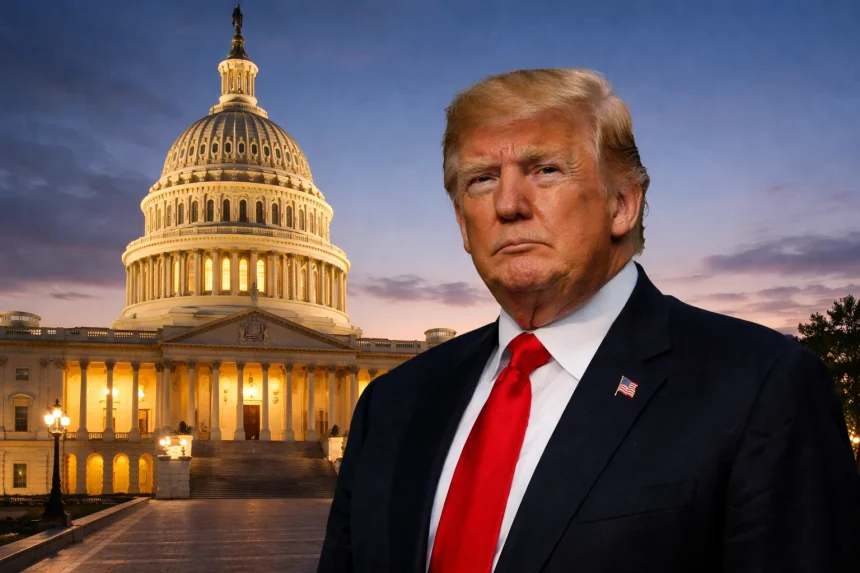
The Republican majority has blocked a Democratic initiative to require congressional approval for military operations against Iran, amid intense political conflict over the legality of the war.
A significant political showdown was recorded in the United States Senate, where a draft resolution aimed at limiting President Donald Trump’s powers in the war against Iran was rejected.
The proposal, submitted by Democratic Senator Tim Kaine, was rejected by 53 votes against and 47 in favor , as the Republican majority strongly supported the continuation of the military operations carried out by the United States in cooperation with Israel against the Islamic Republic.
The draft resolution was submitted in late January, a few days before the conflict broke out, and provided that the US armed forces could not engage in hostilities against Iran without prior approval from Congress .
The vote also highlighted unusual political alliances . Democratic Senator John Fetterman, who has advocated for military intervention, voted against the plan. On the other hand, Republican Rand Paul was the only member of his party to vote in favor of limiting presidential powers .
Tim Kaine and other Democrats sought to use the initiative to remind that, under the US Constitution, only Congress has the institutional authority to declare war . The Virginia senator accused Trump of leading the country into war “illegally” , noting that “Americans want the president to lower prices, not drag them into futile and eternal wars ”.
After a secret briefing to senators by government and military officials — including Secretary of State Marco Rubio — Kaine said no clear evidence was presented of an “imminent threat” from Iran against the United States .
The issue of “imminent threat” is the Trump administration’s central legal argument. While the Constitution gives Congress the power to declare war, the War Powers Act of 1973 allows the president to order limited military operations in the event of an extraordinary threat to the country.
Trump had invoked precisely this argument when he announced the attack from Mar-a-Lago, claiming that Iran posed an immediate threat to American security , a position that the Democratic opposition continues to dispute.
A similar initiative is expected to be put to a vote soon in the United States House of Representatives, however it is estimated that it will fail to gather the required support there as well.
House Speaker Mike Johnson warned that such a move would be “dangerous,” arguing that it would strip the president — as commander-in-chief of the armed forces — of the authority to complete the military operation.
The failure of the resolution demonstrates that, despite the intense political confrontation in Washington, the majority of the US Congress remains for the time being aligned with the White House’s strategy in the war unfolding in the Middle East.