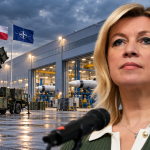
Moscow wants to decide how much Ukraine can defend itself and how much Europe will be allowed to help it. This is the political content of Maria Zakharova ‘s statement that European factories producing weapons for Kiev are “legitimate military targets.” A threat couched in the language of legality, so that intimidation appears as a right and a potential attack as an expected consequence.
The message to European governments is stark. If you continue to arm Ukraine, you should consider the risk to your own facilities. Russia is thus attempting to transfer fear from the battlefield to the cabinet offices, industries and societies of Europe. To make supporting a country that is defending itself look like a threat to the security of those who support it.
And here the question arises. Where is Russia going? Does it want to negotiate a peace that can stand or ensure that Ukraine sits at the table exhausted, isolated and unable to resist? Why does the complaint that European aid is “delaying the resolution” of the war conveniently leave the essential question unanswered. What resolution does Moscow seek and on what terms for the people who will be called upon to accept it?
The word “peace” does not purify every demand. There is peace that ensures the survival of a state, and there is the cessation of hostilities that is imposed because that state no longer has the means to fight. The latter may serve the aggressor. It does not therefore become just, safe, or lasting. The military exhaustion of Ukraine cannot be called a peace policy.
The Russian argument attempts a provocative reversal. The blame is shifted from the one who continues the attacks to the one who helps to counter them. As long as Ukraine resists, its supporters are to blame. As long as it has interceptor missiles, its suppliers are to blame. By this logic, the desired European contribution to the “solution” would be to turn off the aid tap and let Kiev negotiate under even greater military pressure.
The reference to the Patriots reveals how tough this requirement is. These are air defense systems. Means that allow intercepting aerial threats and protecting military installations, infrastructure and people. When their production becomes the object of a threat, the political essence is that Moscow wants to increase the cost of protecting Ukraine . To scare those who can strengthen its defense.
Even more serious is the geography of this threat. Poland is a NATO country. A facility on its territory is not located in some neutral space on which Russia can mark targets without calculating consequences. It belongs to a sovereign state, within the area of allied defense. Anyone threatening to strike it should know that the political and military stakes go far beyond the destruction of a factory.
Article 5 needs to be clarified precisely because the issue is so serious. Zakharova’s statement does not trigger it. Nor does collective defense function as an automatic mechanism that imposes the same military action on every ally. An armed attack on a member state, however, directly raises the question of assistance from the others. Moscow cannot take for granted that a strike on Poland will remain a matter between Russia and Poland.
Equally unacceptable is the attempt to present the phrase “legitimate military objective” as a license to attack. International humanitarian law defines under what conditions a facility constitutes a military objective. It does not abolish the rules governing the use of force between states. The UN Charter prohibits in principle the threat or use of force against the territorial integrity and political independence of states. A weapons factory does not automatically turn the country hosting it into a territory free from bombing.
In my opinion, this invocation of legitimacy serves a specific political purpose. It prepares the argument that, if something happens, it will be the fault of those who continued production. The threatened country is called upon in advance to take responsibility for the threat it receives. Intimidation thus acquires a convenient alibi. We warned you, therefore you caused the consequences.
We do not know whether there is a decision to escalate militarily behind the statement. It would be irresponsible to present such an assumption as fact. But there is a clear attempt to put European options under Russian pressure. And there is a risk that a leadership will believe that the adversary is so afraid of the wider conflict that it will tolerate a limited blow.
Therein lies the trap of miscalculation. In the belief that allies will be divided, that governments will retreat, and that an aggressive action will yield political benefit without a corresponding cost. Such an assessment can prove disastrous. Tension does not always remain at the level desired by the one who provokes it.
Europe needs to address this message with political seriousness and credible deterrence . Condemnation is of limited value when it is not accompanied by protection of critical facilities, defence preparedness, coordination and clear decisions. Its governments must explain to their citizens what is at stake. If an external power can determine through threats what they will produce and whom they will support, their sovereignty has already been undermined.
The channels of communication must remain open. A sustainable peace requires negotiation and difficult decisions. Negotiation, however, weakens when one side sees that every threat brings a retreat. Then it has an incentive to come back with greater demands. Giving in to intimidation can buy a temporary peace and mortgage the next day.
So where is Russia headed? This particular statement shows an attempt to gain a say in Europe’s defense decisions through fear. To impose limits on aid to Ukraine and test how solid the commitments of its allies are.
Europe’s response will show whether this method works. And that is the crucial thing. Because every threat that is rewarded with retreat becomes a model for the next one.
Neologos