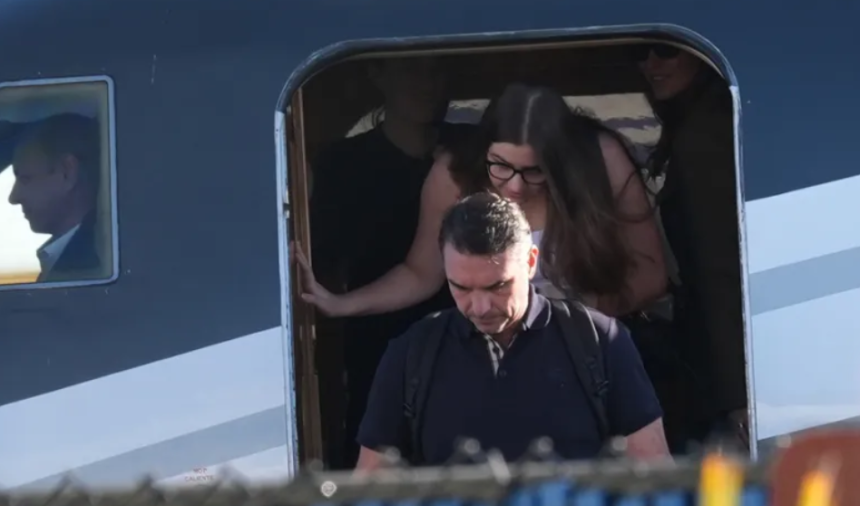
With a letter that takes Brazil’s political confrontation beyond its borders, Flavio Bolsonaro is attempting from the United States to challenge the electoral victory of Luiz Inácio Lula da Silva and assume leadership of the opposition from abroad.
In his extensive letter to the Brazilian people and the international community , Flávio Bolsonaro presents his own version of what preceded his departure, explains why he believes his freedom was at risk, and declares his determination to maintain an active role in the political life of his country.
His intervention comes after the electoral victory of Luiz Inácio Lula da Silva and reflects the depth of the confrontation between the two political camps. In the first version of the letter, Bolsonaro described himself as “the real elected president of Brazil,” while in a later formulation he appeared as “the leader of Brazil.” The change shifts the emphasis towards claiming political representation for his supporters, without negating the questioning he expresses about the electoral process.
The letter focuses on the extension of voting hours , which Bolsonaro considers problematic in terms of timing and implementation. He argues that different conditions have been created for voters and raises questions about the intervention of the Supreme Federal Court in matters of electoral competence. At the same time, he denounces the abuse of political and economic power , as well as the exploitation of the state apparatus for the benefit of Lula’s re-election.
These allegations are at the heart of his political stance, but have not been substantiated as evidence of vote-rigging . According to published election data, Lula won 51.79% of the vote, compared to Bolsonaro’s 48.21% , a margin of about 4.43 million votes . The number of votes cast after the normal closing time was about 34,000 , which was not enough to change the winner. Bolsonaro’s party had also requested an extension in some areas due to problems caused by rainfall.
Beyond the electoral dispute, the letter places particular emphasis on the relationship between political power and Justice . Bolsonaro argues that judicial institutions are used to limit the opposition and links his own situation to the case of his father, former President Jair Bolsonaro . In his assessment, the confrontation has gone beyond the limits of ordinary political conflict and now touches on freedom of expression, the possibility of exercising opposition and the personal safety of political figures and their families.
He describes the fear of a series of restrictive measures, from passport confiscation and electronic surveillance to house arrest. This description expresses his own assessment of the possible development of his affairs. A court order had already been issued to surrender his passports and ban him from leaving the country, while investigations are underway that include suspicions of money laundering. The investigations do not constitute a conviction , and Bolsonaro denies that he has committed any crime.
The reference to his family is one of the most personal points of the intervention. He states that he did not wish to leave his homeland, but chose to go to the United States for security reasons , believing that there he could protect his loved ones and continue to express himself freely. He thus attempts to explain his departure as a choice that, according to him, allows him to remain politically active and maintain communication with the citizens who supported him.
In the letter, he thanks Donald Trump , Javier Milley and the American people, emphasizing the values of freedom and the reception he says he has received. In this way, he also addresses an international audience, seeking to make known his concerns about the situation in Brazil. These thanks reflect his own position, without implying recognition of his electoral claims by the specific governments. Trump, according to the Financial Times, stated that he will not get involved.
To explain his decision to continue his action from abroad, Bolsonaro invokes figures such as Ruy Barbosa , Charles de Gaulle and José Martí . Through these historical references, he attempts to emphasize that physical distance from a country does not preclude political contribution to it. The parallels function as part of his message to his supporters, to whom he assures that his presence in the United States does not mean abandoning his political commitments.
Within his party, however, different approaches are taking shape for the day ahead. Rogerio Marinho , the coordinator of his election campaign, acknowledged Bolsonaro’s political weight as a representative of the Right, while clarifying that there is no evidence that allows the party to adopt the accusation of fraud. This position shows that recognition of his leadership role can coexist with different assessments of the management of the election result.
The letter is therefore a statement of political continuity . Flavio Bolsonaro seeks to maintain his relationship with his voters and to participate decisively in shaping the opposition strategy. The coming period will show how his action from the US will be connected to the presence of his allies within Brazilian institutions. For the country, the challenge remains a political life in which the transparency of elections, the independence of the Judiciary and the free exercise of the opposition will support the trust of citizens, even in the most intense disagreements.