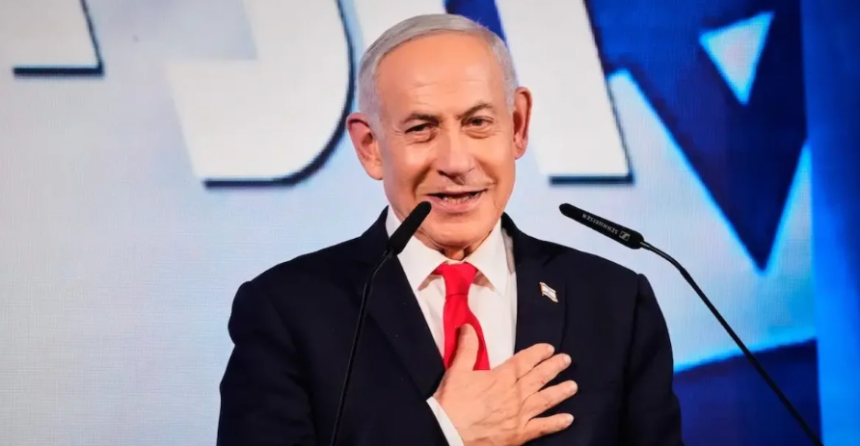
Benjamin Netanyahu remains in a strong position in the battle for power in Israel, despite the loss of his coalition’s parliamentary majority. The election did not ensure that he could continue to govern with the same coalition, but neither did it offer his opponents an easy way out to replace him. On the contrary, the current connections are shaping a complex political impasse that could prolong his stay as caretaker prime minister while negotiations for a new government continue.
With nearly 86% of the vote counted, projections from the country’s three major television networks gave 53 seats to the coalition of right-wing, far-right and ultra-Orthodox parties supporting Netanyahu. The camp of his main opponent, Gandhi Eisenkot , was projected to win 48 seats , while parties representing Israel’s Arab citizens appeared to secure 19 seats . These are projections with the count still underway, which leaves room for changes in the final distribution.
In the 120-member Knesset , an absolute majority requires 61 seats . Netanyahu is therefore eight seats away from this threshold and Eisenkot thirteen. However, the distance from the majority is not only numerical. It is primarily political and is linked to the partnerships that each side can negotiate without causing internal rifts.
For Netanyahu, the stronger-than-expected performance of his coalition is an important bargaining chip. It allows him to claim a central role in developments and to make the argument that his camp has greater parliamentary power than that of his main opponent. The loss of the majority, however, remains a real obstacle. To form a new government, he needs to broaden his support and make deals beyond his existing allies.
The situation is equally challenging for Eisenkot , who is called upon to transform the common desire of different parties for a change of prime minister into a workable government proposal. The opposition camp extends from the center-left to the hard right. Its composition offers breadth, but at the same time creates difficulties on issues of security, national identity, relations with the Palestinians and cooperation with Arab parties.
In theory, the 48 opposition seats and the 19 Arab parties form a 67-seat force, more than the required majority. However, this addition does not amount to an agreed-upon government. For it to have political substance, it will have to overcome deep-rooted objections in parts of Israeli politics. Some of Eisenkot’s potential partners even view the external support of a government by Arab factions negatively.
The increased presence of Arab Israelis in the new parliamentary equation is one of the most important developments in the contest. Their increased participation strengthens their representation and gives greater weight to their claims. At the same time, it forces the other parties to take a more specific stance on the possibility of cooperating with them, especially since neither of the two main alliances has a majority.
In this context, the distinction between participation in a government coalition and parliamentary support without ministerial positions becomes particularly important. The Joint List expressed a willingness to consider supporting an alternative government to remove the outgoing coalition, without participating in it. The position leaves room for negotiation, but does not eliminate disagreements on Gaza, the West Bank and the overall policy towards the Palestinians.
The turnout in the elections reached 77.7% , reflecting the intensity of political mobilization. The high turnout, however, did not provide a clear government solution. It revealed a society that participates dynamically, but remains divided in terms of leadership and the necessary political partnerships. At the same time, the strong presence of right-wing forces shows that challenging Netanyahu does not automatically imply a shift towards the traditional positions of the center-left.
Netanyahu himself attempted from the first hours to link the next day to national security and strategic cooperation with the United States . Addressing Likud supporters, he called for a strong right-wing national government and presented Israel’s military successes as an argument in favor of continuing his policy. He placed particular emphasis on Iran , arguing that cooperation with Donald Trump creates a historic opportunity to address the threat he attributes to Tehran.
The American president, who had openly expressed his support for Netanyahu, positively assessed his electoral performance and claimed that his own intervention helped him. The relationship between the two leaders is an important element of the Israeli prime minister’s political argument, especially towards voters who prioritize deterrence and close cooperation with Washington. However, these statements do not in themselves constitute an announcement of a new military operation.
For his part, Eisenkot insists that the loss of the outgoing coalition’s majority is a significant political message. He warned of the possibility of security issues being exploited for partisan purposes and addressed the heads of the security services and the public administration. His intervention shows that the confrontation is already extending from the formation of a government to the way in which power is exercised during the transitional period.
The uncertainty was also reflected in Israeli markets , with the shekel under pressure and stock market indices falling. The prospect of lengthy negotiations, a fragile government coalition or new elections makes it difficult to assess the economic outlook. For businesses and investors, the challenge is the ability to make decisions with durability, in an environment where geopolitical risks remain elevated.
Possible solutions include a broader government agreement , an alternative majority with direct or indirect Arab support, or a new election if negotiations fail. Each entails political costs and requires decisions that may conflict with pre-election commitments. The possibility of finding a solution will depend on whether the leaderships consider a difficult compromise preferable to prolonging the impasse.
Netanyahu remains politically resilient, but needs additional support for a new government term. Eisenkot has potential parliamentary routes, but must prove he can unite forces across deep divisions. Arab parties are gaining influence, but they have no assurance that this will translate into an acceptable cooperation agreement. Israel’s next government will be judged on the ability of political leaders to translate these opportunities into commitments they can sustain.