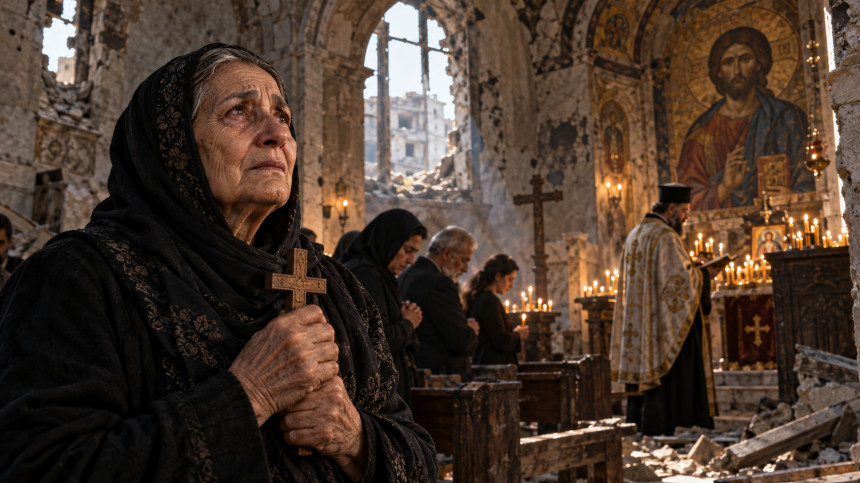
There is something unbearable about the image of people going to church to say goodbye to a dead person and never returning home . Standing next to a coffin, trying to comfort a family, and within minutes their own families need comfort. In the Greek Orthodox church of Hamoud , in the Kerak region of Jordan , the funeral service became a place of bloodshed . On October 23 , gunmen attacked the gathered faithful, leaving seven dead and dozens injured . Authorities described the attack as terrorist , while the investigation into the connections of the perpetrators continued. Behind the toll are people who left their homes to support the pain and became the pain themselves .
This is the reality that no diplomatic formulation can tame . People were murdered in the space where they had sought refuge for prayer and comfort. Where man briefly lets go of his defenses. Where the elderly lean on the pew, the relative wipes his eyes and the priest speaks of resurrection . Terrorism invades this very vulnerable moment, to subject the survivors to the most inhumane thought. That not even in front of the Holy Altar do they have the right to feel safe .
The wound of Damascus remains open . On June 22, 2025 , a suicide attack on the Greek Orthodox Church of Prophet Elias killed 25 people and injured dozens more. Two different countries, two churches, two communities faced terror in their prayer. We do not need to invent common operational guidance to recognize the common human wound . Faith becomes a cause of fear where it should be a source of freedom.
The scale of the problem does not allow for complacency . According to Open Doors’ World Watch List 2026 , more than 388 million Christians face high levels of persecution and discrimination because of their faith . The organization records 4,849 deaths linked to the Christian faith during its reporting period. These are data from a specific investigative record, behind which lies an overwhelming reality . Families breaking apart, communities shrinking , people learning to hide who they are in order to survive .
In the face of this reality , a clear language and a clear conscience are needed. Islamist extremism must be named when it is documented . The ideology that turns the non-believer into a potential dead person deserves neither embellishment nor excuses . Its networks, its financiers and those who recruit people to kill in the name of God must be confronted. But the responsibility has specific bearers. It is not transferred collectively to millions of Muslims , many of whom themselves live under the threat of the same barbarity.
Jordan gave a meaningful response to those who would like to turn the crime into a religious civil war . It declared three days of national mourning , while the Grand Mufti condemned the attack and stressed the inviolability of the lives of Christians, as well as Muslims . This attitude matters. The mourning of a Christian community was recognized as the mourning of the entire country. This is exactly what the terrorist is fighting for. The ability of people to recognize each other as fellow citizens and brothers.
And Europe? The question must be asked with rigor, but also with honesty . The European Union explicitly condemned the terrorist attack in Damascus and clearly referred to the violence against Christians . Therefore, the accusation that it never utters a word is unfounded. The essential question is what follows after the words. Who monitors the protection of the communities when the television cameras leave? Who demands results of the investigations ? Who ensures that the next service is not held in fear of the next attack ?
The European Union now has a special envoy for the promotion of religious freedom outside its borders, Mairead McGuinness , who was appointed in March 2026. The existence of the position creates specific responsibility . It requires a constant presence, public accountability and measurable work . The persecuted cannot be protected by a title on an organizational chart. They need people who will persist when their case is no longer newsworthy .
A Europe that wants to speak convincingly about human rights must integrate religious freedom into its real priorities . To demand protection for places of worship and communities . To support survivors . To demand investigations and justice . To treat impunity as a serious issue in its relations with third countries. Solidarity acquires content when it commits resources, imposes persistence and assumes political costs. Otherwise, it risks being exhausted in an archive of announcements that grows with the list of victims .
There is, however, a second test , within European society itself. Its relationship with its Christian heritage . Here a distinction is needed. Abandoning a church is not the same as murdering a believer. Leaving a Church is a right , while persecution is a violation of a right . If we confuse the two, we do injustice to both the dead and the truth . We can, however, ask ourselves what a society loses when it ceases to understand the spaces, symbols and language that have accompanied the deepest moments of its life for centuries.
A temple is a place of worship , but also a living memory of people . There some were baptized , some were united in the mystery of marriage , some said goodbye to their parents . There a helping hand was found, an offering was organized, a word of comfort was heard. The protection of this heritage also concerns those who do not believe . A society can be free and polyphonic , while at the same time knowing where it comes from. Religious tolerance does not presuppose historical amnesia.
Nor, however, are church leaders allowed to attribute every loss to the times, politics or others. In Germany , official Catholic statistics recorded 307,117 departures in 2025. Such a number calls for self-examination . Where there has been a cover-up of abuse, administrative arrogance or indifference to human suffering , truth, justice and change are required. No denunciation of social decline absolves the Church from the responsibility of its own witness. Trust is restored by works that stand the test of time .
It must also be clearly stated that the Muslim who legally builds his place of prayer is not responsible for the Christian who abandons his . Faith is not resurrected by envy of the faith of others. It is resurrected in the life of the community , in caring for the weak , in being close to the young who doubts and the elderly who are left alone . A temple needs a roof that does not leak. But it also needs people who feel that they can be heard within it .
For us Orthodox , Hamoud’s pain also has the intimacy of common prayer . We recognize the funeral procession , the icons , the candle , the expectation of the Resurrection . This kinship deepens our responsibility . It does not give us the right to limit our compassion. It calls us to put it into practice. To support the wounded communities , to demand their protection , to keep the memory of the victims alive beyond the emotion of a day .
And in Greece , the open doors of churches should not lull us to sleep . Tradition is not automatically inherited because there are bell towers on the horizon. It needs transmission, participation and experience . It needs families who will speak to their children , parishes that will welcome them and pastors who will be next to their people . We must also serve what we love. The invocation of our roots has value when they continue to nourish our lives .
The people who perished in Hammoud did not choose to become symbols . They had gone to stand by a grieving family . It is this simple human act that makes the crime even more painful. We owe them justice. We owe the injured care. We owe the survivors safety. And we owe all of us something that does not fit into a typical condolence message . The decision to never get used to the idea that a person can pay with their life for the right to pray.
GEORGE A.