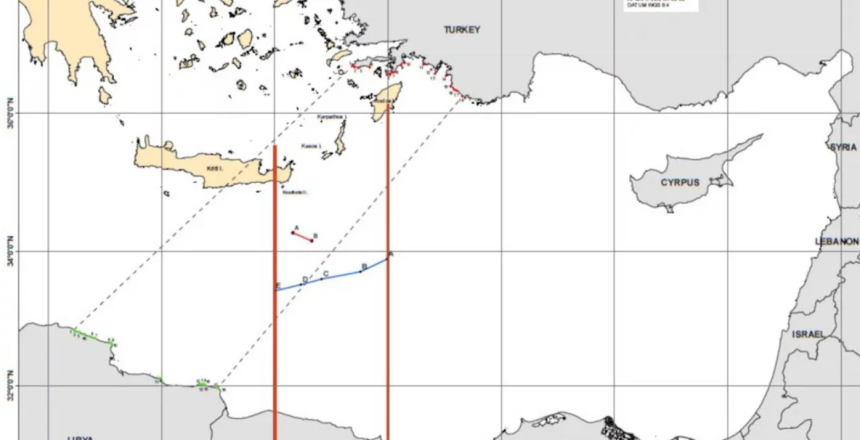
Greece and Egypt are focusing their diplomatic efforts on the expansion of the 2020 Exclusive Economic Zone delimitation agreement , strengthening their coordination following the ratification of the Turkish-Libyan Memorandum by the Libyan House of Representatives. During a telephone conversation on Thursday, October 22 , Foreign Minister George Gerapetritis and his Egyptian counterpart Badr Abdellatti agreed to continue consultations with the aim of expanding the geographical scope of the bilateral agreement, based on International Law and the United Nations Convention on the Law of the Sea, UNCLOS .
The development gives concrete content to the joint reaction of Athens and Cairo. The two countries reaffirm their rejection of the Turkish-Libyan memorandum and at the same time set as their goal the further development of their own agreed framework for maritime delimitation. The political significance of the move lies in this connection of the diplomatic reaction with the continuation of a bilateral negotiation .
According to the Greek Foreign Ministry, the discussion focused on the strategic partnership between Greece and Egypt and developments in the Eastern Mediterranean . The two ministers categorically rejected the ratification of the 2019 Turkey-Libya memorandum , underlining respect for the rules of international law. The wording reflects a common position on the Libyan decision and the intention to maintain close coordination.
The essential element for the coming period is the reference to the expansion of the geographical scope of the 2020 agreement . This specific agreement concerns a partial delimitation of the EEZ between the two countries. Therefore, the continuation of the consultations aims to negotiate additional parts of the delimitation, beyond those already agreed. This is a process with a clear objective, but with an outcome that remains to be shaped.
The official wording requires caution. Athens and Cairo agreed to continue consultations with a view to extending the border , without announcing that they had reached a new agreement. No specific coordinates, direction of extension, or timetable for completion were made public. Therefore, the political will to continue the discussion cannot yet be reflected as a new, agreed line on the map.
This distinction is particularly important in a region where maritime delimitations are linked to sovereign rights, economic activities and regional balances . The geographical extent of a potential new agreement will determine its specific content. Until there are official announcements, any reference to specific maritime areas as already included in the extension would go beyond the available data.
The joint rejection of the Libyan ratification was also confirmed by the Egyptian side . According to the Egyptian Foreign Ministry’s statement, as reported by Ahram Online, the two ministers expressed their opposition to the ratification of the memorandum signed in 2019 between Turkey and the then Libyan government under Fayez al-Sarraj . They also reiterated the importance of the 1982 UNCLOS for the delimitation of the EEZ and the continental shelf.
The Egyptian statement emphasizes continued coordination on regional issues of common interest and the continuation of talks on maritime boundaries. The Greek statement defines the intended goal more specifically, making explicit reference to the geographical expansion of the 2020 agreement . The two statements converge on maintaining the negotiation process and invoking a common legal framework.
The reference to UNCLOS is a key component of the message of the two countries. Athens and Cairo choose to present the next consultations as a continuation of a delimitation process based on rules and mutual agreement. This common basis has political value, without negating the need to negotiate the individual technical and legal issues that will arise.
For Greek diplomacy , the communication confirms that the relationship with Egypt remains an important field of cooperation in the Eastern Mediterranean. Egyptian participation in the rejection of the Libyan sanction gives regional weight to the reaction, while the prospect of expanding the demarcation creates a specific object of further cooperation. This is a possibility that will be evaluated by the progress of the talks and the terms of any final agreement.
The common position also sends a message to Ankara and the Libyan side that the ratification of the memorandum does not change the opposition between Greece and Egypt. At the political level, the two countries are promoting their own cooperation as a basis for addressing their outstanding issues at sea. The scope and effectiveness of this cooperation will depend on their ability to transform the declared intention into a concrete agreed result.
The next crucial step is, therefore, substantial progress in the consultations on the extension of the EEZ . The Gerapetritis-Abdelatti telephone call sets the political direction and reaffirms the joint rejection of the Turkish-Libyan Memorandum. The sequel will show which additional sections can be delimited and under what conditions, with the 2020 agreement remaining the starting point for the negotiation.