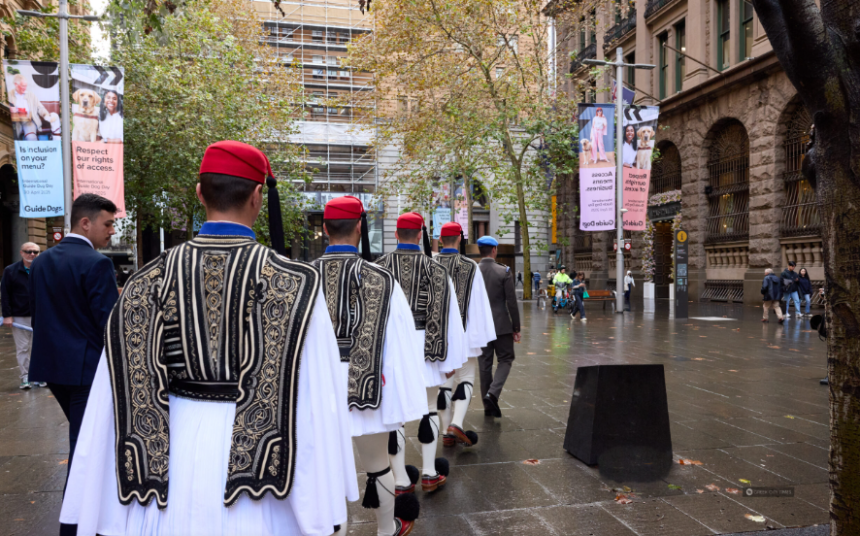
The Presidential Guard of the Hellenic Republic will be in Australia from October 22 to 29, where it will commemorate the 86th anniversary of the “NO” in Sydney and Canberra with the Greek diaspora. For the first time, the Evzones are officially visiting the Australian capital, while the visit coincides with the 100th anniversary of the Hellenic Club of Sydney and the 85th anniversary of the Battle of Crete.
Sydney: from the Cenotaph to Hyde Park
In Sydney, where they are hosted by the Hellenic Club with the support of the NSW Government, the Evzones will stand guard of honour at the Martin Place Cenotaph and will accompany the Club’s centenary gala dance. The highlight is their march to the Anzac Memorial in Hyde Park and the raising of the Greek flag on Sunday 25 October, hosted by the Kalymnian Brotherhood. The visit concludes on 29 October with a Doxology at the Cathedral of the Annunciation of the Theotokos in Redfern, officiated by Archbishop Makarios.
Canberra: first official appearance, on October 28th
On the anniversary day, the Evzones will be present at the Divine Liturgy of St. Nicholas, at a reception in Parliament by the Speaker of the House Milton Dick and at a wreath-laying ceremony at the Australian War Memorial. In the evening, they will parade down Matilda Street and form a guard of honour at the Hellenic Club of Canberra, while central points of the city will be illuminated in blue.
What do the organizers say?
The president of the Hellenic Club of Sydney, Nikolaos Hadzistergos, likened October 28 to ANZAC Day, as both commemorate sacrifice against a stronger opponent. The president of the St. Nicholas Community of Canberra, Yiannis Loukadellis, spoke of the great honor of welcoming the Evzones to the capital for the first time.
From 1940 to the common struggle of 1941
Ioannis Metaxas’ refusal to the Italian ultimatum, in the early hours of October 28, 1940, opened the Epirus front. A few months later, in 1941, approximately 34,000 Australians and New Zealanders fought alongside the Greeks on the mainland and in Crete, a memory that links the “NO” with the common history of the two peoples.