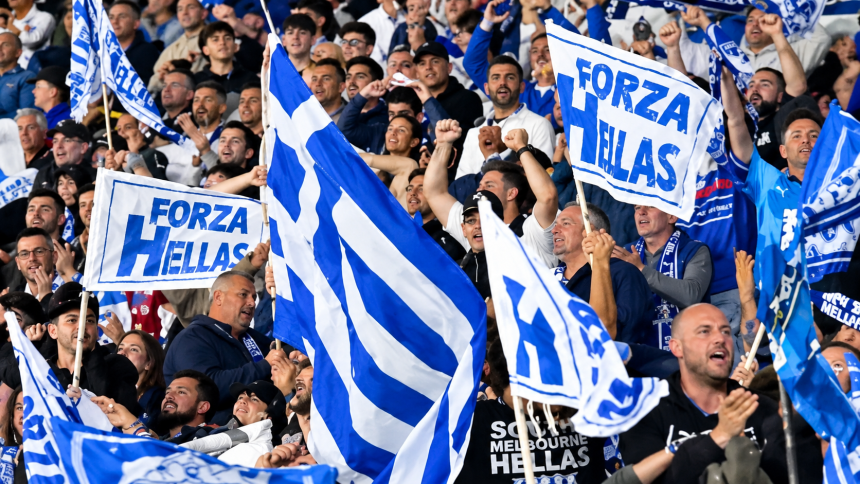
One of the biggest surprises in the history of Australian football occurred on Saturday in Melbourne, starring South Melbourne FC Hellas , the historic team of the Greek diaspora, which won the Australia Cup , defeating Melbourne Victory 4-3 on penalties , after a thrilling final that ended in a 1-1 draw in extra time.
The success takes on special significance, as South Melbourne became the first team outside the top professional division A-League to win the title since the competition’s inception in 2014, breaking a twelve-year tradition and confirming that the historic clubs of Australian football still have significant competitive potential.
The final was held at AAMI Park in front of 29,911 spectators , with Melbourne Victory appearing as the theoretical favourites, due to their participation in the A-League and their greater experience of high-level matches. South Melbourne, however, presented a particularly competitive team, limiting their opponent’s offensive initiatives and keeping the trophy open until the last minutes.
The regular period ended goalless, with both teams going into extra time, where Melbourne Victory took the lead through Denis Jeanroux , who scored in the 95th minute, putting his team in a strong position.
South Melbourne’s response came shortly before the end. In the 117th minute , Max Mikola , who had entered the field as a substitute, scored the equalizer, making it 1-1 and sending the final to a penalty shootout.
This development completely changed the picture of the match. Melbourne Victory lost the opportunity to maintain their lead, while South Melbourne gained the psychological boost that allowed them to claim the title until the end.
In the penalty shootout, the Greek team won 4-3 . The defining moment came when Melbourne Victory’s Jason Davidson sent the ball over the crossbar, sparking celebrations in the stands and on the pitch.
South Melbourne were now Australian Cup champions , completing a run that secured them one of the most important titles in their modern history.
Beyond the competitive result, winning the Cup brings back to the forefront the journey of a club that has linked its name with the history of Greek immigration to Australia.
South Melbourne Hellas was founded in 1959 , through the merger of Greek football teams in Melbourne, at a time when the city’s Greek community was growing rapidly.
Its founding was spearheaded by figures from the Greek diaspora, including Theodoros Marmaras and Georgios Samaras , grandfather of the international Greek footballer Giorgos Samaras.
From the first years of its operation, the team was a point of reference for Greek immigrants, who found through football an organized space for social activity and maintaining their ties with the Greek community.
Gradually, South Melbourne developed into one of the strongest clubs in the country, winning four national championships in the old National Soccer League and playing a significant role in the development of Australian football.
Angelos Postecoglou was also closely associated with the team, playing for it and later taking over its technical leadership, leading it to significant successes, before pursuing his international coaching career.
The restructuring of Australian football and the creation of the A-League changed the situation, however. Despite its history and strong presence, South Melbourne was not included in the new professional league and continued its course in the Victorian state competitions.
This development was a significant turning point for the club, which had to adapt to a different competitive and economic environment, while maintaining its infrastructure, organization and supporter base.
This year’s victory in the Australia Cup is South Melbourne’s most important sporting achievement in modern times , as it was achieved against an A-League team and in a competition that, until now, has been dominated exclusively by professional clubs in the top division.
The result is expected to reinforce the debate that has been going on for years in Australia about the place of historic clubs in professional football and the possibility of creating more competitive opportunities between the different categories.
South Melbourne is a typical case of a team that has a significant historical legacy, organized infrastructure and a strong social presence, without participating in the country’s top league.
Their success against Melbourne Victory offers new data to this discussion, without however automatically implying any change in their participation status in national competitions.
The statements of the team’s co-president, Vasilis Papastergiadis , who, after the final, referred to the history of the club and the Greek immigrants who created it, were particularly moving.
Papastergiadis emphasized that the current generation continues the work of South Melbourne’s founders, who, as he pointed out, believed in unity, equality and the ability of football to bring people of different backgrounds together .
At the same time, he described the success as particularly important not only for the club, but also for Australian football as a whole, expressing the belief that it can contribute to a broader reconsideration of the role of teams outside the A-League.
For the Greek community in Australia , winning the Cup has special symbolism. South Melbourne is one of the oldest and most recognizable sporting institutions created by Greek immigrants, while its history is closely linked to the development of the Greek community in Melbourne.
Its path reflects the course of an immigrant community that, from the first decades of its settlement in Australia, created organized structures of social, cultural and sporting activity.
Today, South Melbourne has evolved into a club with a wider appeal, while maintaining its historical connection to Hellenism. Its Greek identity remains a key element of its identity, while its presence in Australian football is part of the wider contribution of the Greek community to the social and sporting life of the country.
Winning the Australia Cup, sixty-seven years after the club’s founding, is therefore a success with a double meaning. On the one hand, it confirms the competitive value of a team that managed to overcome higher-class opponents. On the other hand, it highlights the timeless presence of a historical institution of the Greek diaspora.
The victory over Melbourne Victory now joins South Melbourne’s most important moments, alongside the national titles and major accolades of previous decades.
For its fans, Saturday night will remain associated with the equalizer in the 117th minute, the dramatic penalty shootout and the conquest of a trophy that until now had remained the exclusive privilege of A-League teams.
For the Hellenic community in Australia, the success of South Melbourne Hellas is another important moment in the history of the community and a reminder of the contribution of Greek immigrants to the shaping of modern Australian football.
The team, which was formed in 1959 by Greeks from Melbourne, is now at the top of a national competition, having achieved something that no other club outside the A-League had ever achieved.
South Melbourne Hellas won the Australia Cup and made history. This time, the biggest news in Australian football had a Greek signature.